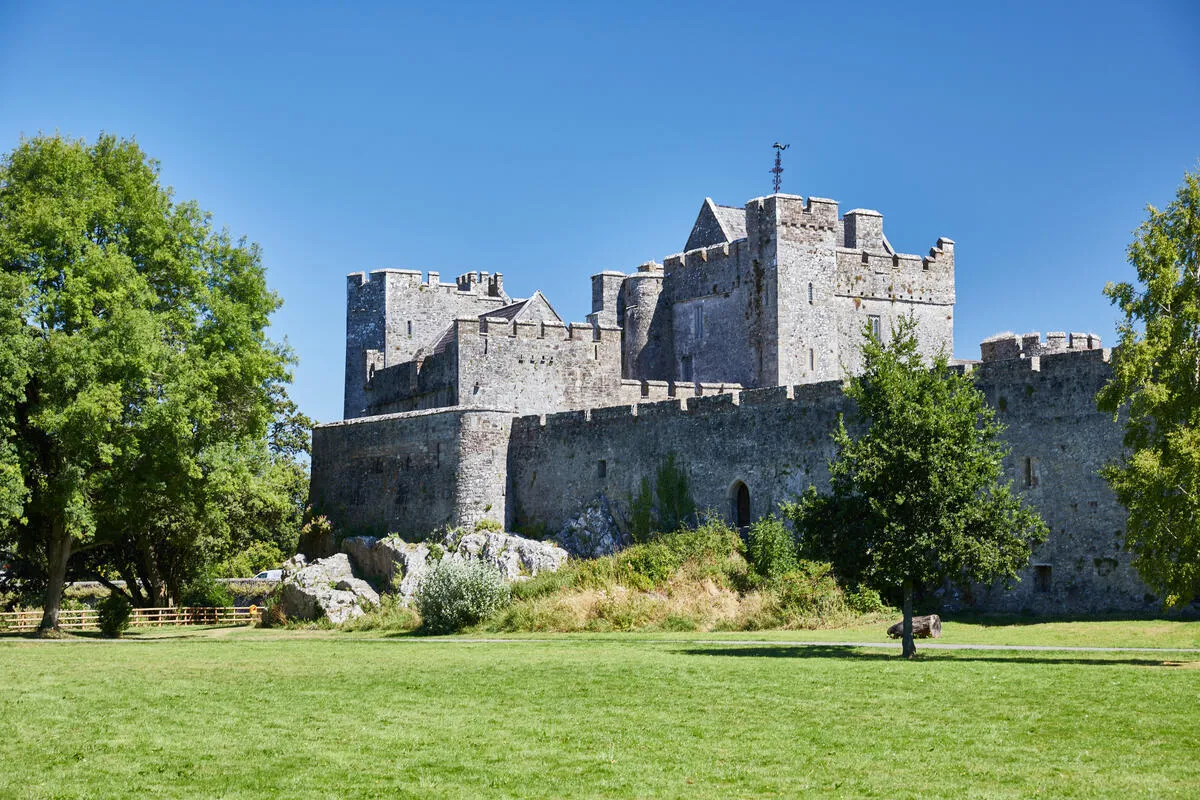
Cahir Castle sits on a rocky island in the River Suir in County Tipperary, and it looks exactly like a castle should. Massive walls, towers, a working portcullis, murder holes, and a great hall. The Butler family held it from the 14th century. It survived sieges by the Earl of Essex in 1599 and by Cromwell's forces in 1650 and came through remarkably intact.
It is one of the largest and best-preserved castles in Ireland. Unlike most Irish castles, which are either ruins or heavily restored, Cahir is genuinely medieval - the fabric of the building is largely original. The OPW manages it well, with a good audiovisual show and guided tours included in the admission price.
Cahir town sits on the main Dublin-Cork route and the castle is right in the centre. You can combine it with the Rock of Cashel (20 minutes away) and the Glen of Aherlow in a day.
What to Expect
The castle is entered through the outer ward, past the 15th-century tower. The audiovisual show in the entrance building runs about 15 minutes and gives useful context on the Butler family and the castle's military history. It is worth watching before you explore.
The guided tours run regularly and are included in the ticket price. The guides are good - they cover the castle's role in the Nine Years' War, the Cromwellian siege, and its later use as a location for the film Excalibur (1981) and more recently The Last Duel (2021). The Great Hall, the keep, and the defensive features are all well-explained.
Walk the wall-walk for views across the river and town. The inner ward, with its keep and residential quarters, gives a real sense of medieval life. The portcullis still works. The arrow loops, the machicolations, and the murder holes are all intact. For anyone interested in military architecture, this is one of the best examples in Ireland.
The Swiss Cottage is a 20-minute walk along the River Suir from the castle. It is a Regency-era ornamental cottage designed by John Nash - all thatched roof, decorative woodwork, and deliberately rustic charm. It is a separate OPW site with its own small admission fee (about EUR 5). The riverside walk to it is pleasant.
Is It Worth It?
One of the cheapest hours in Irish heritage at EUR 5, or free on an OPW Heritage Card. What you get is unusual: most Irish castles are either ruins or heavy restorations, and Cahir is neither. The fabric is largely original medieval, down to the working portcullis and the murder holes, and it came through sieges in 1599 and 1650 more or less intact. Allow an hour to an hour and a half with the audiovisual show and the guided tour, both included in the price.
The catch: Cahir Castle is not large. If you skip the audiovisual show and guided tour, you could walk through it in 20 minutes and feel you have seen everything. The castle rewards context - the history makes the stones interesting. Without it, it is a well-preserved but compact site. Also, the spiral staircases are tight and steep, and parts of the castle have limited accessibility.
How to Get There
Cahir is on the N24, about two hours from Dublin via the M8 and 90 minutes from Cork. It sits on the main Limerick-Waterford road. The castle is right in the town centre - you cannot miss it from the main street.
Parking is available across the street from the castle entrance. It is paid but inexpensive. The town is compact and walkable.
Bus Eireann services connect Cahir to Dublin, Cork, Limerick, and Waterford. The bus stop is in the town centre, a two-minute walk from the castle. Irish Rail serves Cahir station on the Limerick Junction-Waterford line.
Where to Stay Nearby
Cahir is a good base for exploring south Tipperary - the castle, the Glen of Aherlow, and the Galtees are all close. See the full County Tipperary guide for more options.
In the town centre, a minute's walk from the castle. Good restaurant, comfortable rooms, well-priced. The obvious Cahir base.
Check availability →What Else is Nearby
A Note on the History
The castle was built in 1142 by Conor O'Brien, Prince of Thomond, on the site of an earlier fortification. The Butler family - Barons of Cahir - took control in the 14th century and held it for over 400 years. They expanded it into one of the most formidable strongholds in Munster.
In 1599, the Earl of Essex besieged the castle with a large army and heavy cannon. The walls were breached and the garrison surrendered. Fifty years later, Cromwell's forces arrived. This time the castle surrendered without a fight, which is why it survived intact - Cromwell's usual approach to castles that resisted was demolition.
Frequently Asked Questions