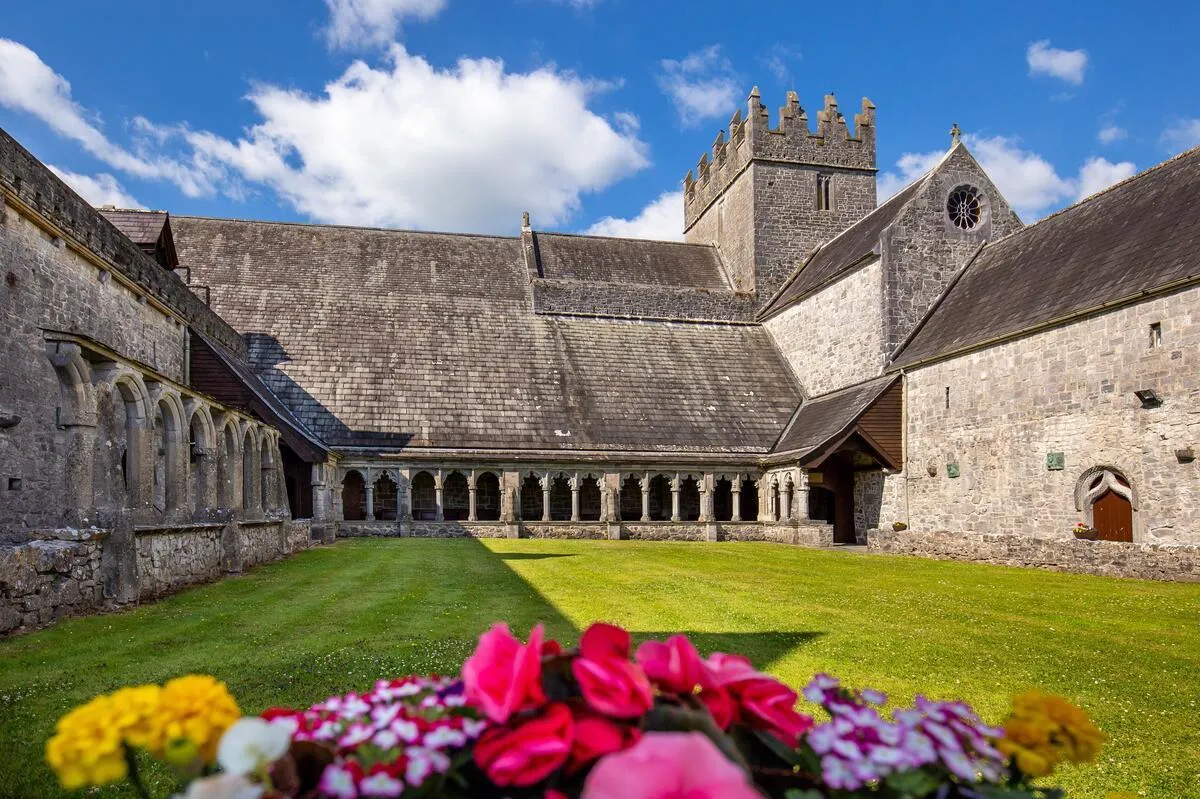
Holy Cross Abbey is a Cistercian foundation on the banks of the River Suir in County Tipperary. Unlike most Irish abbey ruins, this one has a roof, pews, and an active parish. It was restored in the 1970s and reconsecrated as a working church. Mass is still said here. Weddings still happen. The medieval stonework is surrounded by living faith.
The abbey houses two authenticated fragments of the True Cross - the relic that gave the abbey its name and drew pilgrims for 800 years. The rib vaulting, the hunting frieze, the ornate sedilia, and the intact cloister make this one of the most rewarding ecclesiastical visits in Ireland. Entry is free. The place is peaceful to a degree that feels deliberate.
Holy Cross is about 20 minutes from the Rock of Cashel and 6 kilometres from Thurles. Most people do not know it exists. That is a shame.
What to Expect
You enter through the west door into a space that is immediately impressive. The rib vaulting in the transept and chancel is 15th-century work, complex and well-preserved. Masons' marks are visible in the stone. The light through the east window catches the vaulting in a way that has not changed in five centuries.
The hunting frieze in the north transept is a rare survival - a carved stone panel showing a deer hunt. It is secular art in a sacred building, and it adds character. The sedilia (stone seating for clergy) on the south side of the chancel is considered the finest medieval church furniture in Ireland.
The relic of the True Cross is displayed in the nave. Two fragments, one authenticated by the Vatican in 1977, are housed in a reliquary. For believers, this is the heart of the place. For everyone else, the relic's history - how it arrived in Tipperary, survived the Reformation, and returned after centuries - is a good story regardless.
The cloister and chapterhouse doorway survive on the south side. The intact night stairs (the passage monks used to reach the church for nocturnal prayers) are still visible. The oldest church bell in Ireland - named Michael - hangs in the tower. A Padre Pio garden behind the abbey provides a contemplative space.
Is It Worth It?
An Irish medieval abbey with a roof on it, free to walk into, and still in use as a parish church. Holy Cross was restored in the 1970s and reconsecrated, so there are pews, Mass, and weddings inside medieval stonework. It holds two authenticated fragments of the True Cross, the relic that drew pilgrims here for 800 years. The rib vaulting, the hunting frieze, the sedilia and the cloister are all intact. Forty-five minutes to an hour, on the banks of the Suir six kilometres from Thurles.
The catch: Holy Cross Abbey is primarily a place of worship, not a heritage attraction. There is no interactive museum, no audiovisual display, no gift shop beyond a small counter. Guided tours run Wednesdays and Sundays in summer but you need to check times. If you visit expecting the full heritage experience you get at an OPW site, you may feel it is sparse. But the building itself is extraordinary, and the atmosphere of a medieval abbey still doing what it was built for is something you will not find anywhere else in Ireland.
How to Get There
Holy Cross Abbey is 6.5 kilometres southwest of Thurles on the R660, well signposted. It is about 20 minutes from the Rock of Cashel via the R639 and R660.
Free parking is available directly adjacent to the abbey. The car park rarely fills.
Thurles is the nearest town with bus and train connections. Irish Rail runs Dublin to Limerick via Thurles (about 90 minutes from Dublin). From Thurles, the abbey is a 10-minute drive or a reasonable cycle.
Where to Stay Nearby
Thurles is the nearest town with hotels and B&Bs. Cashel (20 minutes) offers more character. See the full County Tipperary guide for accommodation across the county.
A Georgian country house near Thurles. Excellent restaurant, elegant rooms, peaceful setting. A proper Tipperary farmhouse experience.
Check availability →What Else is Nearby
A Note on the History
Holy Cross Abbey was founded around 1182 by Domnall Mor O'Brien, King of Thomond. The relic of the True Cross arrived around 1233, reportedly from Queen Isabella of Angouleme. The abbey became a major pilgrimage site - the relic's drawing power funded the 15th-century renovations that produced the vaulting and stonework visible today.
The Reformation and Cromwell's campaign left the abbey in ruins. It deteriorated for three centuries. Restoration began in 1880 and continued in stages until the full reconsecration in 1975. The fact that a 12th-century Cistercian foundation is still functioning as a parish church is remarkable in itself.
Frequently Asked Questions