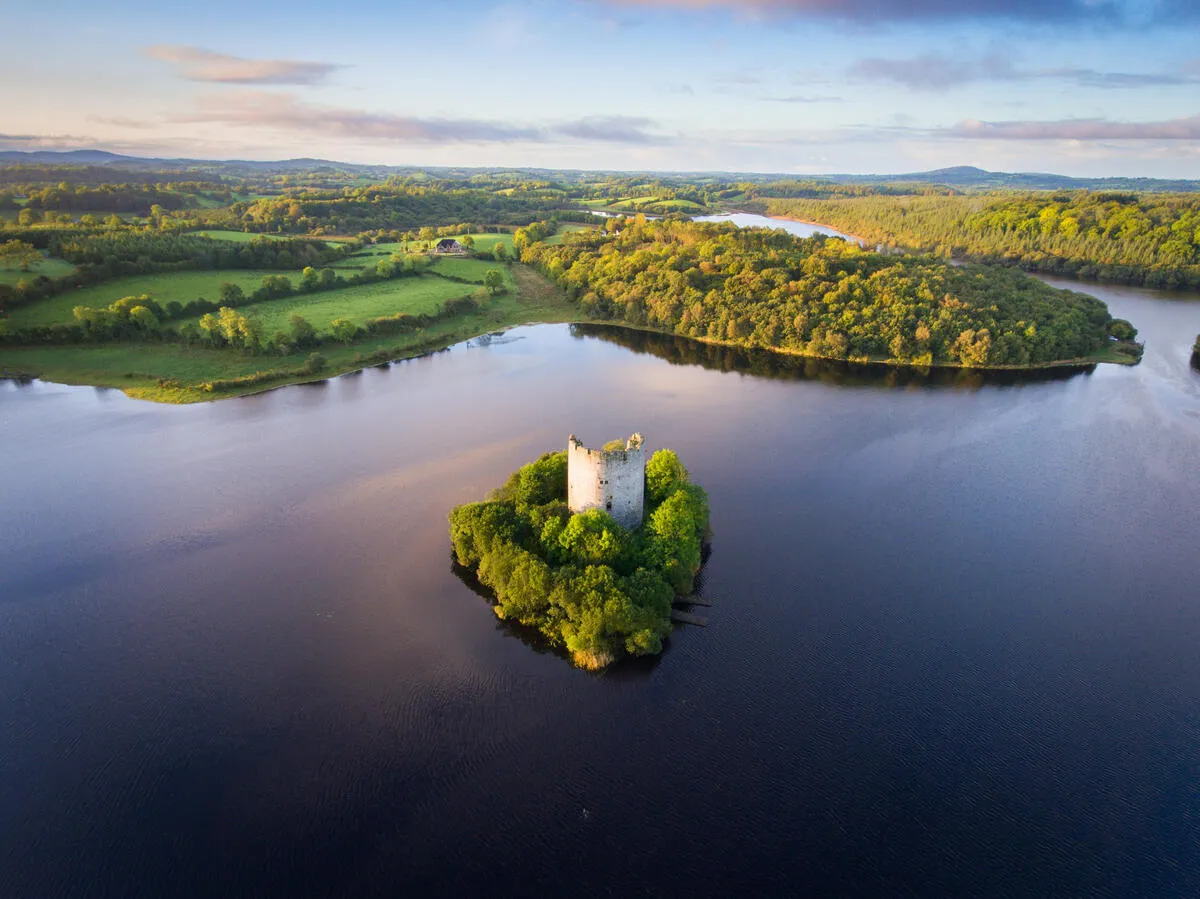
Lough Oughter is not really a single lake. It is a sprawling maze of water, islands, and sunken drumlins that covers over 8,900 hectares across County Cavan. The River Erne threads through the whole system, connecting dozens of separate channels and inlets that can disorient even experienced navigators.
The landscape here was shaped by the last ice age. Glaciers deposited rounded hills called drumlins across this part of Ireland, and when water levels rose, many of those hills became islands. What you get today is something between a lake and a flooded woodland - a place that feels genuinely apart from the rest of Ireland.
At the centre of it all stands Cloughoughter Castle, a ruined circular tower on a small crannog island. You cannot walk to it. There is no bridge and no jetty from the shore. You reach it by kayak or boat, which makes the first sight of it - rising from the water with no land connection visible - one of the more striking things you can encounter in the Irish midlands.
This is quiet country. The Hidden Heartlands region of Cavan does not attract the same crowds as the west coast. That is not a drawback. It is the point.
What to Expect
The most visited part of the lake system is Killykeen Forest Park, which sits right on the water's edge a few kilometres from Killeshandra. Marked walking trails run through mixed woodland with regular gaps where you can look out across the channels and spot islands in the middle distance. It is an easy place to spend a morning without getting on the water at all.
If you do want to reach Cloughoughter Castle, a kayak is the standard approach. Cavan Adventure Centre runs three-hour guided tours from around EUR 39 per person and covers the paddling route to the castle. The guided option makes sense if you are not confident reading the water here - the maze of islands and channels looks similar from every direction, and it is genuinely easy to lose your bearings without local knowledge.
Birdwatching is one of the better reasons to visit, particularly in winter. Lough Oughter is a Special Protection Area, and the shallow, sheltered channels attract whooper swans, tufted duck, pochard, and wigeon in good numbers during the colder months. In summer, great crested grebes breed on the quieter inlets and kingfishers are a regular sighting along the reed margins. The Rann Point viewpoint gives a clear line of sight across the water towards the castle and is a reliable spot for scanning the lake without a boat.
Fishing is popular throughout the system. The lake holds bream, roach, perch, and pike - typical Irish coarse fishing species - and the network of interconnected channels means you can find sheltered spots even when the wind is up.
One limitation worth knowing before you go: if you want the full Lough Oughter experience, including the castle, you need to be on the water. There is no shortcut. The lake is remote, facilities are minimal, and navigation in the island maze takes some care. For visitors who want a gentle scenic drive with a viewpoint photo stop, Rann Point and the Cornagee Viewpoint deliver that without any physical commitment. For everyone else, the kayak tour is the way to do it properly.
How to Get There
Lough Oughter sits in the middle of County Cavan, roughly 12 kilometres north-west of Cavan Town. The main access point for visitors is Killykeen Forest Park, reached by taking the R198 west from Cavan Town towards Crossdoney, then following signs onto the R199 towards Killeshandra.
The nearest town is Killeshandra, about 4 kilometres from the lake. It has a small shop and a petrol station - worth knowing if you are arriving from further afield and need to stock up before a day on the water. Cavan Town, with a full range of services, is about 20 minutes by car.
There is no public transport to the lake. A car is essential. From Dublin, the journey is around two hours via the N3 and N55. From Belfast, allow roughly 90 minutes via the A3 and N3.
Kayak tours are run by Cavan Adventure Centre. Contact them in advance to book - tours do not run daily and availability depends on weather and group numbers.
Where to Stay Nearby
Accommodation options near Lough Oughter run from a large country house hotel outside Cavan Town to self-catering lodges right on the water at Killykeen. Staying close to the lake makes an early morning paddle significantly easier - and the birdlife on the water at first light is worth the effort.
A restored Georgian estate set in 1,300 acres on the edge of Cavan Town, about 20 minutes from the lake. The spa is one of the better ones in the region.
Check availability →What Else is Nearby
A Note on the History
Cloughoughter Castle was built in the early 13th century, most likely by William Gorm de Lacy between around 1200 and 1224. The Anglo-Normans positioned it on a crannog - a small artificial island in the lake - which gave it natural defensive advantages on all sides. The circular tower design is typical of early Norman construction in Ireland.
The O'Reilly clan, who dominated County Cavan for much of the medieval period, later took control of the castle. It became a site of particular significance during the 1641 Rebellion. Owen Roe O'Neill, one of the key military leaders of the rebellion and a figure of lasting importance in Irish history, died at Cloughoughter in November 1649 under disputed circumstances.
The castle was destroyed during the Cromwellian campaign of 1653 and left as a ruin. Conservation work was carried out in 1987 to stabilise what remained. Today the tower stands to roughly half its original height, but the setting - isolated on its island, accessible only by water - gives it a presence that more complete ruins sometimes lack.
Frequently Asked Questions