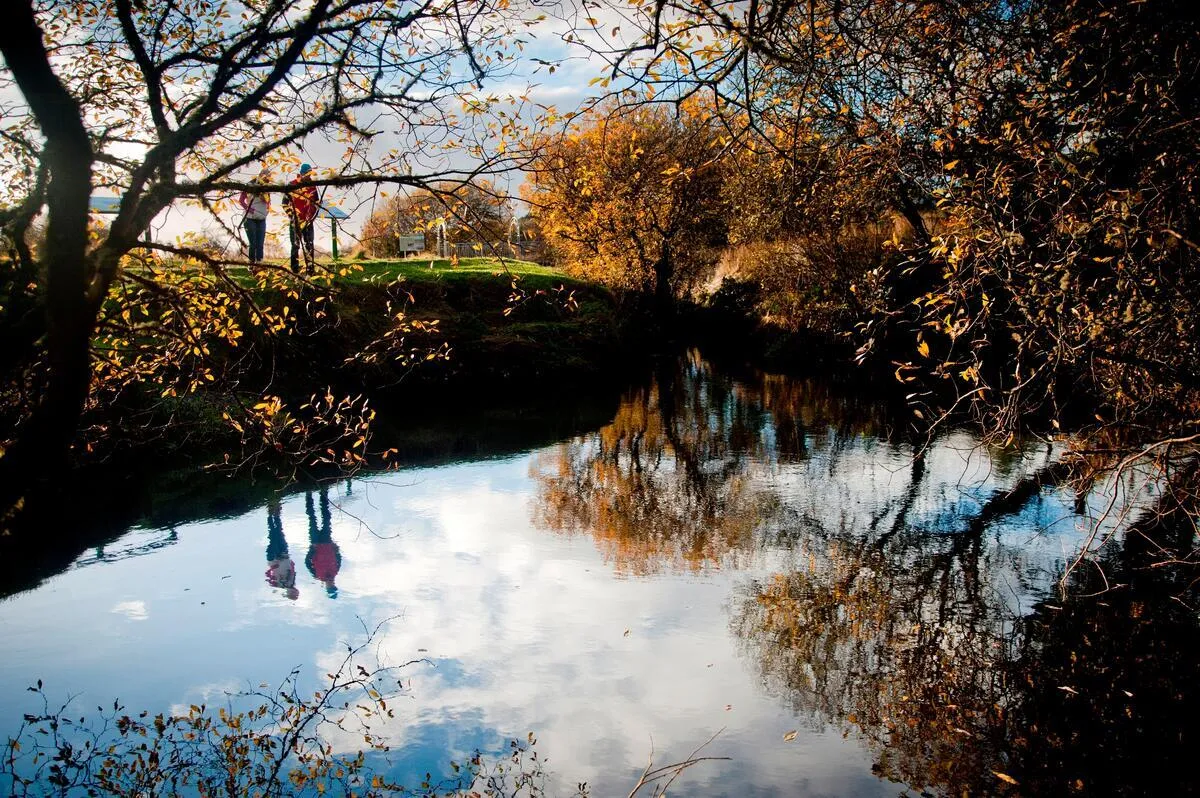
The Shannon Pot sits in a quiet hollow in the hills of Glangevlin, near Blacklion in County Cavan. It is a small, dark pool - around 16 metres wide and nearly 15 metres deep - and it is the official source of the River Shannon, Ireland's longest river at 344 kilometres.
There is something quietly significant about standing here. The water rises from an underground aquifer fed by the slopes of Cuilcagh Mountain. From this point it begins a journey south and west through nine counties before reaching the Atlantic at Limerick. It is not a dramatic waterfall or a grand scenic viewpoint. It is a pool in a field, and that is part of what makes it worth the effort.
Entry is free and the site is open all year. A paved path leads from the car park to a small bridge over the outflow, with interpretation panels explaining the geology and mythology. The path is wheelchair accessible. There are no toilets and no cafe, so come prepared. A Shannon Pot Discovery Centre is under construction nearby and is due to open in 2026, which may affect access intermittently during visits.
What to Expect
The walk from the car park to the Shannon Pot takes about five minutes along a paved path. It is short and flat, which makes it accessible for most visitors. The path ends at a small bridge over the outflow stream, and from there you look down into the pool itself.
The water is dark and still. On a calm day you can see surprisingly deep into it. The pool fills from below rather than from a visible spring or stream, which gives it an unusual quality. The outflow begins here and becomes the River Shannon within metres of where you stand.
The site is small - know that before you make a long drive. There is a picnic area and a playground beside the car park, which makes it a reasonable stop for families, but the main attraction is the pool and the outflow channel. In poor weather it can feel exposed and muddy beyond the paved section. In clear weather, with the Cuilcagh slopes visible to the north, it is a genuinely rewarding place to spend half an hour.
The interpretation panels are worth reading. They explain how water from a 12.8 square kilometre catchment area on Cuilcagh drains underground through Shannon Cave before rising here. The cave system is not accessible to the public, but knowing it exists adds a layer to what you are looking at.
The site connects directly to the Cavan Way, a 26-kilometre walking route between Blacklion and Dowra. If you are walking any section of that route, the Shannon Pot is a natural starting point or waypoint. For those just stopping by, allow 30 to 45 minutes including the drive in from Blacklion on the R206.
Is It Worth It?
The source of the longest river in Ireland, and it takes half an hour. The Shannon Pot is a dark pool about 16 metres across and nearly 15 deep, in a hollow in the hills at Glangevlin, fed by an underground aquifer running off Cuilcagh Mountain. From here the water starts a 344-kilometre run through nine counties to the Atlantic. It is free, there is a picnic area and interpretation panels, and the path from the car park is paved and wheelchair accessible right to the bridge over the outflow.
One thing to know: this is a remote location with no services. There are no toilets at the site and no shops or cafes within easy reach. Bring water and anything you need before you leave Blacklion.
How to Get There
The Shannon Pot is located near Glangevlin, roughly 15 kilometres south of Blacklion in northwest County Cavan. The access road is the R206, which runs from Blacklion through Glangevlin. Brown tourist signs direct you to the car park from the main road.
By car from Dublin, the drive takes around two hours and fifteen minutes via the M3 and N3 through Cavan town, continuing northwest to Belturbet and Blacklion. From Enniskillen in Northern Ireland, the drive is around 35 minutes via the A4 and crossing at Belcoo-Blacklion.
There is no public transport to the Shannon Pot. The site is only practical by car. If you are travelling without a car, the nearest useful base is Enniskillen, which has good bus connections from Belfast and Dublin. From there, a taxi or car hire would be required.
The road into Glangevlin is narrow in places. It is well-maintained but requires careful driving, particularly when passing other vehicles. Allow extra time on the approach if you are unfamiliar with rural roads in this part of the country.
From the same area, Marble Arch Caves (25 minutes) and the Cuilcagh Boardwalk trail (20 minutes) are both just across the border in County Fermanagh. Combining all three into a full day is a practical option if you are staying in the Blacklion or Enniskillen area.
Where to Stay Nearby
Blacklion is the closest village to the Shannon Pot, and it punches well above its size for accommodation. For those who want more options, Enniskillen in County Fermanagh is 30 minutes away and has a full range of hotels and guesthouses.
Neven Maguire's acclaimed restaurant with rooms in the centre of Blacklion. One of Ireland's most respected restaurants, and the rooms are quiet and comfortable.
Check availability →What Else is Nearby
A Note on the History
The Shannon Pot has been known and named for a very long time. The Greek geographer Ptolemy recorded the River Shannon around 170 AD, making it one of the earliest named features on any map of Ireland. The pool itself is known in Irish as Lag na Sionna - the hollow of the Shannon.
In Irish mythology, the river's origin is associated with Sionann, a granddaughter of Manannán mac Lir, the god of the sea. The story varies in its details but in most versions she approaches a sacred well to gain forbidden knowledge, the well overflows, and the resulting flood becomes the River Shannon.
The oldest written reference to the pool as the river's source comes from a poem in the Book of Magauran, a 14th-century manuscript compiled around 1349. The poem calls the Shannon "Ireland's noblest stream." That manuscript is now held in Trinity College Dublin.
For most of Irish history this was a remote and borderland place, sitting at the edge of the old province of Connacht and close to the Ulster border. That remoteness is part of why it survives today much as it always was - a small pool in a quiet hollow, with a very long river beginning at its edge.
Frequently Asked Questions