If you've read my 7-day Ireland itinerary, you'll know I ended it with a confession: seven days is tight. You see the highlights, but you spend a lot of time in the car and you miss some of the best bits. Ten days changes everything.
A 10 day Ireland itinerary gives you room to actually enjoy the places you're visiting rather than just photographing them through a windscreen. You get a full day on the Aran Islands (which you'd have to skip entirely on a 7-day trip), time to explore Connemara properly, and two nights in Dublin that don't feel rushed. You'll still cover the classic route, Dublin down through Kilkenny and Kerry, across to the Cliffs of Moher and up to Galway, but with breathing room that makes the whole trip more enjoyable.
I grew up in County Armagh, performed with Riverdance and the choral group Anuna, and drove the entire Wild Atlantic Way in a camper van. I keep coming back to this route because it shows first-time visitors the best of Ireland without burning them out.
This itinerary covers: Dublin, Glendalough, Kilkenny, Rock of Cashel, Kerry (Dingle Peninsula), Cliffs of Moher, Aran Islands, the Burren, Galway, and Connemara.
Best time to do this: May, June, or September. You'll get the longest daylight hours, manageable crowds, and the best chance of decent weather. Read my guide to the best time to visit Ireland for month-by-month detail.
You'll need: A rental car for days 3 through 10 (you don't need one in Dublin). Compare Ireland car rental prices here. Book Kilmainham Gaol and the Book of Kells at least 2 weeks ahead.
Itinerary Overview
Total driving over 10 days: Roughly 19 hours, spread across 7 driving days. That's significantly less daily driving than the 7-day version, and your legs will thank you. This 10 day Ireland itinerary is designed for a clockwise loop starting and ending in Dublin.
Day 1: Arrive in Dublin
Most North American flights land at Dublin Airport between 6am and 8am. You'll be wired from the flight and unable to check into your hotel until 2pm or 3pm, so don't fight it. Use the morning to walk and shake off the jet lag.
Morning
Get through passport control (allow 30 to 45 minutes), then take a bus or taxi into the city centre. The Airlink Express (Route 747) costs about €8 ($9) and drops you at O'Connell Street. You can also pre-book a private transfer. For all your options, see my guide to Dublin Airport ground transportation.
Drop your bags at your hotel (most will store luggage before check-in) and head out. Walk across the Ha'penny Bridge, through Temple Bar, and down to Trinity College. Temple Bar is actually pleasant before the stag parties arrive.
Afternoon
Check into your hotel and freshen up. Walk the area around St Stephen's Green and Grafton Street. If you're holding up against the jet lag, continue through Merrion Square to see the Georgian doors and the Oscar Wilde statue.
Don't cram in major attractions today. Tomorrow is for that. Today is about getting your bearings.
Evening
For dinner, try Camden Street or Wexford Street, where Dubliners actually eat out. For your first pint of Guinness, try Kehoe's on South Anne Street or the Long Hall on George's Street. Both are proper Dublin pubs with no gimmicks.
Where to stay: Dublin has great neighbourhoods for visitors. I'd recommend staying around Temple Bar or the St Stephen's Green area for your first visit. Read my full guide on where to stay in Dublin for neighbourhood breakdowns. Find hotels in Dublin
Patrick's Tip: Don't pick up your rental car until Day 3. You don't need a car in Dublin and the city centre parking charges will eat into your budget. Public transport and walking cover everything you need for the first two days. My Dublin local transport guide explains how to get around.
Day 2: Dublin Full Day
Today is your museum and sightseeing day. Dublin has enough to fill a week, but these are the highlights that matter most for a first visit.
Morning
Start at Trinity College and the Book of Kells, Ireland's oldest university and home to the famous 9th-century illuminated manuscript. Book timed entry online at least two weeks ahead because walk-ups are rarely available in peak season. Book through Viator. Tickets cost around €18 ($20).
From Trinity, walk five minutes to St Patrick's Cathedral, dating to 1191. Jonathan Swift was Dean here. Entry is about €9 ($10) and you'll need 30 to 45 minutes.
Afternoon
Kilmainham Gaol is where leaders of the 1916 Easter Rising were held and executed. The guided tour takes about 90 minutes and it will genuinely move you. It's the hardest ticket to get in Dublin, so book at kilmainhamgaol.ie the moment your dates are confirmed.
Patrick's Tip: Book Kilmainham Gaol at least 2 weeks ahead. It sells out constantly and you can't just walk up. Morning slots tend to release first, but afternoon slots between 2pm and 3:30pm are sometimes easier to get.
If Kilmainham is booked out, swap in the Guinness Storehouse or Jameson Distillery instead. Both are well-produced visitor experiences. The Guinness Storehouse has the better rooftop views; Jameson has whiskey tastings.
For a broader sense of what to see, read my Dublin travel guide and my suggestions for day trips from Dublin if you end up with extra time.
Evening
Tonight is your night for a proper Dublin trad session. The Cobblestone in Smithfield is the best pub in Dublin for authentic traditional music: not a performance, but a session where musicians play for the love of it. Get there by 9pm. If Smithfield is too far, O'Donoghue's on Merrion Row (where The Dubliners got started) is a solid alternative.
Where to stay: Second night in Dublin. Find hotels in Dublin
Day 3: Dublin to Kilkenny (via Glendalough)
Total driving: 2.5 hours (with Glendalough stop)
Today you pick up your rental car and head south. If you haven't booked your car yet, compare prices here. Read my complete guide to car rental in Ireland for advice on insurance, manual vs automatic, and tips for driving on the left.
Morning: Glendalough
Leave Dublin mid-morning and drive an hour south into County Wicklow to Glendalough, a 6th-century monastic settlement in a glacial valley.
I filmed a music video here when I was part of Anuna. The round tower, stone churches, and old graveyard are genuinely atmospheric, especially before tour buses roll in around 11am. Park at the visitor centre (small fee), walk through the monastic site, then follow the path towards the Upper Lake. The walk takes about 30 minutes each way.
Time needed: 1.5 to 2 hours.
Afternoon: Kilkenny
Continue south to Kilkenny, a compact medieval city. Kilkenny Castle overlooks the River Nore and dates to 1195. The gardens are free; castle tours cost about €8 ($9).
Walk the Medieval Mile from the castle to St Canice's Cathedral. Climb the 9th-century round tower for views over the city. Steep and narrow, but only 10 minutes and the views are brilliant.
Evening
Kilkenny has a pub scene that punches well above its weight for a small city. Kyteler's Inn (built in 1324, allegedly by a witch) is atmospheric. Cleere's often has live music. For dinner, Campagne does excellent modern Irish food, or Zuni if you want something a bit more casual.
Where to stay: Kilkenny is small enough that anywhere in the city centre puts you within walking distance of everything. Find hotels in Kilkenny
Patrick's Tip: Kilkenny is an easy city to explore on foot and you'll find it far less hectic than Dublin. If you arrive by 2pm, you can comfortably see the castle, walk the Medieval Mile, and still have time for an evening pint. Don't rush it.
Day 4: Kilkenny to Kerry (via Rock of Cashel)
Total driving: 3.5 hours (with Rock of Cashel stop)
This is your longest driving day, but you break it up with one of Ireland's most dramatic historical sites.
Morning: Rock of Cashel
Drive 90 minutes to the Rock of Cashel in County Tipperary. This medieval fortress sits on a limestone outcrop above the town, its silhouette unmistakable. It was the seat of the Kings of Munster before being handed to the church in 1101.
The ruins include a round tower, Gothic cathedral, Romanesque chapel, and high cross. Views stretch for miles across Tipperary farmland. Book tickets online at heritageireland.ie in summer. Entry is about €8 ($9).
Time needed: 1 to 1.5 hours.
Afternoon: Drive to Killarney
Continue southwest through Cahir into County Kerry (about 2 hours from Cashel to Killarney). Arrive late afternoon. Killarney is a busy tourist town but a solid base for Kerry. If you have energy, drive 10 minutes to Ross Castle on Lough Leane. The 15th-century tower house on the lakeside is lovely in evening light.
Evening
Killarney town has plenty of restaurants and pubs clustered along Main Street and High Street. The Laurels and Cronin's are reliable for food and often have live music.
Patrick's Pick: I've stayed at a few places in Killarney but the Killarney Park Hotel stands out for its location, right in the centre of town with views of the national park. If you want somewhere slightly outside but with incredible views, check the options at Aghadoe Heights. Find hotels in Killarney
Day 5: Dingle Peninsula
Total driving: 3 hours (Killarney to Dingle + Slea Head loop)
Here's where I'm going to be opinionated. Most 10 day Ireland itinerary guides tell you to drive the Ring of Kerry today. I'm going to tell you to skip it and do the Dingle Peninsula instead.
The Ring of Kerry is famous but clogged with tour buses in summer, and you spend most of the day driving rather than stopping. The Dingle Peninsula gives you the same wild Atlantic coastline, better food, better pubs, and the Slea Head Drive, one of the most beautiful coastal roads in Europe.
If your heart is set on the Ring of Kerry, go for it. But Dingle is where I'd send a friend.
Morning: Killarney to Dingle
Head west over the Connor Pass, Ireland's highest mountain pass. The views from the top are extraordinary: mountains dropping into lakes on one side, Dingle Bay on the other. If you're nervous about narrow mountain roads, take the longer route via Tralee.
Arrive in Dingle town by mid-morning. This is a working fishing town with colourful buildings and some of the best seafood in Ireland. Grab coffee at Bean in Dingle and lunch at Out of the Blue (seafood only, exceptional) or The Fish Box for something casual.
Afternoon: Slea Head Drive
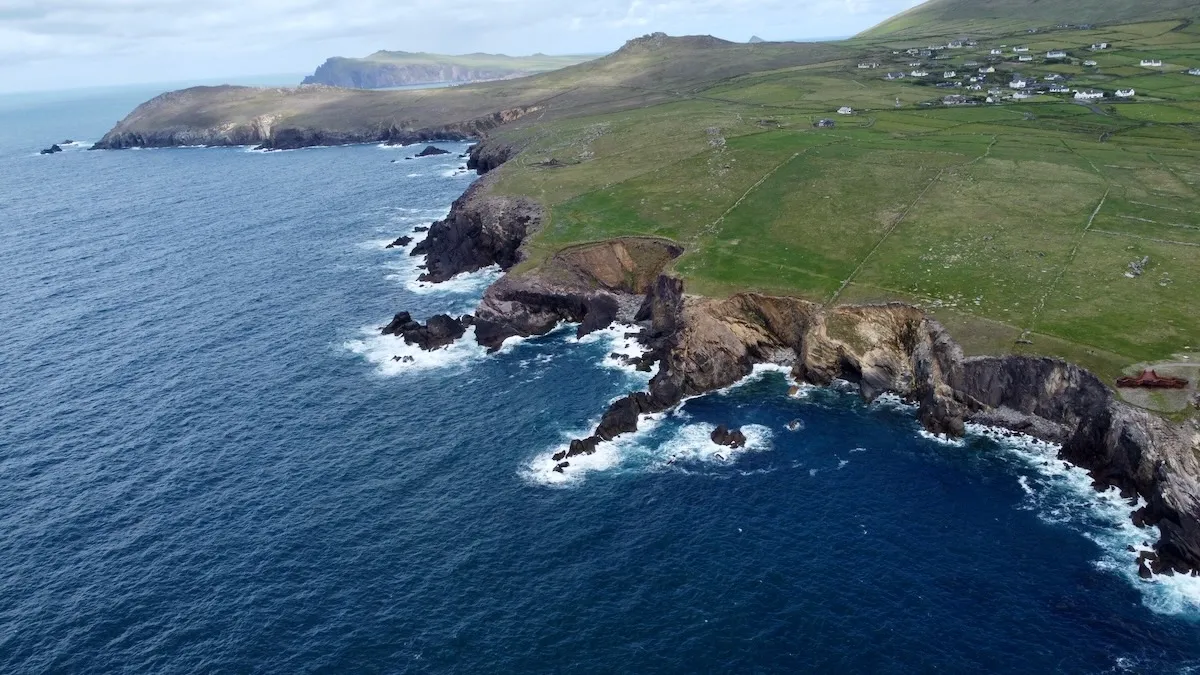
The Slea Head Drive is a 47km loop west of Dingle town, hugging the Atlantic coast with far fewer tour buses than the Ring of Kerry.
Key stops: Ventry Beach (wide, sandy, often empty), Slea Head viewpoint (views of the Blasket Islands), Dunquin Pier (that famous zigzag pier), and Coumeenoole Beach (small, dramatic, surrounded by cliffs).
The full loop takes 2 to 3 hours with stops. Roads are narrow, so drive slowly and use passing places.
Evening
Drive back to Killarney, or stay in Dingle if you can swing it. Dick Mack's, Foxy John's, and An Droichead Beag all have regular trad sessions. For dinner, The Chart House or Idas.
Patrick's Tip: If you want to do both the Ring of Kerry and Dingle, use today for Dingle and squeeze in a partial Ring of Kerry drive tomorrow morning before heading to Clare. Drive as far as Cahersiveen and back via the N70. You'll see the best coastal sections without committing to the full loop.
Where to stay: Return to Killarney for the night, or stay in Dingle if you'd prefer the smaller town. Find hotels in Killarney
Day 6: Kerry to the Cliffs of Moher and Doolin
Total driving: approximately 3 hours
Today you leave Kerry and head north into County Clare, crossing the Shannon Estuary by ferry and ending at one of Ireland's most iconic sights.
Morning: Tarbert Ferry
Patrick's Tip: The Tarbert Ferry between Kerry and Clare saves you about 2 hours of driving around the Shannon Estuary. It runs every hour on the hour from Tarbert (Kerry side) to Killimer (Clare side) and costs about €22 ($24) per car. No booking needed; just turn up and drive on. It's a 20-minute crossing and a welcome break from driving.
Leave Killarney (or Dingle) and take the N69 west to Tarbert. The ferry crossing is quick and painless. From Killimer on the Clare side, it's about an hour's drive north to the Cliffs of Moher.
Afternoon: Cliffs of Moher
The Cliffs of Moher rise 214 metres above the Atlantic and stretch for 8km along the Clare coast. They're Ireland's most visited natural attraction, which means crowds from June to August.
Timing matters. Arrive before 10am or after 4pm to miss tour buses. Parking costs about €8 ($9) and includes the visitor centre. For the best experience, walk south along the cliff path towards Hag's Head, where the crowds thin out and you can see the full sweep of cliffs behind you. Stay on marked paths.
Read my complete guide to the Cliffs of Moher for more detail. A Cliffs of Moher cruise from the water gives you a completely different perspective on their scale.
Time needed: 1 to 2 hours.
Evening: Doolin
Drive 10 minutes to Doolin, a tiny village that punches miles above its weight for trad music. Gus O'Connor's, McDermott's, and McGann's all have nightly sessions with real musicians playing for the craic, not staged performances. Doolin is also your launch point for tomorrow's Aran Islands trip.
Where to stay: Doolin is small and accommodation books up fast in summer. Reserve your room well ahead. Find hotels in Doolin
Patrick's Pick: Doolin is one of those places that feels like a genuine discovery. The village is tiny, just a handful of pubs, a few B&Bs, and the pier. But the trad music here is some of the best in Ireland and you'll be surrounded by the Burren landscape, which is unlike anything else on the island. It's worth two nights if you can manage it. Find hotels in Doolin
Day 7: Aran Islands Day Trip
No driving today (ferry day)
This is the day you'd skip on a 7-day trip, and it's one of the highlights of the entire 10 days. The Aran Islands are three limestone islands off the Clare/Galway coast where Irish is still the daily language and the landscape feels like stepping back centuries.
Morning: Ferry to Inishmore
Take the morning ferry from Doolin Pier to Inishmore (Inis Mor), the largest island. The crossing takes about 40 minutes and can be choppy, so take seasickness tablets if needed. Ferries usually depart around 10am. Book ahead in summer. Read my Doolin ferry guide for full details, and book the crossing directly with the local operator, Doolin Ferry. To make a full day of it, add a full-day Aran Islands cultural immersion experience through GetYourGuide.
On the Island
Rent a bike at the pier (about €15/$16 for the day) and cycle to Dun Aonghasa, a prehistoric cliff-top fort on the edge of a 100-metre drop into the Atlantic. The cycle takes about 40 minutes each way, mostly flat with the last stretch uphill.
There are no barriers at the cliff edge. Crawl to the edge on your stomach (that's how everyone does it) and look down at the Atlantic crashing against the base. I've written a detailed guide to Dun Aonghasa and a separate guide to doing the full Inishmore bike tour.
Afternoon
Cycle back to Kilronan (the main village) for lunch at one of the island's pubs. Explore the quieter lanes if you have time. The stone walls, wildflowers, and silence are a world away from the mainland.
Evening
Take the afternoon ferry back to Doolin (usually around 4pm or 5pm). You'll be tired in the best way. Dinner and a pint in Doolin for your second night.
Patrick's Tip: The Doolin ferry to Inishmore can be cancelled in rough weather. Have a backup plan: the Burren makes an excellent alternative day trip (you'll drive through part of it tomorrow anyway). Check the ferry website the evening before and have a Plan B in mind.
Where to stay: Second night in Doolin. Find hotels in Doolin
Day 8: The Burren and Galway
Total driving: 1.5 hours
Today is a shorter driving day, which means more time exploring and less time behind the wheel.
Morning: The Burren
Drive east through the Burren, a vast expanse of exposed limestone pavement dotted with wildflowers, ancient dolmens, and ring forts. It looks barren at first glance but supports Arctic, Alpine, and Mediterranean species side by side.
Stop at the Poulnabrone Dolmen, a 5,800-year-old portal tomb right beside the road. Only takes 10 minutes but it's one of the most photographed spots in Clare. Caherconnell Stone Fort nearby has sheepdog demonstrations that are genuinely entertaining.
Afternoon: Arrive in Galway
Continue north to Galway, arriving around lunchtime. Galway is Ireland's cultural capital: music, art, festivals, and good food. It's bohemian, lively, and completely different from Dublin.
Check in and head for the Latin Quarter. Walk Shop Street and Quay Street, past buskers and independent shops, down to the Spanish Arch. If the weather cooperates, continue along the Salthill promenade.
For detailed neighbourhood recommendations, read my Galway travel guide and guide to where to stay in Galway.
Evening
Ard Bia at Nimmo's does great fish by the river. Kai is a favourite for creative Irish cooking. For trad music, Tigh Coili on Shop Street has sessions every night and The Crane Bar in the west end is smaller and more local.
Where to stay: Anywhere around Eyre Square or the Latin Quarter puts you in the thick of things. Find hotels in Galway
Patrick's Pick: I've been visiting Galway since I was a child and it's one of my favourite cities in the world. If I could afford a wee cottage there, I'd have one in a heartbeat. For accommodation, you want to be as close to Eyre Square as possible. The Park House Hotel is my go-to: boutique, central, and excellent restaurant. Find hotels in Galway
Day 9: Connemara Day Trip
Total driving: 3 hours (loop from Galway)
This is another day you'd have to sacrifice on a 7-day trip, and it's another highlight. Connemara is the wild, mountainous, lake-filled region west of Galway city, and it's some of the most dramatic scenery in the whole country.
Morning: Galway to Kylemore Abbey
Drive the N59 towards Clifden through Connemara bog, past lakes and mountains with the Twelve Bens ahead of you.
Your first stop is Kylemore Abbey, a 19th-century castle on the shore of a lake, now home to Benedictine nuns. The grounds include a Victorian walled garden, Gothic church, and woodland walks. It looks almost too perfect to be real. Entry is about €16 ($17). See my full guide to Kylemore Abbey for timing tips.
Time needed: 1.5 to 2 hours.
Afternoon: Connemara Loop
Continue to Clifden, the unofficial capital of Connemara, for a coffee stop. Then drive the Sky Road, a loop that climbs above the town with views across the Atlantic to the islands. Only 30 minutes to drive but you'll stop several times.
Head back via the coast road (R341/R340) through Roundstone and Cashel. If you have time, stop in Roundstone for the traditional bodhran-making workshop at Malachy Kearns.
For more ideas, see my guide to day trips from Galway.
Evening
Back in Galway for your second night. This is your last evening on the west coast, so make it count. Have a proper dinner, find a good trad session, and soak up the atmosphere.
Patrick's Tip: Connemara is a Gaeltacht area, meaning Irish (Gaeilge) is the community's first language. You'll see bilingual signs and hear Irish spoken in shops and pubs. Don't be shy about saying "go raibh maith agat" (pronounced "guh rev mah agut"), which means "thank you." Locals genuinely appreciate the effort.
Where to stay: Second night in Galway. Find hotels in Galway
Day 10: Galway to Dublin (or Onward)
Total driving: 2.5 hours to Dublin
Your final day. How you spend it depends on your flight time and your onward plans.
If Flying Out Today
Have a last walk around Galway in the morning, then drive the M6/M4 motorway to Dublin Airport (2.5 hours on good roads). Allow an extra 30 minutes for returning the rental car.
If you have a late flight, stop at Clonmacnoise (30 minutes off the motorway near Athlone), an early Christian monastic site on the Shannon with high crosses and round towers.
If Extending Your Trip
Ten days covers the south and west beautifully. If you have extra days:
- Donegal (3 hours from Galway): Slieve League cliffs, Malin Head, wild coastline.
- Belfast and the Causeway Coast (3 hours from Galway): Giant's Causeway, Carrick-a-Rede, Titanic Quarter.
- Cork (3 hours from Killarney, if rerouting earlier): English Market, Blarney Castle, excellent food scene. Read my Cork travel guide.
For help choosing flights to Ireland, I've written a complete guide on Planet Patrick.
Patrick's Tip: If you're flying out of Dublin, check whether Shannon Airport works for your route instead. Shannon is right beside Clare and Galway, and flying from there could save you the entire 2.5-hour drive back to Dublin on your last day. Several airlines run transatlantic routes from Shannon.
Before You Go: Practical Essentials
Booking in Advance
A successful 10 day Ireland itinerary depends on booking a few key things early. Some attractions sell out and can't be walked up to. Here's what to book ahead:
| What to book | How far ahead |
|---|---|
| Kilmainham Gaol | 2 to 4 weeks ahead. This is the hardest ticket in Dublin. |
| Book of Kells | 1 to 2 weeks ahead in summer. |
| Accommodation in Dublin and Galway | 4 to 6 weeks ahead for summer dates. |
| Aran Islands ferry | 1 week ahead in summer. |
| Car rental | Book as early as possible. Summer prices spike dramatically if you wait. Compare prices here. |
| Kylemore Abbey | Buy tickets online to skip the queue. |
Driving in Ireland
You need a car for this itinerary from Day 3 onwards. Here's the truth about driving in Ireland:
The left side of the road takes about 30 minutes to feel normal. Roundabouts are the trickiest part: always go clockwise, yield to traffic from your right.
Roads vary wildly. Motorways (M-roads) are excellent. National roads (N-roads) are mostly fine. Regional roads (R-roads) in Kerry and Connemara can be narrow and winding with no hard shoulder.
Allow more time than Google Maps says. Add 20 to 30 minutes to any estimate for narrow roads, tractors, and photo stops.
Book an automatic transmission. Shifting with your left hand while driving on the left is a lot for day one. Read my complete guide to renting a car in Ireland for insurance advice and practical tips.
Packing Tips
Irish weather is unpredictable. You can get sunshine, rain, and fog in the same afternoon. Pack a proper waterproof jacket, layers you can add and remove, and walking shoes that handle wet ground. I've written a detailed packing list for Ireland with specific recommendations.
Tipping
Tipping isn't expected at the same level as North America. 10% to 15% at sit-down restaurants is standard. No tipping at pubs (you order at the bar) and rounding up for taxis is fine. More detail in my guide to tipping in Ireland.
Budget (Rough Guide)
These are per-person estimates for 10 days:
Prices vary hugely depending on the season, how far ahead you book, and the type of accommodation you choose (B&Bs vs hotels).
FAQ
Is 10 days enough for Ireland?
Ten days is excellent for a first trip. You'll cover the classic highlights (Dublin, Kerry, Clare, Galway) with room for the Aran Islands and Connemara, which 7-day itineraries have to skip. You'll miss the north (Giant's Causeway, Donegal) and southeast (Waterford, Wexford), but you won't feel rushed. See my guide to the best places in Ireland for an overview.
Do I need a car for 10 days in Ireland?
Yes. Public transport is limited outside Dublin and the main cities. Buses and trains won't get you to the Cliffs of Moher, Slea Head, or Connemara efficiently. You don't need one in Dublin (Days 1-2), but from Day 3 onwards a rental car is essential. Book an automatic if you're used to driving in North America.
What's the best time of year for a 10 day Ireland trip?
May, June, and September offer the best balance of weather, daylight, and manageable crowds. July and August are warmest but busiest and most expensive. April and October give good value with fewer visitors. Avoid November to February unless you enjoy short days and cold rain.
Should I do the Ring of Kerry or Dingle Peninsula?
I recommend Dingle. It has the same wild Atlantic scenery as the Ring of Kerry but with better food, better pubs, a more charming town, and far fewer tour buses. The Slea Head Drive is spectacular. That said, if you've always dreamed of the Ring of Kerry, it's still a great drive. Just go anti-clockwise to avoid being stuck behind coaches.
How much driving is there on this 10 day Ireland road trip?
The longest driving day is Day 4 (Kilkenny to Killarney via Rock of Cashel, about 3.5 hours). Most other days involve 1.5 to 3 hours of driving. Days 1, 2, and 7 have no driving at all. The total for the trip is roughly 19 hours spread across 7 driving days, which is very manageable compared to the 7-day version of this route.
Can I extend this itinerary to 2 weeks?
Absolutely. Add Belfast and the Causeway Coast (2 to 3 extra days), Donegal (2 extra days), or a day in Cork between Kilkenny and Kerry. This 10-day route forms the core of an ireland 2 week itinerary with those additions layered in. Start with the 7-day Ireland itinerary if you're still deciding on trip length.
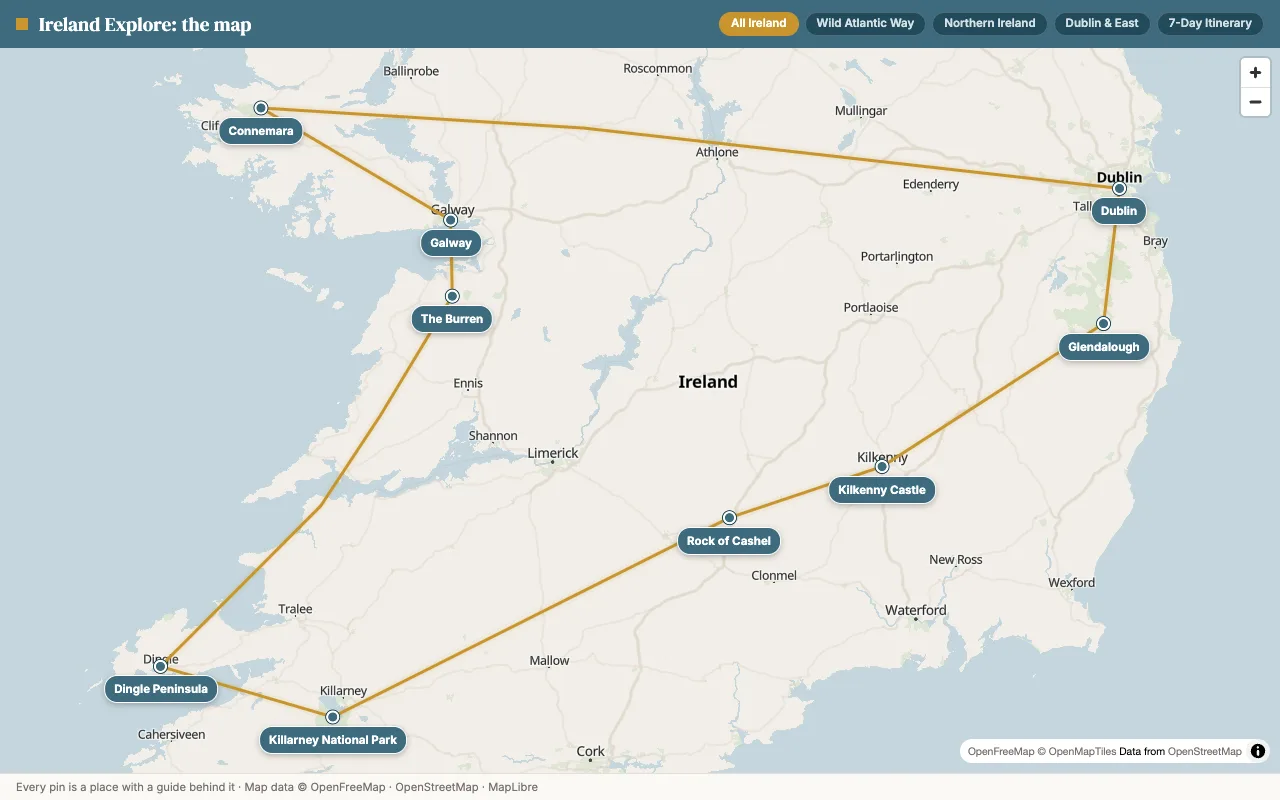
The route on the map
The full loop - the classic route plus the Burren, Connemara and more time in the west. Tap any stop for its guide.