When I was a child growing up in County Armagh, places in County Mayo like Westport and Achill Island were where families went on holidays. More popular than Spain or France. It wasn't until my 40s, driving a camper van the length of the Wild Atlantic Way, that I finally made it to Achill. I'd been missing out for decades.
Achill Island is Ireland's largest offshore island, connected to the mainland by the Michael Davitt Bridge. No ferry needed. You drive across. That accessibility is part of the appeal - it feels remote and wild, but getting there is straightforward. The island packs in some of Ireland's finest beaches, a 20km coastal driving loop, a deserted famine village, and surf breaks that draw people from across Europe.
Most visitors come for a day trip from Westport. That's a mistake. Give it at least two days.
What to Expect
I parked my camper van near Keel Beach, not far from some excellent pubs for food. Keel is the island's main beach - a long stretch of Blue Flag sand with reliable surf and space to breathe even on busy days. It faces west, so the sunsets are worth hanging around for.
The drive from Keel to Keem Beach changed what I thought I knew about Ireland. The road narrows as it climbs above the Atlantic, twisting along cliff edges with views that make you pull over every few minutes. When I arrived at Keem Beach on a windy day, the clouds scudding across the sky, the sea turned from slate grey to the brightest of blues. It's one of the most beautiful places I've been to in the world.
Keem is a horseshoe bay. Small, sheltered relative to the rest of the coast, and framed by high cliffs. The water is startlingly clear. The downside: parking is limited to roughly 50 spaces, and in July and August you may not get in at all after 11am. There is no overflow. If the car park is full, you wait or you leave.
The Atlantic Drive is a 20km loop around the southern tip of the island. It's free, it's beautiful, and the roads are narrow enough to require patience when you meet oncoming traffic. Stop at the viewpoints - they are well marked - and budget 90 minutes for the full loop with stops.
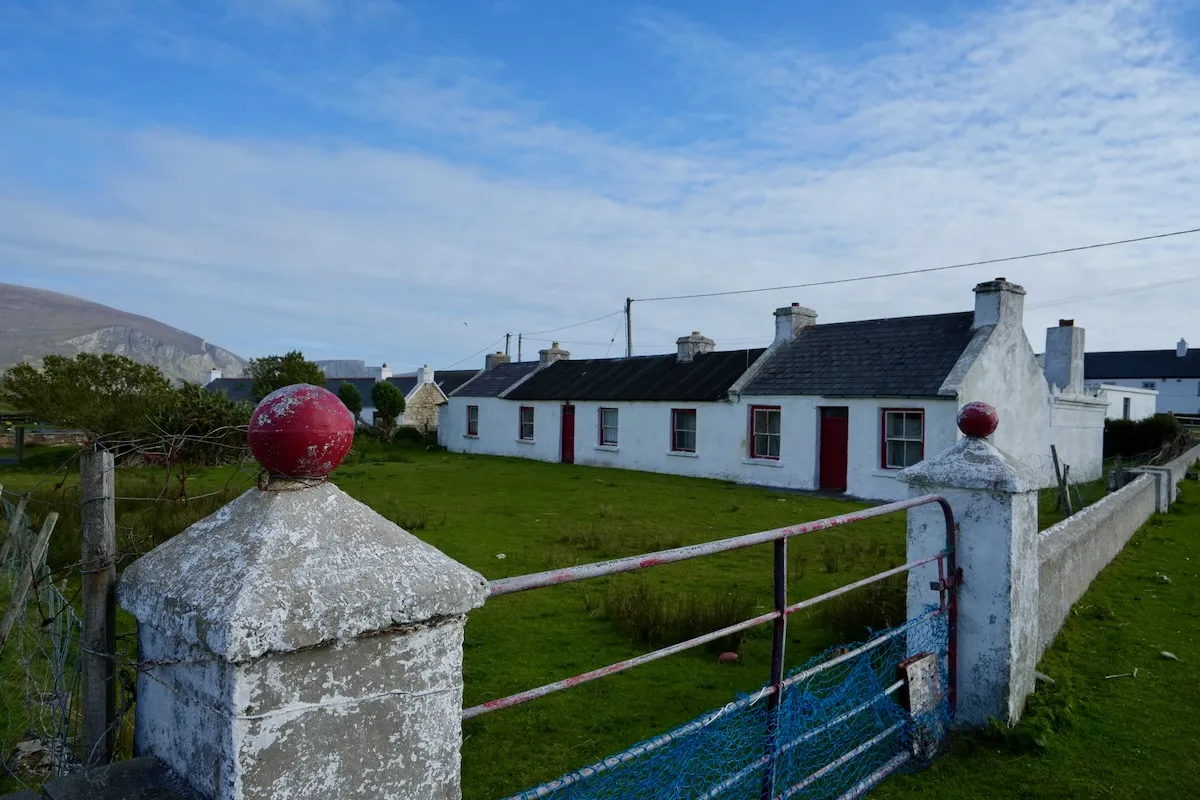
At Slievemore, the Deserted Village is an eerie row of roughly 80 stone cottages abandoned during the Great Famine. There are no guides, no entry fees, no visitor centre. You walk among the ruins on rough ground. It takes about 45 minutes to see properly.
I stopped at Ceide Fields on the same trip - briefly, on a day it was closed - and the wind took my breath away. Mayo is in some places quite wild. That wildness is part of what makes Achill so memorable.
How to Get There
Achill Island is about one hour west of Westport on the N59 and then the R319. You cross the Michael Davitt Bridge onto the island - no ferry, no booking, just drive across. The roads on the island are generally good, though some stretches on the Atlantic Drive are single-track with passing places.
The Great Western Greenway cycling trail ends at Achill Sound, right at the bridge. If you're cycling from Westport or Mulranny, you can continue onto the island by road from there.
Public transport exists but is limited. Bus Eireann route 440 connects Westport to Achill Sound. On the island, the TFI Anseo app offers on-demand bus services from 7am to 8pm, though coverage varies by season.
A car is strongly recommended. The island is 20km long and the best beaches and viewpoints are spread across it. If you're flying into Ireland West Airport Knock (40 minutes east), picking up a rental car is the simplest option for getting around Mayo.
Where to Stay Nearby
Keel village is the best base on Achill - it has the most restaurants, pubs and accommodation. If you'd prefer a larger town with more choice, Westport is an hour's drive and makes a good base for day trips across County Mayo.
Right on Keel Beach with sea views from most rooms. Family-run, good restaurant. The location is hard to beat on the island.
Check availability →What Else is Nearby
A Note on the History
Achill has been inhabited for at least 5,000 years. Megalithic tombs dot the hillsides, and the island's position on the Atlantic made it both a refuge and a point of contact with the wider world.
The Deserted Village at Slievemore is the most visible piece of the island's history. Around 80 stone cottages line the base of Slievemore mountain. The settlement was abandoned during the Great Famine of the 1840s, though some houses were still used as summer "booley" dwellings into the early 1900s, when families moved livestock to upland grazing.
The island has a complicated colonial history. Captain Charles Boycott - whose name became a verb - was a land agent in nearby County Mayo. Achill's population dropped sharply in the 19th century through emigration and famine. The ruins at Slievemore are a quiet, physical reminder of that loss.
Frequently Asked Questions