Derrygimlagh is a signature discovery point on Ireland's Wild Atlantic Way. While not as famous as the Cliffs of Moher or Malin Head, this unusual and remote bog is home to two fascinating pieces of history: it's the landing spot for the first transatlantic flight by Alcock & Brown, and the site of one of Marconi's signature radio signalling locations.
If you're coming to Galway or Mayo on a trip, or staying in nearby Clifden (7 mins), then Derrygimlagh is a day trip location that you won't easily forget - not only for its history, but also for the remote beauty of this place and the sense of big sky that you get here.
What to Expect
Your visit to Derrygimlagh will be a hike. The sites that you'll want to see are approached through Derrygimlagh Bog on tarmac path, over gravel and on grass. I'd recommend hiking boots and a waterproof jacket and warm clothing. You may want to read my Packing List for Ireland.
The skies were extremely heavy on my visit and it absolutely poured rain, but it was still worth it.
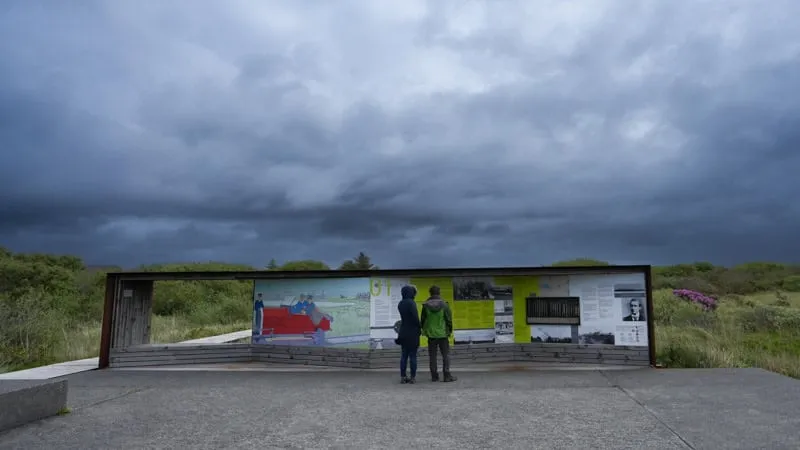
The path follows along the location of Marconi's old railway line, long since gone, which ran between the buildings of his wireless station. A series of 7 interpretative signs can be found along the loop, pointing out areas of interest. The majority of these relate to Marconi. Try out the metallic instrument which is a helpful tutorial in sound waves, as well as the crystal radios built into one particular sign. The remains of buildings lie in the landscape, including concrete slabs or partial foundations.
This is 'big sky' country. Derrygimlagh is exposed to Atlantic weather patterns, including the very heavy rain I encountered on my trip. One or two of the interpretative signs offer a little covered alcove to hide in.
The Marconi Connection
Why did Marconi set up a listening station on a bog in Derrygimlagh? Proximity to North America and the ready availability of fuel to power steam and heat needs. Marconi was born in Bologna in 1874, but his mother was Annie Jameson - a descendant of the Irish Whiskey Jamesons. When his transatlantic route between Massachusetts and Cornwall proved unreliable, he shortened the distance by establishing new centres in Newfoundland and Derrygimlagh. The station he built here in 1905 was, at the time, the largest in the world.
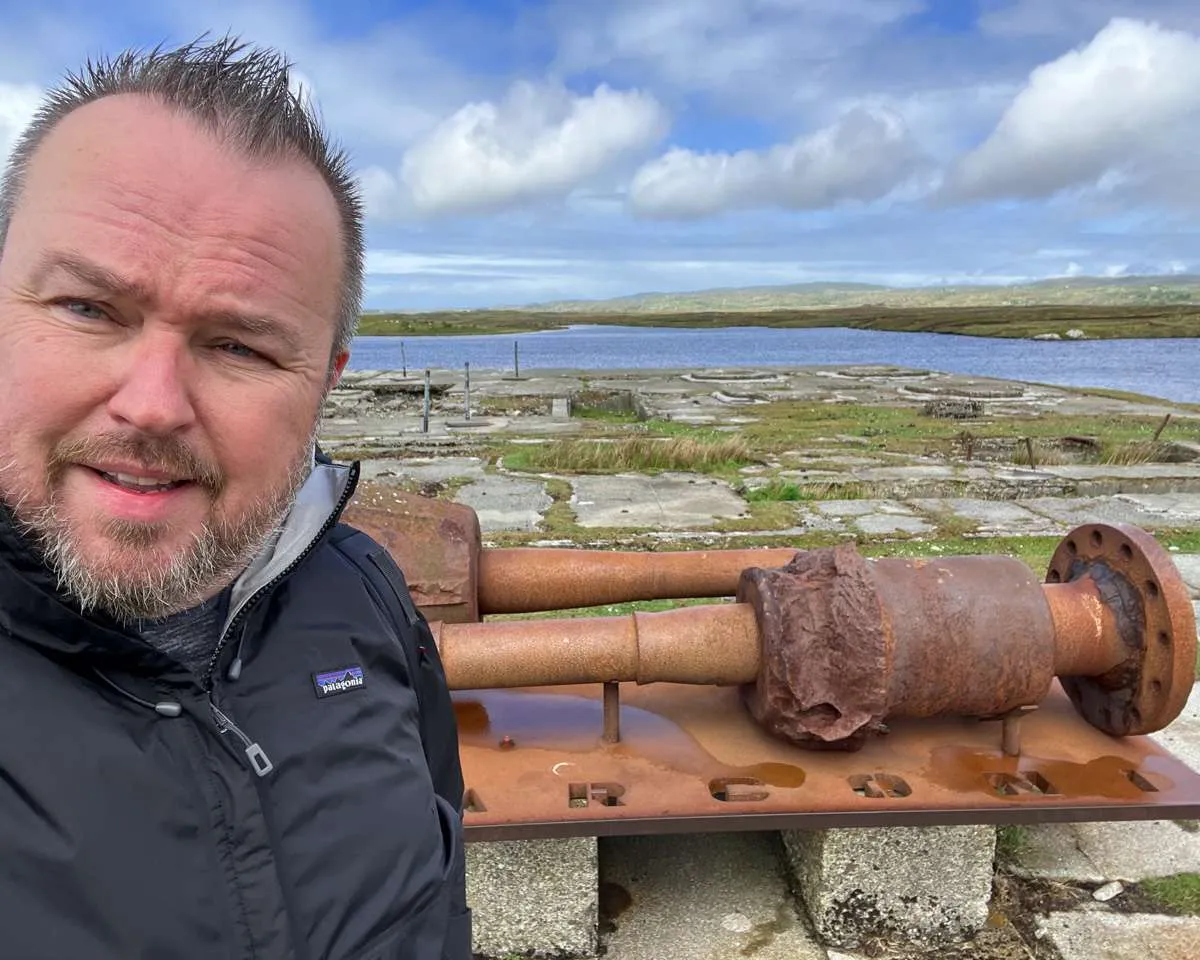
The most obvious remnant of the Marconi era is the location of the old Power House, where rusted remains of what I believe is the original generator machinery still stand. The signage provided at the site is genuinely helpful, and it's lovely to see it in both Irish and English.
Alcock & Brown: First Transatlantic Flight
On the morning of 15th June, 1919, Alcock & Brown cemented their place in aviation history as the first people to fly continuously across the Atlantic. They took off from Newfoundland on 14th June 1919. In a journey of more than 16 hours, flying at an average 120 mph, the two men endured freezing temperatures when their heated suits failed, severe fog, and a damaged airspeed dial.
They mistook Derrygimlagh bog for a field and crash-landed, their plane starting to sink. The workers at the Marconi telegraph station had tried to wave them away from the bog. In a twist that ties both histories together, it was the Marconi station that sent the message confirming their achievement to the world. Within days, they collected a prize from the Daily Mail and were knighted by King George V.
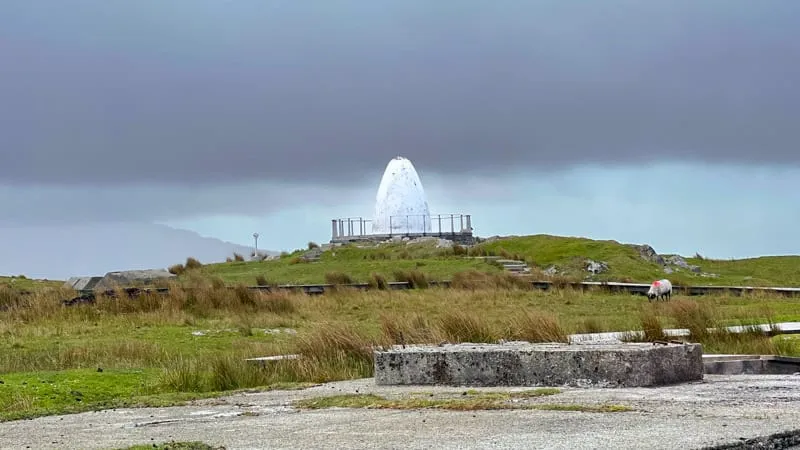
Two things stand out about the memorial. First, a unique circular contraption that allows you to imagine the sight of the biplane sinking into the bog. It's a simple device but very effective. Second, the white cairn inscribed with "Alcock and Brown, landing site, 500 meters." As you look out across the now-barren bog, it's hard not to imagine the incoming plane and the Marconi workers rushing out to wave caution.
How to Get There
I travelled from where I was staying in Clifden, County Galway - a gorgeous town in Connemara that everyone loves. Derrygimlagh is only a 7 minute drive from Clifden. The route, the R341, takes you a bit off the beaten track as you head towards Ballyconneely on a single carriageway road for a couple of kilometres and then, suddenly, there's a gravel car park that almost appears from nowhere.
For my trip, I keyed in the coordinates (53.4613, -10.0224) to reach the car park. In summer, there is usually a charming food van with chatty owners and a scattering of other vehicles. The car park is large enough for regular cars, small vans, or camper vans. It's free to park, but keep a few euros on hand to buy an artisanal coffee or lunch at the food truck when it's there.
I brought my bike with me and decided to cycle across Derrygimlagh, which worked out just great. The surfaces - tarmac, gravel, and grass path - are all bike-friendly.
Where to Stay Nearby
Clifden is the natural base for Derrygimlagh - just 7 minutes by car. I've visited the area with friends and stayed at Clifden Station House Hotel which I'd strongly recommend. I've also visited by campervan, which is a cool way to see this part of County Galway. If you intend staying more centrally in Galway City, read my guide to the best areas and hotels in Galway.
I've stayed here and would strongly recommend it. Great location in Clifden town, comfortable rooms, and an easy base for exploring Connemara and the Wild Atlantic Way.
Check availability →What Else is Nearby
A Note on the History
Derrygimlagh links two pivotal moments in communications history. Marconi's 1905 telegraph station was a leap in global connectivity - shortening the transatlantic signal path from Cornwall to Connemara. Fourteen years later, the bog that housed his station became the unintended runway for the first non-stop transatlantic flight. The Marconi workers who rushed out to warn the incoming plane away from the soft ground were, minutes later, the ones who telegraphed the news of the landing to the world.
Both Alcock and Brown were knighted within a week. Alcock died in a flying accident six months later, aged 27. The bog has been quiet since.
Frequently Asked Questions