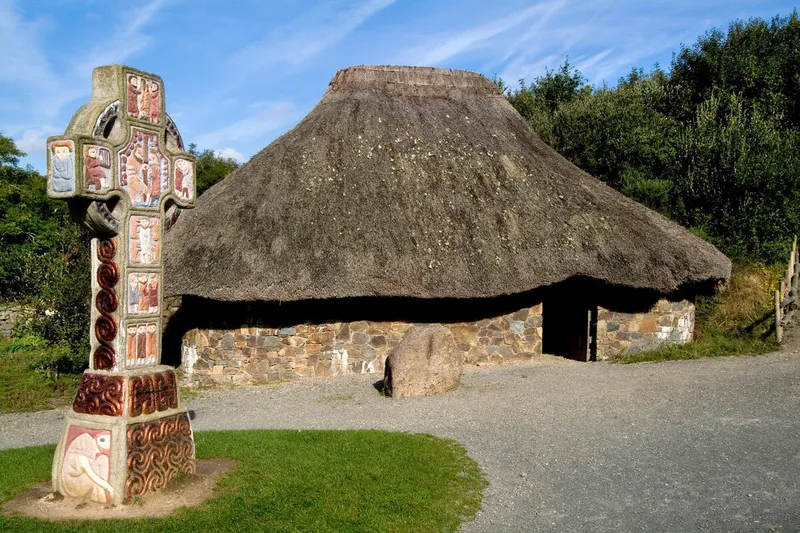
The Irish National Heritage Park covers 9,000 years of Irish history across 35 acres of woodland at Ferrycarrig, just outside Wexford Town. Reconstructed settlements from every major period - Mesolithic camps, Neolithic farmsteads, Bronze Age dwellings, a Viking boatyard, an early Christian monastery, a Norman motte and bailey - sit along trails through oak and ash forest.
This is the kind of place that sounds educational and dry but is actually a good day out. The reconstructions are full-size and walkable. You can step inside a crannog, peer into a ring fort, and see how a Viking longship was built. For families with children, it is one of the best attractions in the southeast. For adults, the depth of what is here - the sheer span of time represented - is quietly impressive. County Wexford does heritage well and this is the flagship.
What to Expect
The park is laid out chronologically along a trail through woodland. You start at the Mesolithic period - a campsite of hunter-gatherers from around 7,000 BC - and walk forward through time. Each reconstruction is full-size and built using period-appropriate techniques. The Neolithic farmstead has a proper thatched dwelling you can enter. The Bronze Age section includes a stone circle and a cist grave. The crannog - a lake dwelling on stilts - is one of the highlights: you walk across a causeway to reach it.
The Viking section is particularly good. A reconstructed boatyard shows how longships were built. The early Christian monastery has a round tower, scriptorium, and high cross replica. The Norman motte and bailey at the end of the trail brings you to the medieval period. Each site has interpretation panels and, on guided tours, live demonstrations.
The woodland setting is part of the appeal. The trail winds through mature forest along the Slaney estuary. Birds, wildflowers, and the smell of the woodland add something that an indoor museum cannot replicate. There is a genuine sense of walking through layers of the past.
The catch: the reconstructions are replicas, not originals, and some are showing their age. Paint peels. Thatch thins. The park opened in 1987 and parts of it feel like they need investment. On a wet day, the trails are muddy and exposed sites are less appealing. And while the chronological approach is clever, the later periods - early Christian, Viking, Norman - are stronger than the prehistoric sections, which can feel sparse.
How to Get There
The Heritage Park is at Ferrycarrig, 5 minutes from Wexford Town on the N11 heading towards Enniscorthy. It is signposted from the main road. From Dublin, it is about 2 hours. From Waterford, 1 hour.
A car is the most practical option. The park is just off the main road but there is no direct public transport. It combines well with a morning at the park and an afternoon in Wexford Town, or with Curracloe Beach (20 minutes) if the weather holds.
Where to Stay Nearby
Wexford Town is 5 minutes from the Heritage Park and has the widest range of accommodation in the county. Enniscorthy is 20 minutes north.
A proper destination spa in the Wexford countryside. If you need to decompress after a week of driving narrow Irish roads, this is where you do it. The thermal suite alone justifies the price.
Check availability →What Else is Nearby
A Note on the History
The Heritage Park was established in 1987 as a way to present the full sweep of Irish history in a single site. The reconstructions are based on archaeological evidence from excavations across Ireland. The crannog, for example, draws on findings from sites like Craggaunowen in Clare. The Viking boatyard is based on Dublin excavations at Wood Quay.
Ferrycarrig itself has genuine historical significance. The Norman castle ruins at Ferrycarrig - separate from the park - overlook the Slaney estuary and date to the 1169 Norman invasion, which landed first in Wexford. The location was chosen for the park partly because of this connection. The landscape around the Slaney estuary has been inhabited continuously for thousands of years, making it an appropriate setting for a museum that covers the same timespan.
Frequently Asked Questions