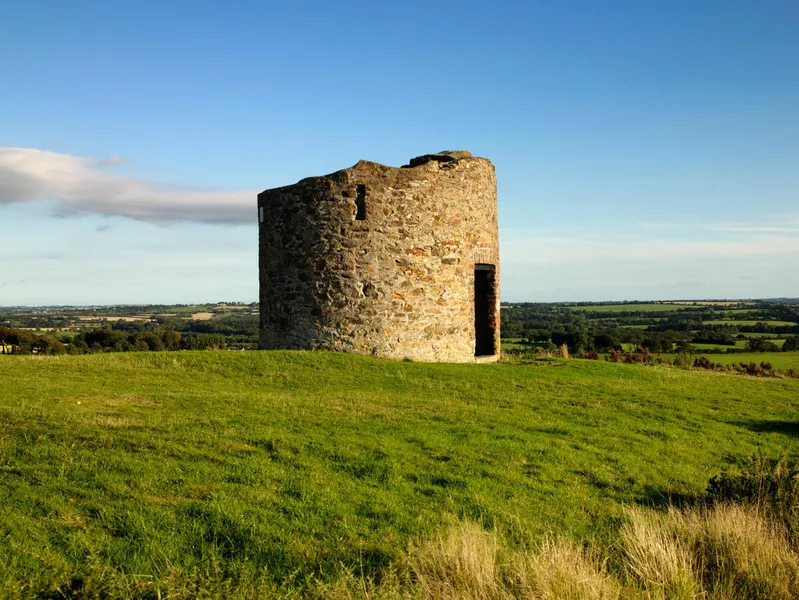
Vinegar Hill is a low hill on the edge of Enniscorthy with a ruined windmill on top and panoramic views across County Wexford. It looks peaceful now. In June 1798, it was the main rebel camp of the Wexford Uprising - and the site of the battle that effectively ended the rebellion. Twenty thousand people camped here. The British assault killed thousands.
The hill is free to walk and takes ten minutes to climb. The views are genuinely good - Enniscorthy below, the Blackstairs Mountains to the west, the Slaney Valley stretching north. But you come here for the history, and the National 1798 Centre in town provides the context that the hill itself cannot.
What to Expect
The walk starts at the edge of Enniscorthy. A path leads up through grass to the ruined windmill at the summit. The mill was the focal point of the rebel camp in 1798 and it is still the landmark you see from miles around. The climb takes about ten minutes and the views open up quickly.
From the top, Enniscorthy is spread out below with Enniscorthy Castle prominent on the riverside. The Slaney Valley runs north towards Ferns. The Blackstairs Mountains form the western horizon. On a clear day, you can see Mount Leinster. An information panel explains what happened here, but the hill is largely uninterpreted - there are no dramatic monuments or statues.
The National 1798 Centre in Enniscorthy town is where you get the full story. The rebellion in Wexford was one of the bloodiest episodes in Irish history. Thousands of poorly armed farmers and townspeople took on the British Army. Vinegar Hill was their stronghold. The battle on 21 June 1798 was decisive - the rebels were overwhelmed by artillery and the camp fell. The aftermath was brutal.
Is It Worth It?
Ten minutes to climb, free, and the ground where the 1798 rebellion ended. Twenty thousand people camped on this hill in June 1798 as the main rebel force of the Wexford Uprising, and the British assault that followed killed thousands and effectively finished the rising. What is up there now is a ruined windmill and a panorama across the county. The National 1798 Centre down in Enniscorthy is about EUR 8. Thirty to forty-five minutes on the hill itself.
The catch: the hill itself is underwhelming if you do not know the history. There is a ruined windmill, some grass, and good views. Without context from the 1798 Centre or a guidebook, it is just a pleasant walk to a viewpoint. And Enniscorthy, while improving, is not a destination town - the food and accommodation options are limited compared to Wexford Town or Kilkenny.
How to Get There
Vinegar Hill is on the eastern edge of Enniscorthy, which sits on the N11 between Dublin and Wexford Town. From Dublin, Enniscorthy is about 2 hours. From Wexford Town, 20 minutes. The hill is signposted from the town centre.
There is a direct train from Dublin Connolly to Enniscorthy - the journey takes about 2.5 hours. From the station, the hill is a 15-minute walk. A car is more practical if you are combining with other Wexford destinations.
Where to Stay Nearby
Enniscorthy has a few options but Wexford Town (20 minutes) has a wider selection. Monart Destination Spa is nearby for those who want something special.
A proper destination spa in the Wexford countryside. If you need to decompress after a week of driving narrow Irish roads, this is where you do it. The thermal suite alone justifies the price.
Check availability →What Else is Nearby
A Note on the History
The 1798 Rebellion in Wexford was sparked by decades of oppression, sectarian violence, and the influence of the United Irishmen movement. In late May 1798, insurgents - mostly Catholic farmers and townspeople armed with pikes - seized Enniscorthy and Wexford Town. Vinegar Hill became their main camp, holding an estimated 20,000 people including women and children.
On 21 June 1798, General Lake's forces attacked with 20,000 troops and artillery. The rebels, outgunned and surrounded, held for several hours before the camp was overrun. Casualties were heavy on both sides but the aftermath was worse - reprisals against the civilian population were widespread. The battle broke the organised rebellion in Wexford, though guerrilla fighting continued for months. Vinegar Hill became a symbol of resistance that echoed through the 1803, 1848, and 1916 risings.
Frequently Asked Questions