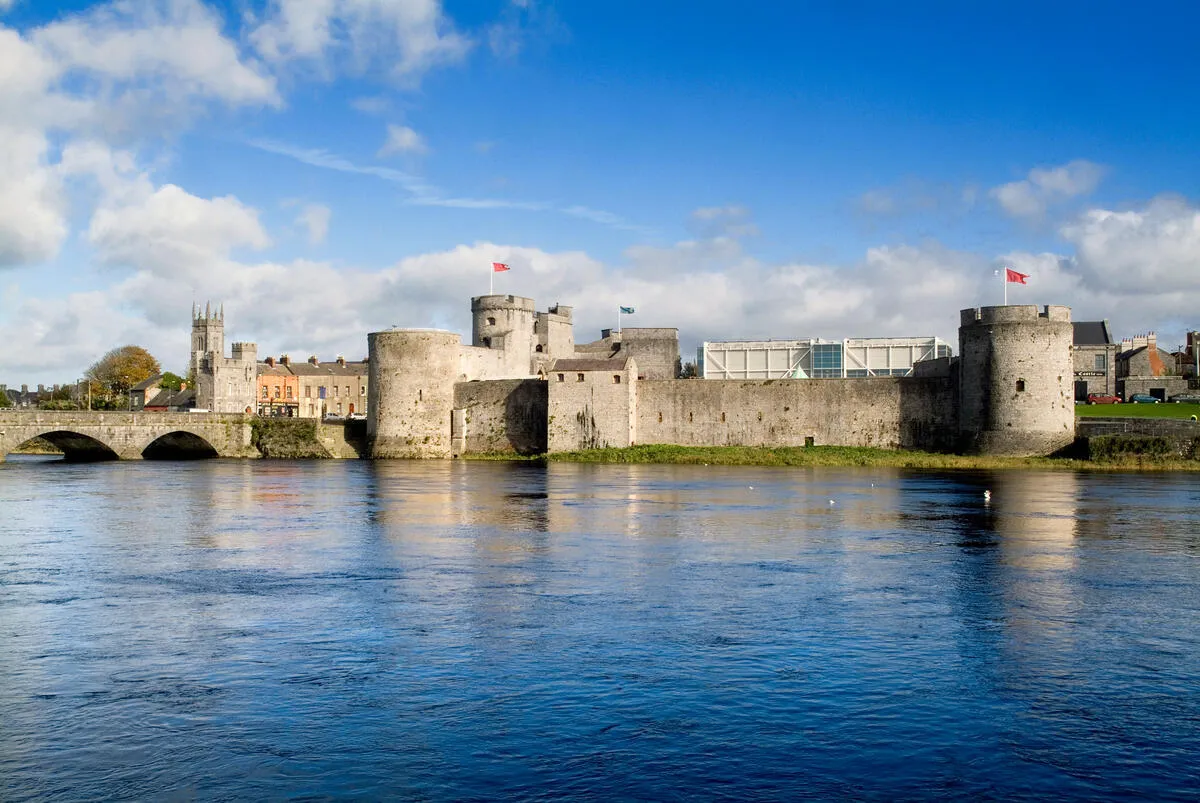
King John's Castle is the best thing in Limerick city and one of the finest Norman castle experiences in Ireland. It sits on King's Island at the heart of the medieval quarter, right on the Shannon, with Thomond Bridge and the Treaty Stone in view from the battlements. The EUR 5.7 million renovation added a genuinely impressive interactive exhibition inside the courtyard - archaeological finds under glass floors, CGI reconstructions of Viking and Norman Limerick, and enough hands-on material to keep children engaged without boring adults. Most visitors to Limerick drive through on the way to Kerry or Clare. That is a mistake. County Limerick deserves more than a flyby, and the castle is where to start.
What to Expect
You enter through the modern visitor centre, pick up tickets, and step into the ground floor exhibition. This is where the renovation money shows. The displays cover Viking and Norman Limerick through multimedia panels, CGI animations, and interactive touchscreens that are engaging without being gimmicky. The highlight of the ground floor is the archaeological excavation visible through glass panels in the floor - actual dig layers from different centuries of settlement.
The courtyard is where children will want to stay. Medieval games, costumes to try on, and enough space to run around. It works as a break between the indoor exhibits and the tower climbs.
The towers are the physical test. Narrow spiral staircases - genuinely narrow, single-file, with low headroom in places - wind up to the battlements. If you have mobility issues or claustrophobia, this is not for you. The reward is panoramic views over the Shannon, across Thomond Bridge to the Treaty Stone, and out over the rooftops of the medieval quarter. On a clear day, the view alone justifies the admission.
Walk the curtain walls between the towers if they are open. The sense of scale is impressive - this was a serious military fortification controlling the most important river crossing in the west of Ireland.
Is It Worth It?
The best thing in Limerick city, and the reason not to drive straight through on the way to Kerry. A EUR 5.7 million renovation put archaeological finds under glass floors and CGI reconstructions of Viking and Norman Limerick inside the courtyard, and the battlements look out over the Shannon, Thomond Bridge and the Treaty Stone. Allow an hour and a half to two hours. A family of four is EUR 33.
The catch: EUR 13 per adult is steep for what is fundamentally a 90-minute visit. If a school group arrives while you are inside, the noise level jumps considerably. And the tower access excludes anyone who cannot manage steep spiral stairs - which rules out a significant proportion of visitors. The ground floor exhibition alone does not justify the price.
How to Get There
King John's Castle is a 10-15 minute walk from most central Limerick locations. Cross Thomond Bridge to King's Island and you are there. If you are driving, there is no on-site parking - use the Hunt Museum car park (5 minutes walk) or any of the city centre multi-storeys at EUR 1.50-2.50 per hour.
From Shannon Airport, it is 25 km and roughly 25-30 minutes via the N18/M18. From Dublin, about 2 hours on the M7 motorway. The castle is extremely well positioned - everything in the medieval quarter is walkable from here, including the Milk Market (10 minutes), St Mary's Cathedral (5 minutes), and the Hunt Museum (5 minutes).
Bus Eireann city services stop nearby. If you are without a car, Limerick city is one of the most walkable destinations in Ireland for the core attractions.
Where to Stay Nearby
Limerick city is the obvious base. The castle is walkable from all central hotels. See the County Limerick hub for full accommodation coverage across the county.
Georgian townhouse on Pery Square, overlooking People's Park. Individually designed rooms, excellent restaurant, genuine character. Walking distance to the castle.
Check availability →What Else is Nearby
A Note on the History
The castle was built between 1200 and 1212 on the orders of King John of England, on the site of an earlier Viking settlement. Its position controlling the Shannon crossing made it one of the most strategically important fortifications in the west of Ireland. The castle was besieged repeatedly - during the Bruce invasion of 1332, the Confederate Wars of the 1640s, and most dramatically during the Williamite siege of 1691, when the Treaty of Limerick was signed on the stone across the river.
The excavations beneath the visitor centre revealed layers of settlement going back to the Viking period. The castle you see today is Norman in structure but stands on ground that has been fought over for a thousand years.
Frequently Asked Questions