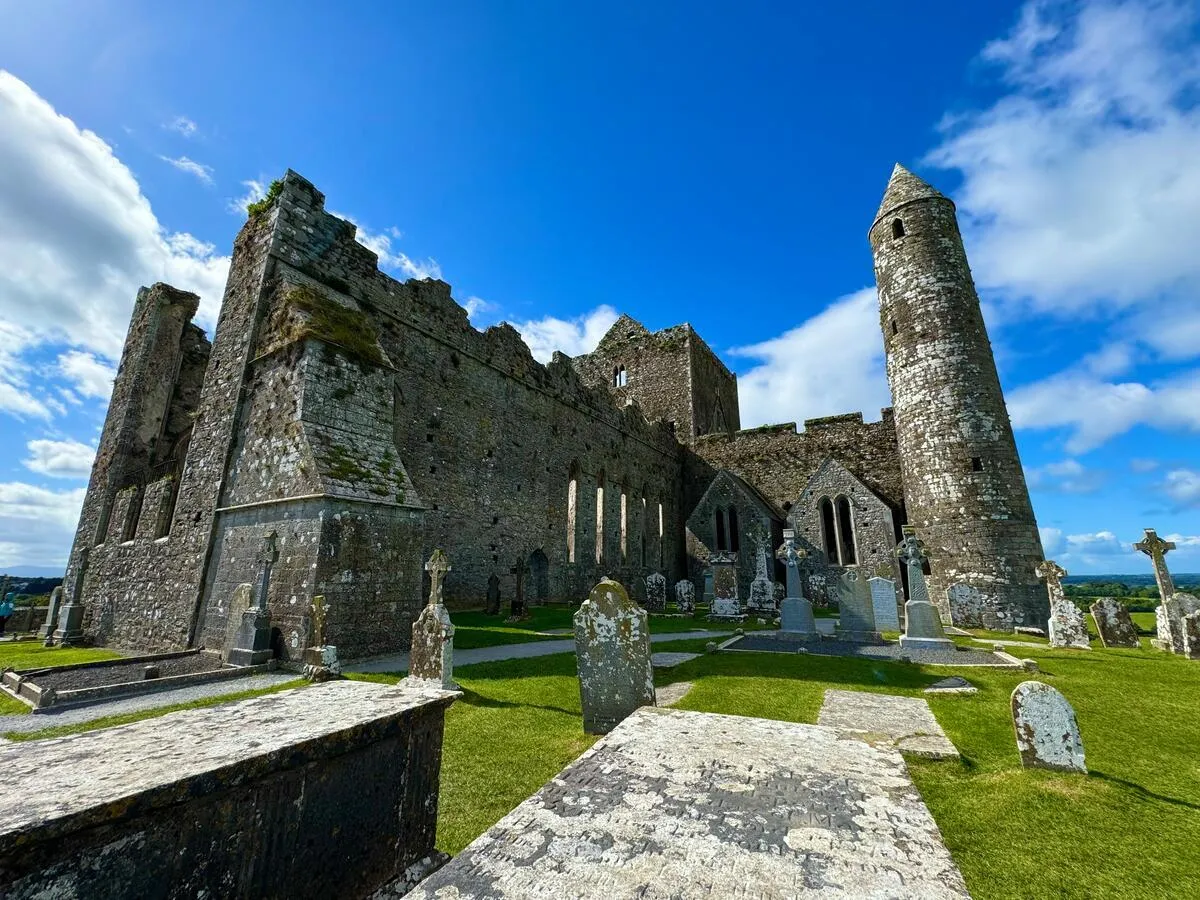
The Rock of Cashel is one of the most visually dramatic heritage sites in Europe. A cluster of medieval buildings - round tower, cathedral, chapel, high crosses - crowns a limestone outcrop that rises from the flat farmland of the Golden Vale like something out of a different landscape entirely. You see it from the motorway and it stops you. It is supposed to.
This was the seat of the Kings of Munster for centuries before Brian Boru handed it to the church in 1101. Cormac's Chapel, built in 1134, contains the finest Romanesque architecture in Ireland. The cathedral ruins, the round tower, and the Hall of the Vicars Choral complete an ensemble that repays a slow visit. Most coach tours allow 45 minutes. That is not enough.
The Rock sits above the town of Cashel in County Tipperary, roughly central in the county and easily reached from Dublin, Cork, or Limerick. It is an OPW heritage site with a small admission fee. If you buy an OPW Heritage Card, this is one of the places that justifies the price on its own.
What to Expect
The approach is uphill from the car park - a steep 200-metre walk on a paved path. There is no avoiding it. The car park sits at the base and you climb to the entrance. The reward is immediate: the first view of the cathedral and round tower from the gate is one of the great reveals in Irish heritage.
Start with the Hall of the Vicars Choral, which houses a short audiovisual presentation and the original St Patrick's Cross (the one outside is a replica). The hall gives context before you step into the open-air complex.
Cormac's Chapel is the highlight. It is the oldest surviving Romanesque church in Ireland, with carved doorways, a stone roof, and fragments of 12th-century frescoes that are among the earliest in the country. Access is by guided tour only - tickets are limited and sold on-site. Tours run regularly but the last one is at 15:45 in summer. If the chapel matters to you, arrive early or check tour times on arrival.
The cathedral is a roofless 13th-century Gothic structure. Walking through it, with the sky overhead and the round tower beside you, is atmospheric. The high crosses are worn but still readable. The views from the Rock across the Golden Vale are panoramic - on a clear day you can see the Galtee Mountains to the south.
Is It Worth It?
Yes, on one condition: give it the time it needs. At EUR 8 for adults, and free on an OPW Heritage Card, the entry price is not what decides this. Time is. Allow 1 to 1.5 hours, and another 30 minutes if you want the Cormac's Chapel tour, which is the best thing on the Rock and runs only until 15:45 in summer. The 45 minutes a coach tour allows is not enough for any of it.
The catch: the site gets busy in summer, particularly when coach tours arrive mid-morning. The car park is small and fills on peak days. The toilets are at the base, not on the Rock. There is no cafe on-site - you need to walk back into Cashel town for food. And the uphill walk, while short, is genuinely steep. None of this detracts from the place itself, but it helps to know in advance.
How to Get There
The Rock of Cashel is right off the M8 motorway, about two hours from Dublin, 90 minutes from Cork, and 45 minutes from Limerick. The Cashel exit drops you practically at the town. Follow signs to the Rock - you cannot miss it rising above the rooftops.
The car park is at the base of the Rock, a short walk from the town centre. It costs approximately EUR 4.50 and fills on busy days. Arrive before 10am in summer to avoid the worst of the coach traffic.
Bus Eireann runs services from Dublin to Cork via Cashel. The bus stop is in the town centre, a 10-minute walk from the Rock. Irish Rail serves Thurles (25 minutes away) and Cahir (20 minutes) on the Dublin-Limerick and Waterford lines respectively.
Where to Stay Nearby
Cashel town has a handful of hotels and B&Bs. For a wider selection, Cahir (20 minutes south) or Tipperary town offer more options. See the full County Tipperary guide for accommodation across the county.
Queen Anne palazzo at the foot of the Rock. The views from the gardens looking up at the ruins are extraordinary. Restaurant, spa, and genuine luxury.
Check availability →What Else is Nearby
A Note on the History
The Rock was the traditional seat of the Kings of Munster from at least the 4th century. Legend says St Patrick baptised King Aengus here in the 5th century, accidentally driving his crozier through the king's foot. Aengus did not flinch - he assumed it was part of the ceremony.
Brian Boru was crowned here before his campaign against the Vikings. In 1101, his descendant Muirchertach O'Brien donated the Rock to the church. Cormac's Chapel followed in 1134. The cathedral was built in the 13th century. The complex was abandoned as a place of worship in the 18th century and has been in state care since 1874.
Frequently Asked Questions