I've spent enough time watching visitors queue for three hours at the Guinness Storehouse to know when Dublin's pulling a fast one. Don't misunderstand me, I adore Dublin, grew up navigating its Georgian squares and still get a thrill walking O'Connell Street at dusk. But if you've only got a week in Ireland and you're spending an entire day fighting Temple Bar crowds for a 7 euro pint, you're missing the country I actually know. County Armagh, ninety minutes north across the border, holds more authentic Irish magic in its apple orchards and Bronze Age earthworks than any tourist-choked Southside pub ever will.
Why Armagh Deserves Your Limited Time
Here's the truth about short Irish holidays: you cannot do everything. Americans especially arrive with romantic notions of kissing the Blarney Stone, photographing the Cliffs of Moher, and somehow squeezing in the Giant's Causeway, all whilst driving on the left for the first time. That's a recipe for exhaustion, not discovery. Armagh offers something radically different: depth over breadth. This is the ecclesiastical capital of Ireland, where St. Patrick built his first stone church in 445 AD, where Iron Age kings ruled from hillforts that predate Christ, and where 6,000 acres of Bramley apple orchards still perfume the countryside each spring. You won't find coach tours clogging the Palace Demesne's 300 acres of gardens, because most visitors don't even know it exists. That's precisely the point.
Northern Ireland follows UK immigration rules, which means visitors from most countries now need an Electronic Travel Authorisation (ETA) before crossing the border - even if arriving via the Republic. The ETA costs 16 pounds, takes minutes to apply for, and is valid for two years. British and Irish citizens don't need one. Check gov.uk/eta well before you travel. Currency switches to pounds sterling once you cross the border, so expect 10-15 pounds for heritage site entries and 20-30 pounds for proper meals. The value proposition improves dramatically. No 25 euro Guinness Storehouse tickets here.
Getting There Without the Hassle
The Enterprise train from Dublin Connolly to Belfast Central runs hourly, takes one hour forty-five minutes, and costs roughly 30 euro. I've made this journey dozens of times, always marvelling how quickly the landscape shifts from Leinster's tidy fields to Ulster's drumlin-studded terrain. From Belfast, the Goldline Express 238 bus reaches Armagh city in an hour for about 10 pounds. Frequent departures, comfortable coaches, none of the stress of navigating unfamiliar motorways. If you're driving, the A1/M1 corridor covers the hundred miles in ninety minutes, though I'd caution first-timers about roundabouts and the psychological adjustment of right-hand-side driving. Save the car rental for day two once you've acclimated.
Where Myth Meets Archaeology at Navan Fort
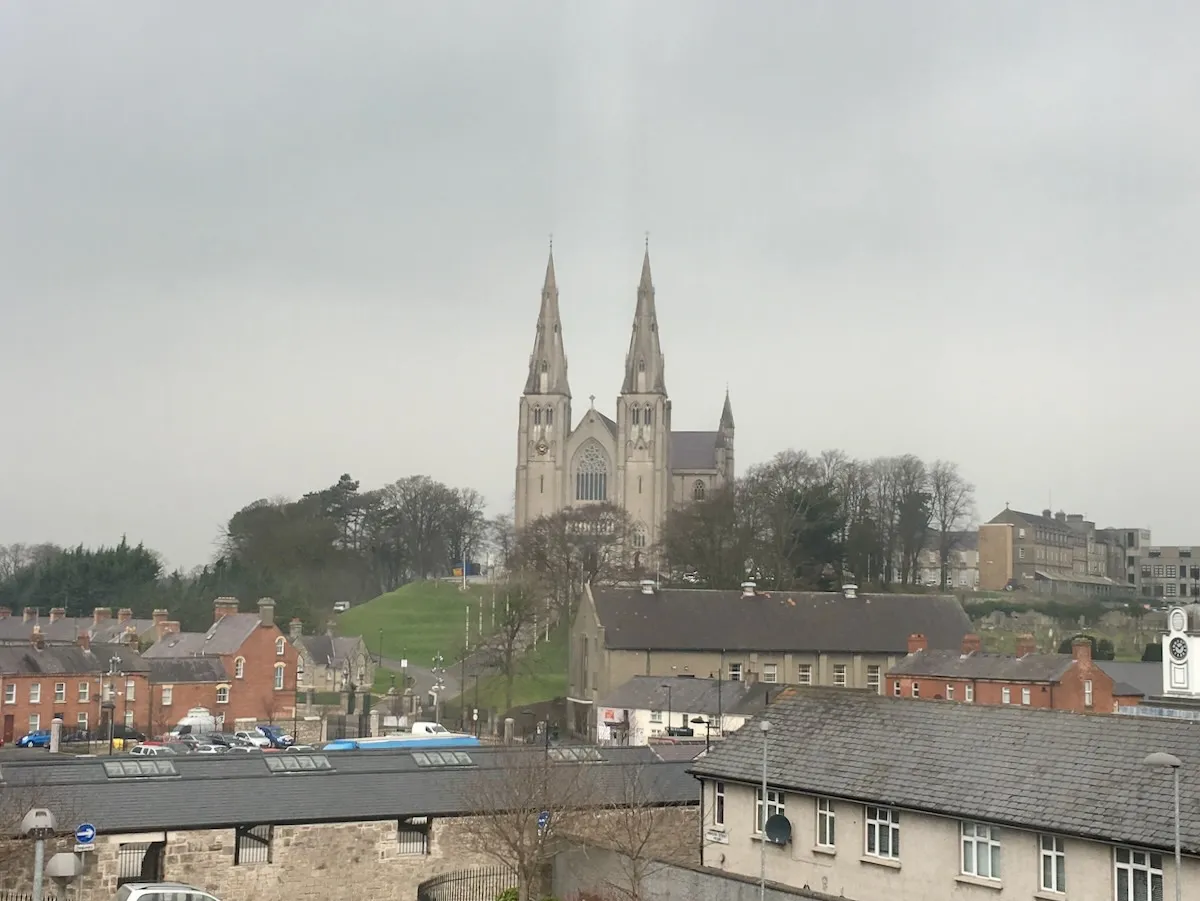
Navan Fort sits two miles west of Armagh city, an unassuming grass-covered mound that reveals its secrets slowly. Excavations uncovered evidence of an Iron Age temple complex deliberately burned around 95 BC, with a massive timber structure forty metres across. Built, used once for ritual purposes, then torched. The archaeological evidence suggests this wasn't destruction but consecration - a Bronze Age mic drop that still gives me chills. The visitor centre charges 10 pounds and uses projections to reconstruct the site, but the magic happens when you climb the earthwork itself and scan the surrounding drumlins. On clear days, you'll spot the twin cathedral spires of Armagh city, Catholic and Church of Ireland facing each other across hills that have witnessed 5,000 years of human ambition.
Don't skip the extended Navan Complex sites. Loughnashade, a ritual lake five minutes' walk from the main fort, yielded four Bronze Age horns in 1798. Votive offerings to gods whose names we've forgotten. Haughey's Fort and the King's Stables, both Bronze Age enclosures within walking distance, see maybe a dozen visitors weekly. I've spent entire afternoons there without encountering another soul, just sheep and the odd curious rook.
The Orchard County's Edible Heritage
Armagh's nickname isn't just talk. Those 6,000 acres of Bramley apple orchards produce fruit that ends up in ciders, desserts, and the county's fierce culinary pride. Visit during late spring, April through June, and the blossoms transform the countryside into something you'll struggle to photograph properly. The annual Armagh Food and Cider Weekend, typically held in summer, showcases local producers with a seriousness you won't find at Dublin's more touristy food markets. This is working agricultural land, not a theme park.
For breakfast, 4C Coffee House & Kitchen on English Street serves a proper Ulster fry for about 10 pounds. Back bacon, smoked salmon, potato bread, the works, with staff who'll chat about local history between orders. Uluru in the city centre runs about 20 pounds per person for lunch and sources ingredients from those very orchards you'll be photographing. The vibe is relaxed, family-friendly, utterly unpretentious. If you're chasing Michelin-starred experiences, you're in the wrong county. If you want to taste what actual Northern Irish people eat when they're celebrating local produce, this is your spot.
Where to Stay in Armagh City
Armagh city centre is compact enough to walk entirely, which matters when you're jet-lagged. Armagh City Hotel offers luxury at 150 pounds-plus nightly, with spa facilities. Book early for summer. Charlemont Arms Hotel, a mid-century fixture on The Mall, runs 100-130 pounds and places you within two minutes of the cricket grounds and Georgian architecture. For something more personal, Drumspittal House is a very highly rated B&B just outside the city, with doubles from around 100 pounds. All three sit within a ten-minute walk of the twin cathedrals, Navan Fort bus connections, and the city's modest but genuine pub scene.
The Quiet Corners Nobody Mentions
Palace Demesne, the Archbishop's former estate, offers 300 acres of gardens with free entry. The Garden of the Senses was designed for accessibility, which means even if you're travelling with elderly relatives or young children, everyone experiences the space fully. I've watched American visitors spend three hours here, genuinely surprised that something this beautiful charges nothing.
Tannaghmore Farm and Gardens, southeast of the city, combines rare breed animals with sculpture trails and the Kissing Gate - legend has it that couples who kiss over the gate will marry within a year. Pack a picnic, because the tearooms close unpredictably off-season. This is rural Ireland without the performance, just families feeding sheep and pensioners walking terriers.
For the genuinely curious, hunt down Holger Christian Lonze's gargoyles scattered through Armagh city. Twenty-two bronze miniature sculptures - gargoyles, angels and chimeras - hidden in nooks, crannies and on ledges across the city centre. There's an official trail from Visit Armagh that maps out the route, or you can simply wander and discover them yourself, which is how the best Irish experiences unfold anyway.
Skip Dublin's crowds for a day. Trade the Guinness Storehouse queue for a hillfort where Irish kings once ruled. Your Instagram will thank you, but more importantly, you'll actually remember why you came to Ireland in the first place.