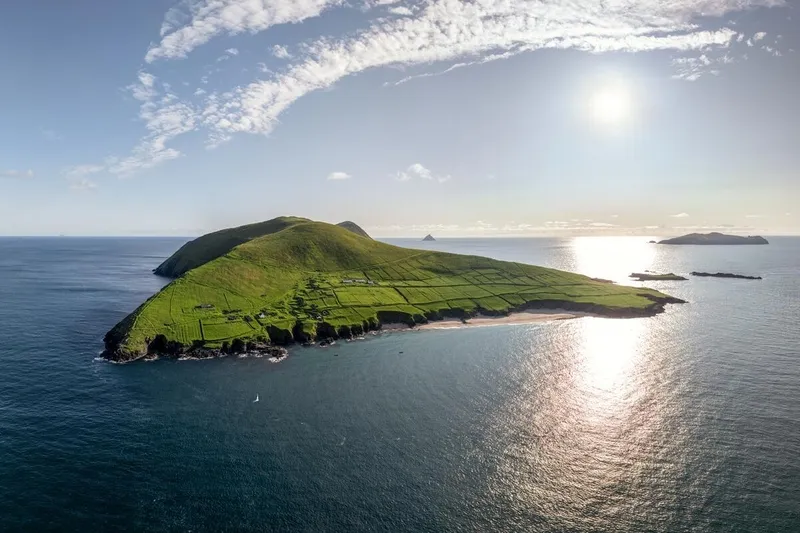
The Blasket Islands lie off the tip of the Dingle Peninsula. Great Blasket was inhabited until 1953, when the last 22 residents were evacuated to the mainland. The government decided the island was too remote, too dangerous in winter storms, and too small to sustain a community. What remains is an abandoned village, two extraordinary beaches, and a grey seal colony that has claimed the strand.
You can visit by ferry from Dunquin between April and September. The crossing takes 20 minutes. You get about four hours on the island. There is a cafe, toilets, and not much else. That is the entire point.
What to Expect
The ferry from Dunquin is a small boat. You walk down a steep concrete path to the pier - the same zigzag path you see in every photograph of Dunquin. At Great Blasket there is no pier. You transfer to a dinghy and wade the last few steps onto the beach. Wear shoes you do not mind getting wet.
The abandoned village is immediately above the landing beach. Stone cottages with collapsed roofs line a grassy path. Peig Sayers' house is marked. The OPW runs free guided tours of the village at 11:30am, 12:30pm, and 1:30pm - about 45 minutes each. Take one. The guides know the stories of who lived where and what the evacuation was like.
Beyond the village, walk north to the white beach. This is where the grey seals haul out. In good weather there can be 40 or 50 on the sand. Get there early in the morning before other visitors disturb them. The seals are wild but habituated to people at a distance.
The island is bigger than it looks from the mainland. You can walk to the western end and back in about two hours. The terrain is rough grass and sheep tracks. There are no fences on the cliffs. Watch your footing.
Is It Worth It?
EUR 50 buys four hours somewhere genuinely emptied out. Great Blasket was inhabited until 1953, when the last 22 residents were evacuated because the government judged the island too remote to sustain a community. What is left is the abandoned village, two beaches, and a grey seal colony that has taken over the strand. The crossing from Dunquin takes 20 minutes and runs April to September. There is a cafe, toilets, and deliberately little else.
The catch: the crossing is weather-dependent and cancellations are common. The dinghy transfer at Great Blasket is not for everyone - it requires reasonable mobility and willingness to get your feet wet. There is no shelter on the island beyond the cafe. If the weather turns, you are stuck until the ferry returns. Bring rain gear even on sunny mornings.
How to Get There
Dunquin Pier is on the western tip of the Dingle Peninsula, 13 km west of Dingle town. The drive takes about 20 minutes along the Slea Head Drive. There is no public transport to Dunquin.
Three ferry operators run from Dunquin. Blasket Island Ferries and Blasket Ferry are the main two. Prices are EUR 50 adults, EUR 30 children return. Ferries depart hourly from about 9:45am. The last return is typically around 5pm. Book ahead by phone or email - online booking is limited.
The Great Blasket Centre on the mainland near Dunquin is worth visiting before or after. It covers the island's history, literature, and the evacuation. Allow an hour.
Where to Stay Nearby
Dingle town is the practical base - 20 minutes from Dunquin with the best food and accommodation on the peninsula. Ventry and Dunquin itself have a handful of B&Bs for a quieter stay.
Harbour views, pool, and spa in Dingle town. Twenty minutes to Dunquin pier.
Check availability →What Else is Nearby
A Note on the History
The Blasket Islands produced a literary tradition out of all proportion to their size. Three books in particular are famous. Tomas O Criomhthain wrote The Islandman in 1929. Muiris O Suilleabhain wrote Twenty Years A-Growing. And Peig Sayers dictated her autobiography, which became a set text for the Irish Leaving Certificate exam.
Peig's book divided generations of Irish students. It was compulsory reading in Irish for decades. Some remember it fondly. Many do not. The book is better than its reputation suggests, but forcing teenagers to read about hardship in a language they were still learning was perhaps not the best marketing for either the Blaskets or the Irish language.
Frequently Asked Questions