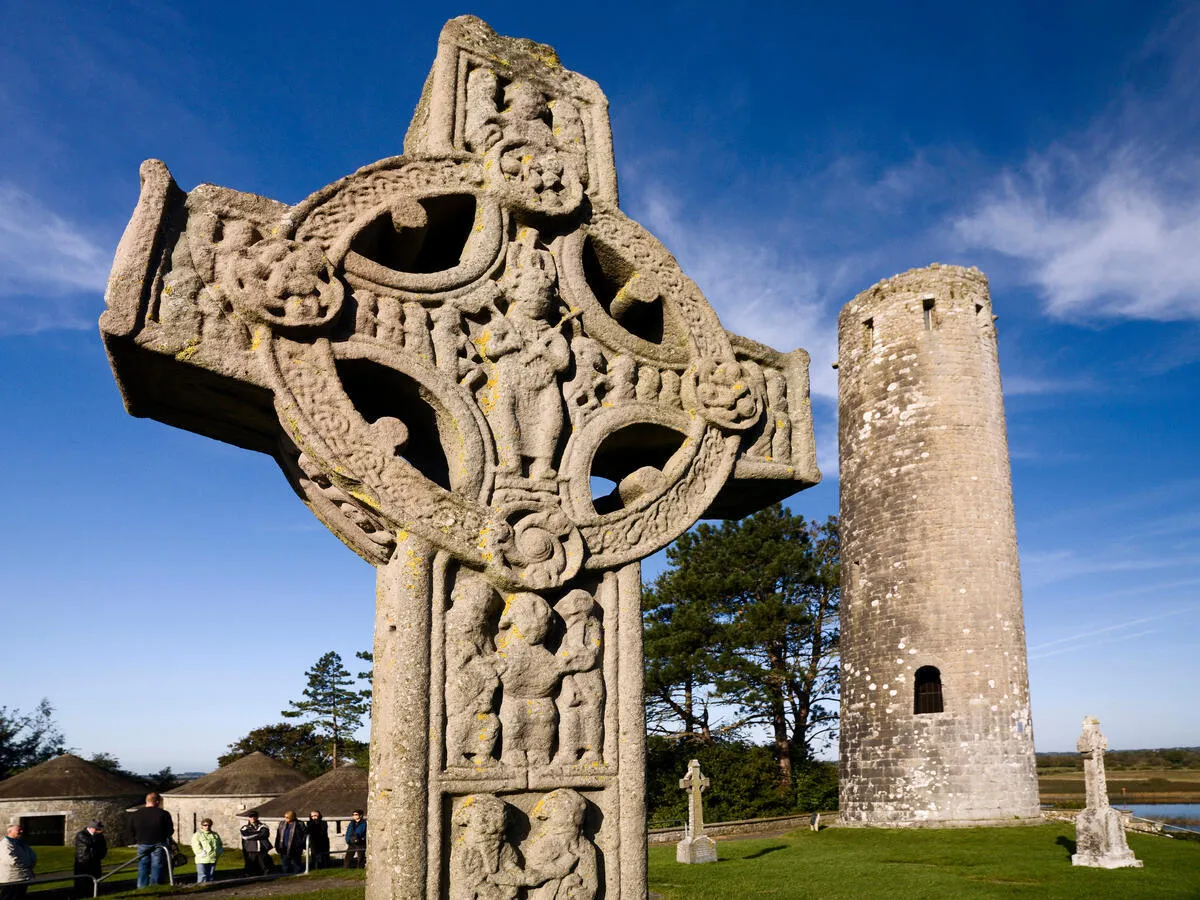
Clonmacnoise is one of those rare places where you feel the weight of Irish history the moment you arrive. Founded in 544 AD by St Ciaran on the banks of the River Shannon, it grew into one of Europe's great centres of learning, art, and faith. For centuries, monks here produced illuminated manuscripts, carved high crosses, and attracted scholars from across the continent.
The site sits on a gentle ridge above the Shannon in County Offaly, surrounded by flat bogland that stretches to the horizon. That isolation is part of the appeal - and part of the reason it survived as long as it did.
One important note for 2026: the visitor centre at Clonmacnoise is closed for renovation from March 2026. The outdoor site remains accessible, and external guided tours are available for pre-booked groups. You can still visit the ruins, round towers, and replica high crosses on the grounds. But the original high crosses and grave slabs that are normally displayed inside the visitor centre will not be viewable until the renovation is complete.
What to Expect
I grew up with a depiction of the Celtic Cross of Clonmacnoise in our house. It was just there on the wall - one of those images you absorb as a child without fully understanding what it represents. When I went to seminary at Maynooth, I had colleagues from the diocese of Ardagh and Clonmacnoise. The name was already familiar before I ever set foot on the site.
When I finally visited as a student, the place matched the image in my head. The round tower rises above the Shannon floodplain. Cathedral ruins stand open to the sky. Temple Ciaran - the tiny church said to mark the founder's burial place - is barely the size of a modern living room. Pilgrims have been visiting it for nearly fifteen hundred years.
The high crosses are the centrepiece. The Cross of the Scriptures, carved around 900 AD, is covered in biblical scenes and is considered one of the finest examples of Celtic stone carving anywhere. Normally you would see the originals inside the visitor centre, with replica crosses standing in the grounds. With the centre closed for renovation through 2026, you will only see the replicas outdoors. It is worth knowing this before you go - the originals are extraordinary, and their absence is felt.
What stays with you is the setting. Stand at the edge of the site and look across the Shannon towards the boglands of east Galway. On a quiet day - and most days here are quiet - it is not hard to imagine why Ciaran chose this spot. Remote enough for contemplation, but right on Ireland's great inland waterway for connection to the wider world.
Is It Worth It?
One of the great monastic sites of early medieval Europe, sitting on a ridge above the Shannon. St Ciaran founded it in 544 AD and it grew into a centre of learning that drew scholars from across the continent, producing illuminated manuscripts and the high crosses still standing on the site. The flat bogland running to the horizon around it is part of why it lasted. One to two hours covers the outdoor site.
The catch: the visitor centre closure is a genuine loss for 2026 visitors. The outdoor site is still extraordinary - the atmosphere, the Shannon setting, the scale of the ruins - but you are missing an important piece. Pre-booked group tours with external guides are the best way to get context during the renovation. Without a guide, bring a good guidebook.
How to Get There
Clonmacnoise is about 20 minutes south of Athlone, signposted off the R444. From Dublin, the drive takes around 1.5 hours via the M6 motorway to Athlone, then south on local roads.
A car is essential. There is no public transport to the site. The road from Athlone is well signposted but narrow in places. Free parking is available on site.
If you are based in Athlone, Clonmacnoise makes an easy morning trip. From Birr, it is about 30 minutes north. You could combine it with Birr Castle for a full day of Offaly heritage.
For visitors doing a wider Ireland loop, Clonmacnoise sits between Dublin and the west coast. It slots naturally into a route that includes Galway or the midlands driving route.
Where to Stay Nearby
There is no accommodation at Clonmacnoise itself. Athlone, 20 minutes north, has the widest range. Birr and Tullamore are also within easy reach.
Reliable hotel in the centre of Birr. Good base for exploring Offaly. Walking distance to pubs and restaurants.
Check availability →What Else is Nearby
A Note on the History
St Ciaran founded the monastery in 544 AD, choosing a spot where an ancient east-west road - the Esker Riada - crossed the River Shannon. It was a strategic choice. Within a century, Clonmacnoise had become one of the most important monasteries in Europe.
The monks produced the Book of the Dun Cow, one of the oldest surviving manuscripts in Irish. The high crosses, round towers, and stone churches were built over several centuries as the monastery grew. At its peak, Clonmacnoise was a university town in all but name.
Viking raids began in the 9th century. The Normans and English forces continued the destruction. By the 16th century, the monastery was in ruins. What survives today - the cathedral, Temple Ciaran, Temple Connor, the round tower, and the high crosses - represents the resilient core of a once-vast complex.
The Office of Public Works has managed the site since the mid-20th century. Conservation work is ongoing, including the current visitor centre renovation.
Frequently Asked Questions