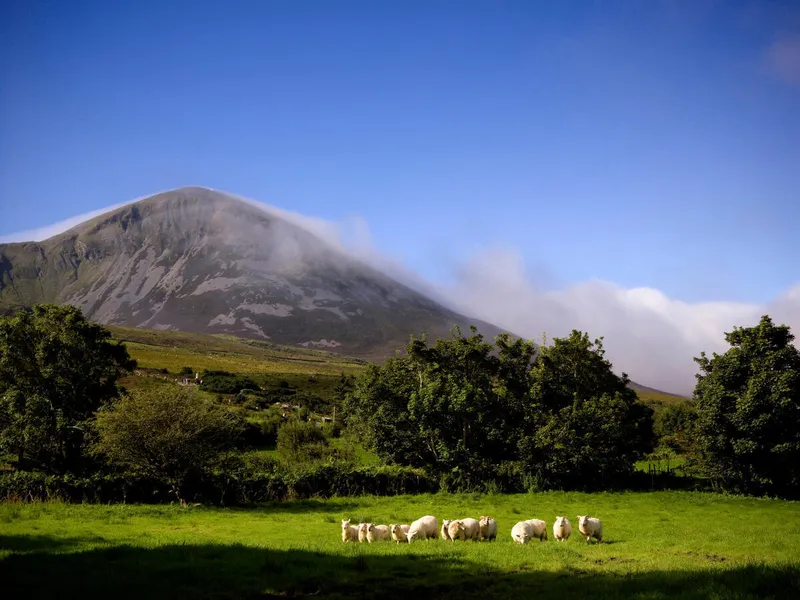
Croagh Patrick is Ireland's most climbed mountain and its most famous pilgrimage site. At 764 metres, it's not a big peak by international standards, but it dominates the landscape of County Mayo, rising in a near-perfect cone above Clew Bay. On a clear day, the summit views stretch from Achill Island to the Twelve Bens in Connemara.
Around 100,000 people climb Croagh Patrick each year. On Reek Sunday - the last Sunday of July - roughly 25,000 do it in a single day. Some climb barefoot as an act of pilgrimage. Most visitors come on ordinary days, when the mountain is quiet and the experience is far better.
The climb is not technical but it is demanding. The path is rough, rocky, and steep in the upper sections. If you're reasonably fit and wearing proper footwear, you'll manage. If you're not sure, the halfway shelf is a good turnaround point with rewarding views.
What to Expect
The climb starts from the car park at Teach na Miasa, the visitor centre at Murrisk. Pick up a walking stick if you want one - they rent for EUR 4 and are genuinely useful on the descent. The path heads directly uphill from the statue of St Patrick at the trailhead.
The first section is the easiest. A gravel path climbs steadily through farmland for about 2km to a shoulder known as the halfway shelf. This takes 40-60 minutes and gives you wide views south over Clew Bay. If you're unsure about the full climb, this is a satisfying stopping point. Many families with younger children turn around here.
Above the shelf, the terrain changes. The path steepens sharply and becomes loose rock and scree. This is where most people struggle. The final 400 metres of elevation gain is hard going - hands on rocks, slipping on loose stones, picking your way up what is essentially a rocky stream bed. It's not dangerous in dry conditions, but it is relentless.
The summit rewards the effort. A small chapel sits at the top, open only on Reek Sunday for Mass. On a clear day, you can see Achill Island to the northwest, Clare Island in Clew Bay directly below, the Twelve Bens of Connemara to the south, and on exceptional days, the mountains of Donegal to the north. It's one of the finest views in Ireland.
The descent is harder than the ascent. Loose rocks on steep ground mean careful footwork is essential. Slips and twisted ankles are common. A walking stick helps enormously. Budget more time than you think for the way down.
Weather is the main variable. Cloud rolls in fast from the Atlantic. You can start in sunshine and be in thick mist by the time you reach the upper slopes. Bring a waterproof jacket regardless of the forecast. The summit temperature is typically 8-10 degrees cooler than the base.
How to Get There
The trailhead is at Murrisk, 8km west of Westport on the R335. The drive takes about 15 minutes. There is no direct public transport to the trailhead, though taxis from Westport are straightforward and cost around EUR 15-20.
The car park at Teach na Miasa holds around 200 cars. It's pay-and-display at EUR 2.50 for four hours. On summer weekends and especially on Reek Sunday, overflow parking opens in adjacent fields. Arrive before 9am on busy days.
If you're walking or cycling from Westport, the route along the R335 has narrow verges and no dedicated footpath. It's not ideal but it's doable. The Great Western Greenway doesn't pass the trailhead directly, but Westport is the start point for both.
For visitors without their own vehicle, renting a car from Westport or Ireland West Airport Knock makes reaching the trailhead simple. Several organised tours from Westport include a Croagh Patrick stop.
Where to Stay Nearby
Westport is the nearest town with a full range of accommodation - 15 minutes from the trailhead. It's the best base for a Croagh Patrick climb, with restaurants and pubs to recover in afterwards. See the County Mayo guide for more options.
Small B&B near the Croagh Patrick car park. Run by a local family. Ideal if you want an early start without the drive from Westport.
Check availability →What Else is Nearby
A Note on the History
Croagh Patrick - known locally as the Reek - has been a place of pilgrimage for over 1,500 years. St Patrick is said to have fasted on the summit for 40 days in 441 AD. The tradition of climbing on the last Sunday of July (Reek Sunday) pre-dates Christianity. The date aligns with Lughnasa, the Celtic harvest festival, suggesting the mountain was sacred long before Patrick arrived.
The small oratory on the summit was built in 1905. Mass is celebrated there on Reek Sunday, when up to 25,000 people make the climb. Some still walk barefoot as an act of penance, a tradition that goes back centuries. Confessions are heard on the summit.
Archaeological surveys have found evidence of a hillfort enclosure on the summit dating to the Iron Age. The mountain's conical shape, visible for miles in every direction, likely made it a landmark and a ritual site long before written records began. Bronze Age artefacts have been found on the slopes.
Frequently Asked Questions