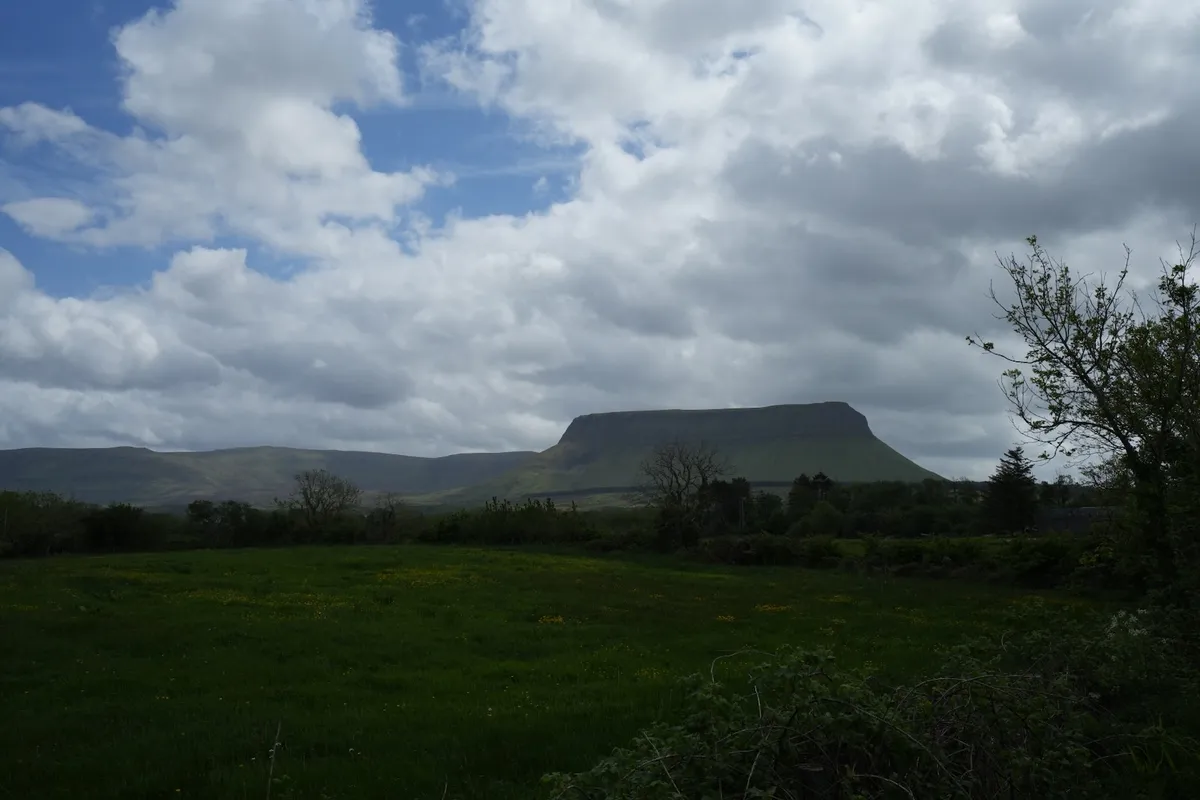
Benbulben is the mountain that defines Sligo. It rises from flat farmland like something geological that forgot to erode properly - a flat top, sheer cliff face, and a profile so distinctive you could draw it from memory after seeing it once. WB Yeats asked to be buried in its shadow at Drumcliffe churchyard. Artists have been painting it for centuries. Photographers still drive hours to catch it in the right light.
Most visitors see Benbulben from the N15 and assume that is enough. It is not. The mountain has walking routes for every fitness level - from a gentle forest loop at the base to a serious summit climb that demands respect. The views from the top stretch from Donegal Bay to the Ox Mountains. But the views from the base are nearly as good, and considerably less likely to kill you.
Benbulben sits about 10 kilometres north of Sligo town, near Drumcliffe village. You do not need to climb it to appreciate it. But you should get closer than the road.
What to Expect
The easy option is the Benbulben Forest Walk. It starts from the Benbulben Walk car park and follows a gravel forest road for about 6 kilometres in a loop. The surface is good. The inclines are gentle. You pass through mixed woodland with views up to the cliff face and out towards Sligo Bay. There is a waterfall section that adds interest. Allow 90 minutes to two hours at a comfortable pace.
The summit route is a different proposition entirely. It starts from Luke's Bridge car park, about 5 kilometres north of Drumcliffe. You follow the river valley, then climb steeply through bog and loose rock into a gully that leads to the plateau. The right side of the river is the less steep approach. Total distance is roughly 9 kilometres return with 400 metres of elevation gain.
The summit itself is extraordinary. The flat plateau is covered in bog grass and wild flowers. The views are panoramic - Donegal, Sligo Bay, Knocknarea, the Atlantic. On a clear day you can see three counties. But the edges are sheer cliff drops with no barriers. The mountain is exposed to weather. Conditions can change in minutes.
People have died on Benbulben. The summit route is not for inexperienced walkers. The terrain is boggy, steep, and poorly marked in places. Waterproof boots are essential. Bring a waterproof jacket, water, and food. Check the weather forecast before you go. If cloud is sitting on the mountain, postpone. The forest walk at the base gives you 80% of the Benbulben experience with none of the risk.
How to Get There
Benbulben is about a 15 minute drive north of Sligo town on the N15. For the forest walk, follow signs for "Benbulben Walk" - the car park is spacious and free, with room for coaches. For the summit route, continue past Drumcliffe to Luke's Bridge car park, also free.
There is no direct public transport to the trailheads. Local buses run along the N15 to Drumcliffe village, which puts you within walking distance of the forest walk start. But a car gives you flexibility to try different viewing points around the mountain.
If you are exploring Sligo without a car, a rental makes the county considerably more accessible. The mountain, the coast, and the megalithic sites are all spread across rural roads.
Where to Stay Nearby
Sligo town is the obvious base for Benbulben - 15 minutes away with restaurants, pubs, and accommodation at every price point. See the full County Sligo guide for more on where to stay.
Riverside hotel in Sligo town centre. Modern rooms, good restaurant, walking distance to everything. 15 minutes from Benbulben.
Check availability →What Else is Nearby
A Note on the History
Benbulben is a table mountain formed during the Ice Age. The distinctive shape comes from a limestone cap sitting on softer shale. Glaciers carved the cliffs and left the flat summit. The mountain is part of the Dartry range and stands 526 metres high.
In Irish mythology, Benbulben is where the warrior Diarmuid was killed by a wild boar - part of the Fenian Cycle. Yeats wove the mountain into his later poetry. His epitaph at Drumcliffe references it directly. The combination of geological drama and literary association gives the mountain a weight that goes beyond scenery.
Frequently Asked Questions