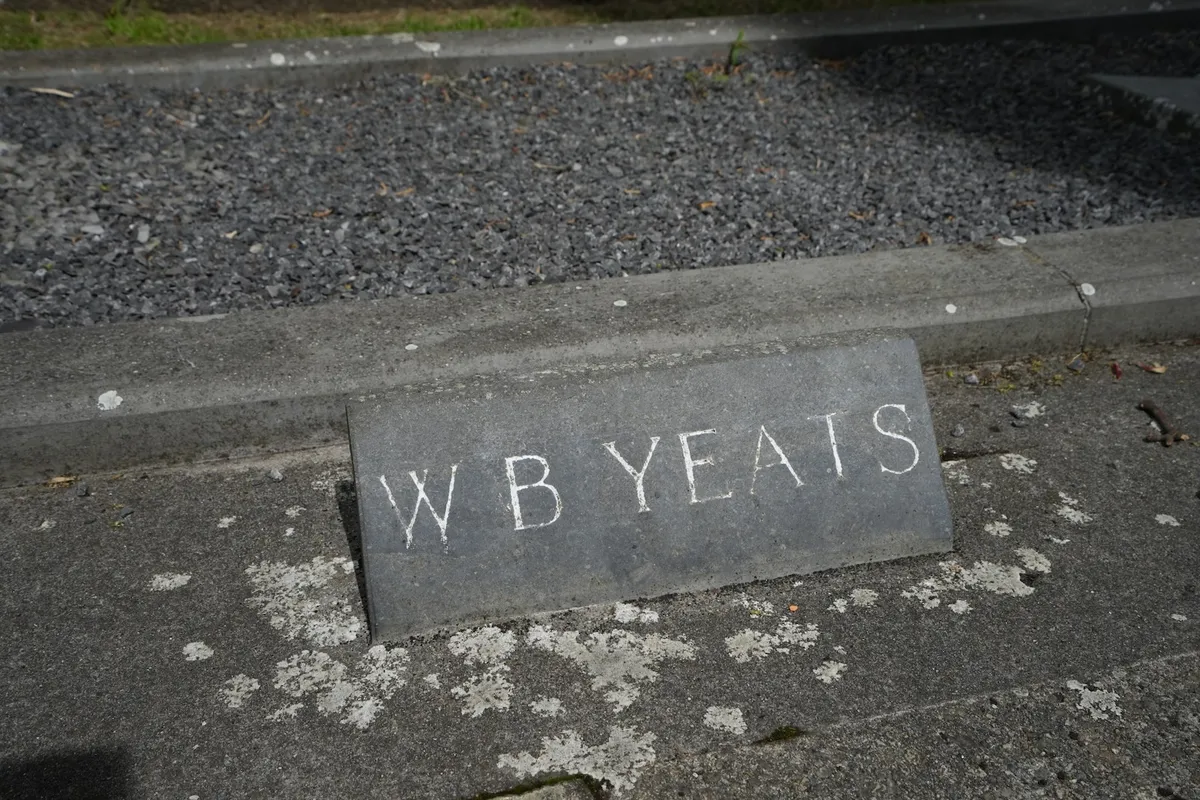
Drumcliffe is a small village on the N15, eight kilometres north of Sligo town. Its churchyard holds the grave of WB Yeats - Nobel laureate, senator, and the poet who made Benbulben famous. He chose this spot deliberately. His great-grandfather was rector here. The mountain he spent a lifetime writing about rises directly behind the church.
The visit takes five to ten minutes. You walk through the gate, find the grave on the left, read the epitaph, look up at Benbulben, and leave. But those few minutes carry weight if you know even a handful of the poems. The view from the grave is the view Yeats chose as his last.
The churchyard also has a 10th-century high cross with remarkable carvings and the stump of a round tower. There is more here than the grave, even if the grave is why most people stop.
What to Expect
The grave is immediately to the left of the church entrance. You will see other visitors gathered around it. The headstone is plain limestone - Yeats's instructions specified "no marble, no conventional phrase." The epitaph is from his poem Under Ben Bulben:
Cast a cold eye / On life, on death. / Horseman, pass by!
His wife Georgie is buried beside him. The grave is simple and understated. It does not announce itself. You have to know it is there or read the sign by the gate.
The high cross stands near the church entrance. It dates to about 1000 AD and has biblical carvings on both faces - the Crucifixion on one side, Daniel in the lions' den on another. The detail is fine for a cross that has been standing outdoors for over a thousand years. Across the road, the round tower stump is all that remains of the original monastery. Lightning struck it in 1396.
Drumcliffe Tea House is next to the car park. It does good scones and coffee. The Teach Ban gallery next door sells crafts and local art. You could stretch the visit to 30 minutes with a cup of tea and a look around.
Is It Worth It?
Ten minutes, no charge, and Benbulben standing directly behind the headstone. WB Yeats chose Drumcliffe deliberately: his great-grandfather was rector here, and the mountain he spent a lifetime writing about rises straight up behind the church. The grave is on the left inside the gate with the epitaph he wrote for it. There is a tea house and a gallery beside the churchyard, the paths are flat gravel and wheelchair accessible, and it is eight kilometres north of Sligo on the N15.
The catch: this is a five-minute stop that some visitors find underwhelming. The grave is small. The churchyard is ordinary. If you do not care about Yeats or Irish poetry, it will mean little. But if you do care, standing at that grave with Benbulben behind it is one of the most evocative five minutes in Ireland.
How to Get There
Drumcliffe is on the N15, eight kilometres north of Sligo town. The drive takes 10 to 15 minutes. The car park is right beside the churchyard. Parking is free, though some visitors report a small donation requested at a nearby kiosk.
Local buses along the N15 pass through Drumcliffe. The stop is adjacent to the church. Ask the driver for Drumcliffe Church - they will know.
Where to Stay Nearby
Drumcliffe is too small for overnight stays. Sligo town is the nearest base, 15 minutes away. See the County Sligo guide for accommodation options.
Sligo town riverside hotel. Best base for the county. Drumcliffe is a 15 minute drive.
Check availability →What Else is Nearby
A Note on the History
St Colmcille founded a monastery at Drumcliffe in 575 AD. It became an important ecclesiastical centre. The high cross and round tower date from around the 10th and 11th centuries. The monastery declined after the medieval period and the current Church of Ireland church was built on the site in 1809.
Yeats died in Menton, France, in January 1939. His remains were repatriated to Ireland in 1948 and buried at Drumcliffe in a ceremony attended by his family and the Irish government. There is some historical debate about whether the correct remains were returned - wartime France made the logistics complicated - but the grave is accepted as his final resting place.
Frequently Asked Questions