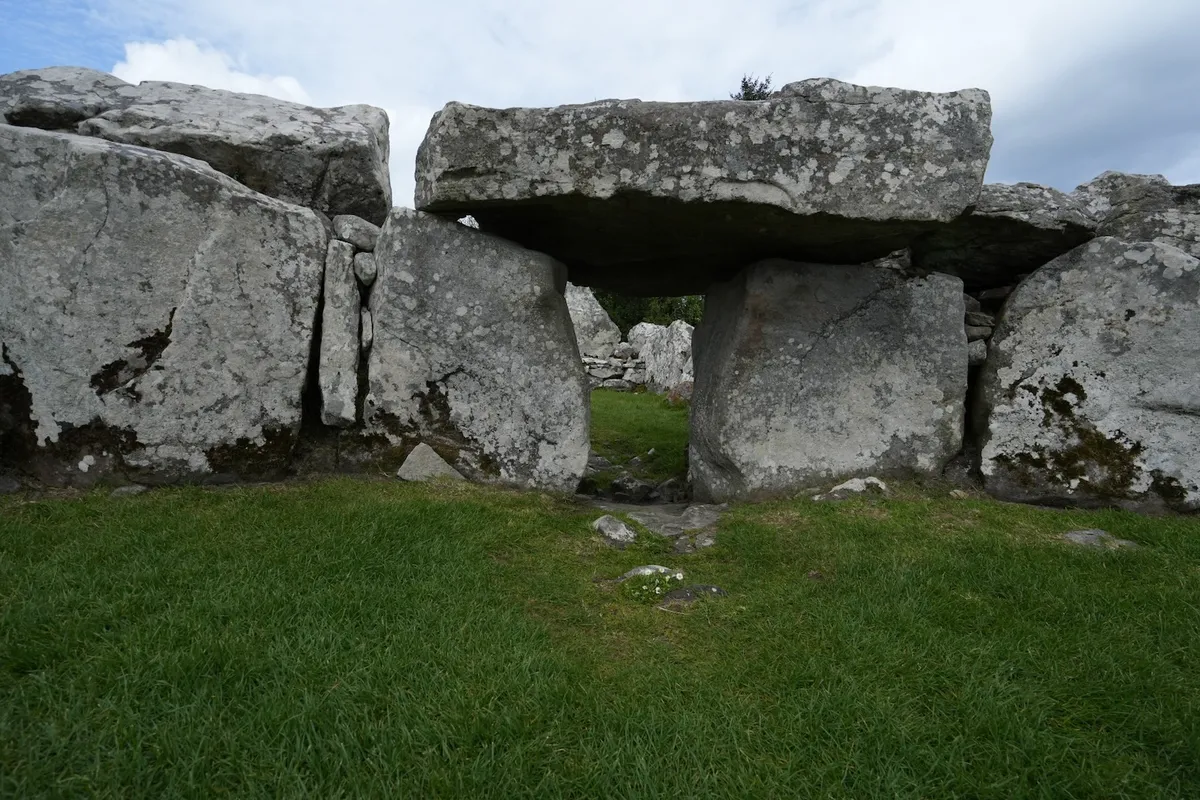
Carrowmore is one of the largest and oldest megalithic cemeteries in Europe. Over 30 passage tombs sit in open fields at the foot of Knocknarea, with Queen Maeve's Cairn watching from the summit above. The tombs date to around 3700 BC - older than Newgrange, older than the Egyptian pyramids, older than most things humans have built anywhere.
This is not a reconstructed visitor attraction. The tombs stand in grass fields exactly where Neolithic communities placed them over 5,000 years ago. You walk between them on grassy paths with Knocknarea above and Benbulben in the distance. The setting does most of the work.
Carrowmore is 4 kilometres southwest of Sligo town, off the R292 towards Strandhill. It is an OPW heritage site with a small visitor centre.
What to Expect
The visitor centre is a restored cottage with an exhibition explaining the site's significance. It is modest in size but well done. The OPW staff run guided tours of about 45 minutes that are worth taking. They cover the archaeology, the alignment theories, and the relationship between Carrowmore and the surrounding landscape. Without the tour, you will miss most of what makes the site important.
The tombs themselves are stone circles and dolmens scattered across several fields. Some are simple boulder circles. Others have capstones. The central tomb, Listoghil, has been partially reconstructed and is the largest on the site. The rest are open and unprotected - you can walk right up to them.
The scale takes a moment to register. These are not one or two monuments. There are over 30 surviving tombs here, and archaeologists estimate there were originally 60 to 100. The density is remarkable. This was a ritual landscape used for over a thousand years.
Allow at least an hour. The guided tour takes 45 minutes and walking between the outer tombs adds another 20 to 30 minutes. Wear sturdy shoes - the ground is uneven grass and can be wet.
Is It Worth It?
EUR 5 and an hour buys you something 5,700 years old standing in an open field. Over 30 passage tombs sit at the foot of Knocknarea with Queen Maeve's Cairn on the summit above and Benbulben in the distance, dating to around 3700 BC, which puts them ahead of Newgrange and well ahead of the pyramids. Nothing here has been reconstructed. It is four kilometres from Sligo town and open mid-March to early November.
The catch: the site is more atmospheric than spectacular. If you are expecting the drama of Newgrange with its passage, chamber, and winter solstice alignment, Carrowmore is quieter and less immediately impressive. The tombs are smaller and simpler. The power is in the setting and the age. Come for the landscape and the history, not for a wow moment.
How to Get There
Carrowmore is about 4 kilometres southwest of Sligo town. Take the R292 towards Strandhill and follow the brown heritage signs. The drive takes about 8 minutes. The car park is free and rarely full outside of peak summer weekends.
There is no direct public transport to the site. From Sligo town, a taxi costs around EUR 10 each way. You could cycle it on quiet roads in about 15 minutes.
Where to Stay Nearby
Sligo town is the natural base for visiting Carrowmore - eight minutes away with full accommodation options. See the County Sligo guide for recommendations.
Modern riverside hotel in Sligo town. Good restaurant, central location, 8 minutes from Carrowmore.
Check availability →What Else is Nearby
A Note on the History
Carrowmore is part of a wider Neolithic ritual landscape centred on Knocknarea and the Cuil Irra peninsula. The passage tombs here belong to the same tradition as Newgrange and Knowth in the Boyne Valley, but Carrowmore may be older. Carbon dating suggests some monuments were built as early as 3700 BC.
The cemetery is on Ireland's Tentative UNESCO World Heritage List alongside the wider Sligo passage tomb complex. Archaeologists from NUI Galway have been studying the site for decades. The relationship between Carrowmore on the lowland and the cairn on Knocknarea above suggests a deliberate landscape design - the living down here, the dead up there.
Frequently Asked Questions