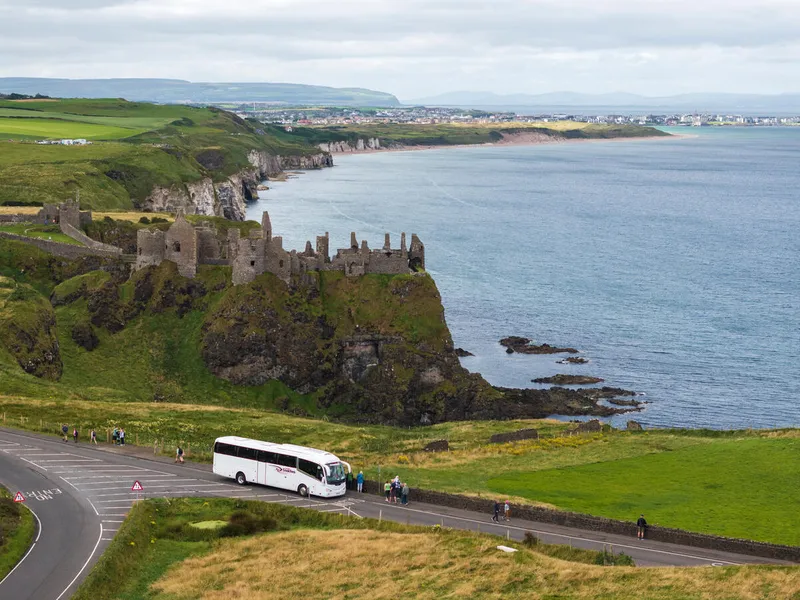
Dunluce Castle sits on a basalt outcrop above the Atlantic, separated from the mainland by a deep chasm. The kitchen fell into the sea in 1639 - and the servants with it. That single detail tells you everything about this castle's relationship with the elements. Built on the edge, literally and figuratively.
The ruins are among the most dramatically sited in Ireland. Walls rise from the cliff edge, rooms open onto sheer drops, and the Atlantic crashes against the rock below. Game of Thrones used it as inspiration for House Greyjoy's Pyke. The castle is small but the setting is everything.
What to Expect
The castle sits across a narrow chasm from the mainland. You cross a bridge to reach the entrance - the same gap that defenders once used as a natural moat. Inside, the layout is compact. The great hall, kitchen site, towers, and living quarters are all readable as ruins. Information boards explain what each area was.
The seaward side is the most dramatic. The outer wall sits right on the cliff edge with the Atlantic visible through gaps in the stonework. The kitchen that fell into the sea was on this side. You can see where the cliff face has eroded away, taking part of the castle with it. The remaining structure feels temporary in geological terms.
Below the castle, archaeological excavations have uncovered a 17th-century merchant town that was previously unknown. The town extended along the cliff base and sheltered bay. Finds included pottery, coins, and evidence of a thriving trading community.
Is It Worth It?
Worth the stop, and it takes less time than you would expect. GBP 6 and 45 minutes to an hour gets you ruins on a basalt stack above the Atlantic, reached by a bridge across the chasm that cuts the castle off from the mainland. It is the most dramatically sited castle in Ireland, the reason Game of Thrones borrowed it for Pyke, and the place where the kitchen went into the sea in 1639 and took the servants with it.
The catch: Dunluce is genuinely small. 45 minutes is plenty unless you are a photographer or particularly interested in the history. The interpretation is minimal - information boards but no audio guide and no in-depth displays. If you are expecting a grand castle experience, this is not it. The value is in the setting and the atmosphere, not the scale.
How to Get There
Dunluce Castle is on the A2 between Portrush and Bushmills, about 5 minutes from either. From Belfast, it is approximately one hour via the A26. The castle is well signposted from the road.
The 172 bus between Coleraine and the Giant's Causeway stops nearby. Most Causeway coast day tours from Belfast include a stop or photo opportunity here. By car, it combines easily with the Causeway (10 minutes) and Bushmills Distillery (5 minutes).
Where to Stay Nearby
Bushmills and Portrush are both 5 minutes away. Bushmills is quieter and more characterful. Portrush is livelier with more dining options. The County Antrim hub covers all options.
Historic coaching inn 5 minutes from the castle. Turf fires, gas lamps, and the best restaurant on the Causeway coast.
Check availability →What Else is Nearby
A Note on the History
Dunluce was built in the 13th century and changed hands violently between the McQuillan and MacDonnell clans. The MacDonnells held it from the 16th century and used Spanish Armada cannon - salvaged from the wreck of the Girona in 1588 - to defend it. The Girona sank nearby and its treasure is now in the Ulster Museum in Belfast.
The castle's decline began on a stormy night in 1639 when part of the kitchen collapsed into the sea, reportedly killing several servants. The Countess of Antrim refused to live there after that. By the 1700s the castle was abandoned. The ruins have been a romantic landmark on the Antrim coast ever since.
Frequently Asked Questions