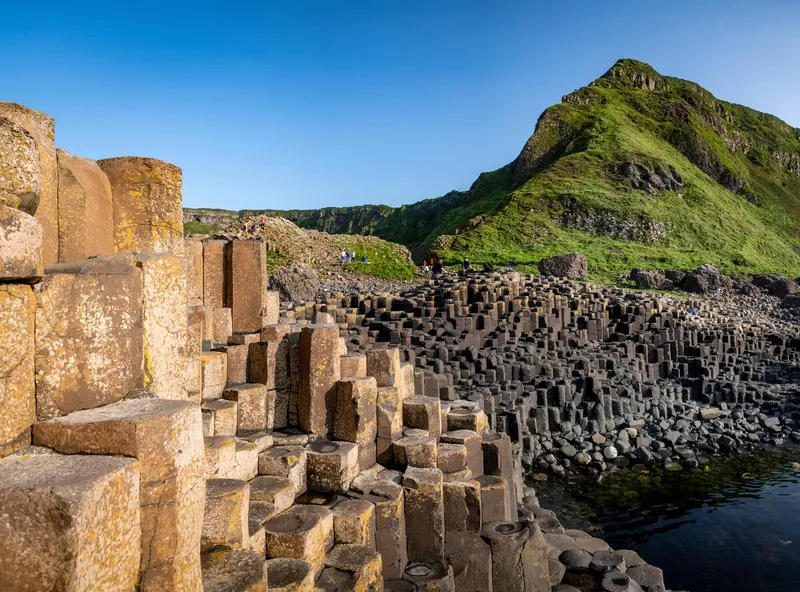
The Giant's Causeway is 40,000 interlocking basalt columns on the north Antrim coast. They formed 60 million years ago when volcanic lava cooled and cracked into hexagonal pillars. The result looks engineered. It is not. It is geology doing something that seems impossible.
This is Ireland's most visited natural attraction and a UNESCO World Heritage Site since 1986. The columns are smaller than you expect from the photographs, but the scale of the headland is bigger. The trick is getting past the main formation where the crowds thin out. The coastal path beyond the columns is where the Causeway becomes genuinely impressive.
What to Expect
From the visitor centre, a steep tarmac path leads down to the stones. The alternative is a shuttle bus, but the queue can be 30 minutes or more in summer. The walk down takes about 15 minutes and the views open up gradually as you descend.
The main formation is the cluster of columns at sea level that appears in every photograph. The hexagonal tops form an uneven pavement you can walk across. The columns range from a few centimetres to about 12 metres tall. They fit together with geometric precision - no mortar, no gaps, just cooled lava doing mathematics.
The real reward is walking past the main formation. The coastal path continues east along the cliff base toward the Shepherd's Steps. The rock formations change character every few hundred metres - organ pipes, chimneys, amphitheatres carved by the sea. The crowds drop off sharply once you pass the main columns. By the time you reach the Shepherd's Steps, you might have the path to yourself.
The Shepherd's Steps climb back up to the cliff top and loop back to the visitor centre. The full circuit takes about 90 minutes at a comfortable pace with stops.
Is It Worth It?
It depends what you think you are paying for. GBP 13.50 buys the headland rather than the stones alone. National Trust members go free. Forty thousand basalt columns, cracked into hexagons when volcanic lava cooled 60 million years ago, and a UNESCO World Heritage Site since 1986. Allow an hour and a half to two hours, and more if you take the coastal path beyond the main formation.
The catch: the shuttle bus queue can be 30 minutes or more in summer and the main formation gets overwhelmingly crowded by 11am. The columns themselves are smaller than the photographs suggest. If you arrive at midday in July and only see the main formation, you will wonder what the fuss was about. Arrive early, walk past the crowds, and the Causeway earns its reputation.
How to Get There
The Giant's Causeway is about one hour from Belfast via the A26. From Bushmills, it is a 5-minute drive. The visitor centre is well signposted from all directions.
There is no train station at the Causeway. The nearest station is Coleraine, from where the 172 bus runs to the site. The seasonal Antrim Coaster bus runs from Belfast along the coast road. A car gives you the most flexibility for combining the Causeway with nearby sites.
Where to Stay Nearby
Bushmills is the natural base - a small town 5 minutes from the Causeway with good accommodation and the famous distillery. The County Antrim hub covers all options along the coast.
Historic coaching inn near the distillery. Turf fires, gas lamps, and a restaurant that takes local ingredients seriously. The best place to stay on the Causeway coast.
Check availability →What Else is Nearby
A Note on the History
Legend says the giant Finn McCool built the Causeway as a bridge to Scotland to fight his rival Benandonner. The Scottish end exists too - identical columns on the island of Staffa. The geological explanation is less dramatic but equally remarkable: a volcanic eruption 60 million years ago sent lava flowing across the landscape, and as it cooled it contracted into these hexagonal columns.
The Causeway became a UNESCO World Heritage Site in 1986. The National Trust has managed the site since 1961. The visitor centre was rebuilt in 2012 after the previous one was destroyed by fire in 2000.
Frequently Asked Questions