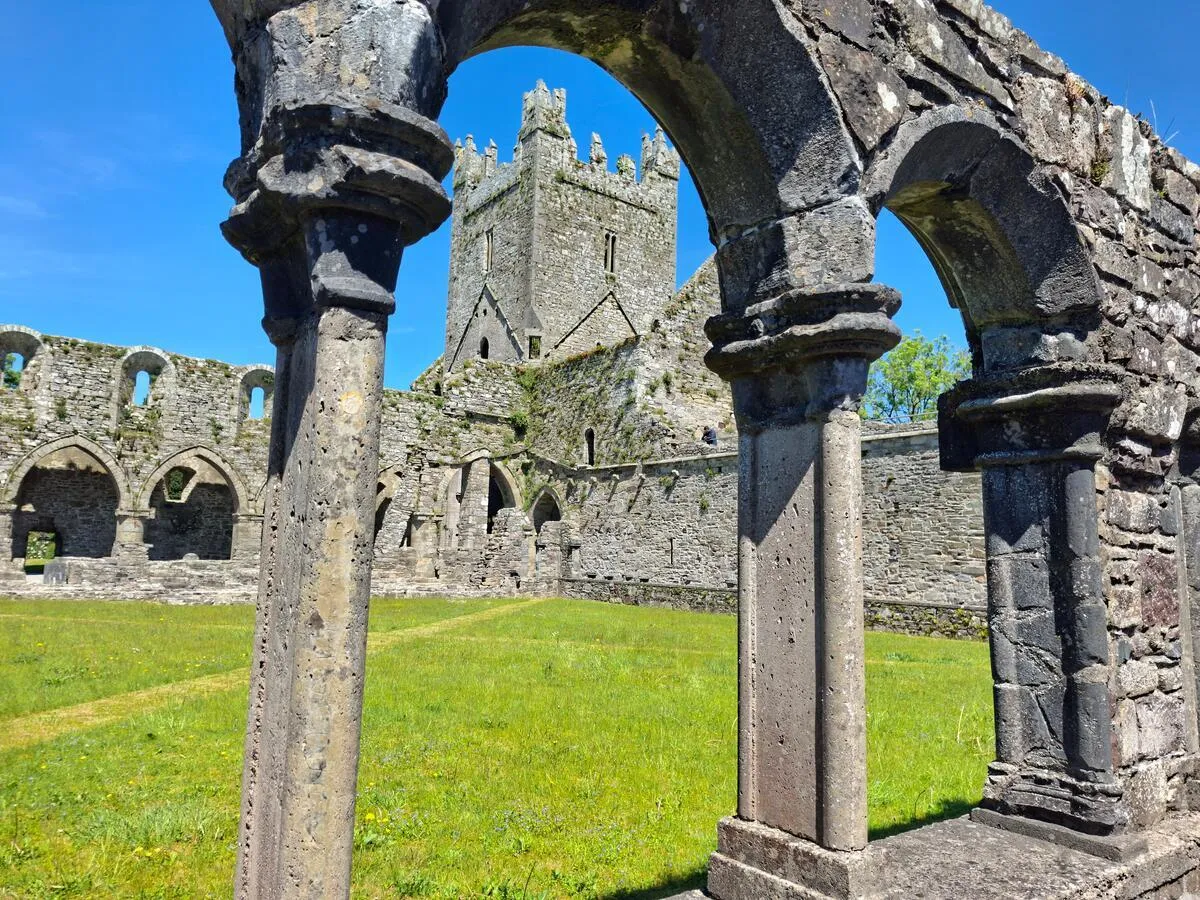
Jerpoint Abbey is one of Ireland's most complete medieval monasteries. Founded around 1160 by the Cistercians, it sits in farmland just outside Thomastown in south County Kilkenny. While it does not have the dramatic clifftop setting of some Irish ruins, what it does have is extraordinary stonework - particularly in the cloister, where 15th-century carvings have survived in remarkable detail.
This is a site that rewards a guided tour. The carvings depict knights, bishops, dragons, and everyday figures, and a guide will point out details you would walk past on your own. The abbey is managed by the OPW and is free with a Heritage Card.
If you are driving through Kilkenny, Jerpoint is an easy 20-minute detour from the city. Combine it with a stop in nearby Inistioge for a rewarding half-day in the Kilkenny countryside.
What to Expect
The abbey is approached through a small visitor centre where you buy tickets and can join a guided tour. The tours run regularly and are included in the entry price. Take one - the carvings are the reason to come here, and without a guide you will miss much of their meaning.
The Cloister Carvings
The cloister arcade is the centrepiece. Cistercian monasteries were typically austere - the order's rules discouraged decorative stonework. Jerpoint is the exception. The 15th-century carvings on the cloister pillars are among the finest in Ireland, depicting saints, knights in armour, mythical beasts, and ordinary people in medieval dress.
Look for the figure known as the "Green Man" - a human face with foliage growing from its mouth, a motif found across medieval European churches. There are also dragon figures, bishops with crosiers, and what appear to be tradespeople. The level of detail is surprising given the exposed position - these carvings have been open to Irish weather for 500 years.
The Church and Tower
Beyond the cloister, the church itself has a cruciform plan with a crossing tower. The chancel (east end) has fine lancet windows and carved tomb surrounds. Some of the floor tombs have worn but readable inscriptions. The tower is not climbable, but you can see the original stone staircase through a doorway.
The transepts contain tomb effigies - stone figures lying in full armour or clerical dress. These are Butler family tombs, and they give a tangible sense of the local power that supported the monastery for centuries.
The Grounds
The abbey sits in a walled enclosure with open fields beyond. After the interior, take a walk around the exterior walls to see the full scale of the complex. The south wall and east window are best photographed in morning light. The setting is peaceful - a working farm surrounds the site, and you may have the place largely to yourself outside summer weekends.
Is It Worth It?
EUR 5, or nothing on an OPW card, for the best cloister carvings in Ireland. Jerpoint was founded around 1160 and Cistercian houses were meant to be austere, which makes this one the exception: the 15th-century pillars carry saints, knights in armour, dragons, bishops and ordinary people in medieval dress, including a Green Man with foliage growing out of his mouth. Guided tours are included in the ticket and are the reason to come. Open March to November, an hour on your own or one to two with a guide.
One practical note: there is no cafe at Jerpoint, so bring water and a snack if you are visiting on a day trip. Thomastown, two kilometres north, has cafes and a few restaurants.
How to Get There
Jerpoint Abbey is 2 km south of Thomastown on the N9. If you are coming from Kilkenny city, it is a straightforward 20-minute drive south. The abbey is signposted from the main road, and the car park is right at the entrance.
From Dublin, allow about two hours via the M9 to Kilkenny and then south on the N9. From Waterford, it is about 40 minutes heading northwest. The site is easy to combine with Inistioge (10 minutes east) or a return to Kilkenny city for lunch.
A car is really the only practical way to reach Jerpoint. There is no regular public transport to the abbey itself, though Thomastown has a train station on the Dublin-Waterford line. From the station, it is a 25-minute walk or a short taxi ride. If you are planning a day in the Kilkenny countryside, renting a car makes the logistics much easier.
What Else is Nearby
A Note on the History
Jerpoint was founded around 1160 as a Benedictine house and became Cistercian in 1180. It grew rapidly under the patronage of the Butler family, becoming one of the wealthiest monasteries in the region. At its peak, the community supported monks, lay brothers, and a substantial farming operation on the surrounding land.
The monastery was suppressed during Henry VIII's dissolution in 1540. Unlike many Irish monastic sites that were demolished for building material, Jerpoint survived largely because the land passed to the Ormond Butlers, who left the buildings standing. Centuries of neglect followed, but the robust construction - thick walls and quality limestone - kept the structure intact.
The 15th-century cloister carvings are the abbey's most puzzling feature. Cistercian rules explicitly prohibited decorative sculpture. The carvings suggest either a relaxation of the rules by that period, or a community that had drifted from the order's founding principles. Either way, they are among the most important medieval stone carvings in Ireland and are the main reason the site attracts archaeology and art history scholars from across Europe.
Frequently Asked Questions