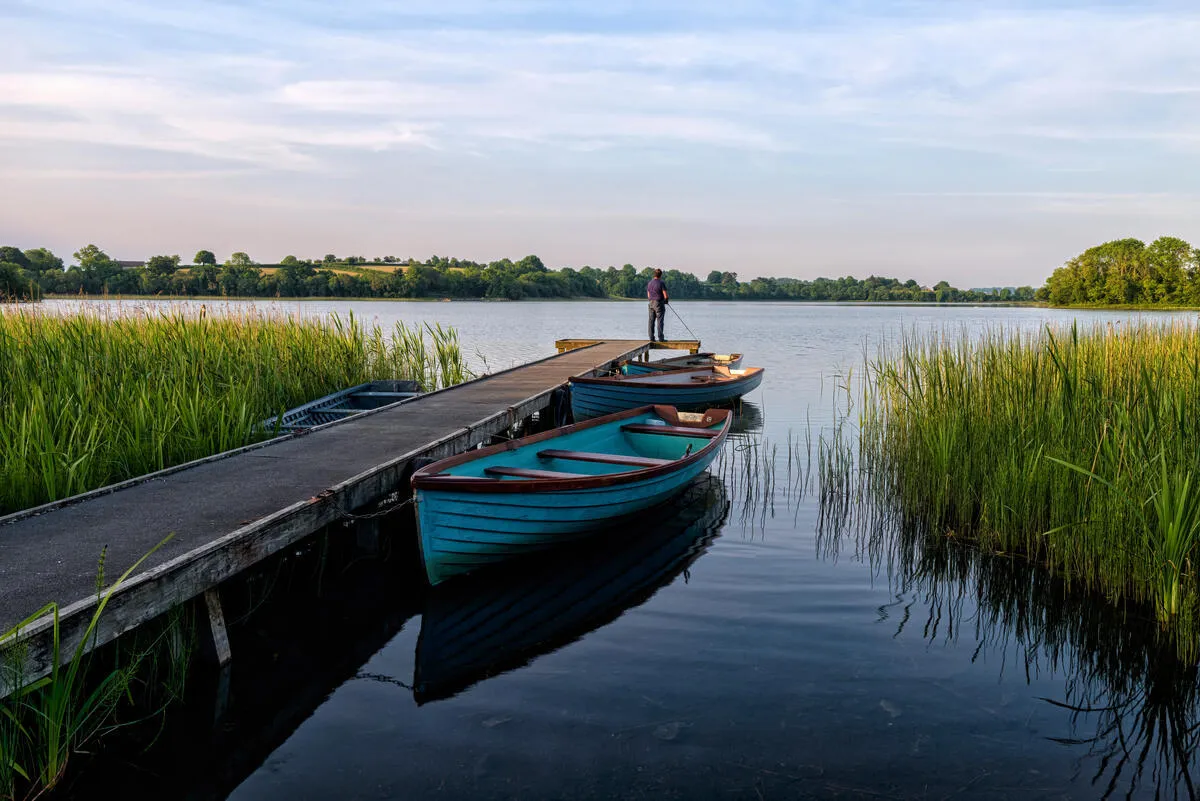
Lough Erne is not one lake but two - Upper and Lower - connected by the River Erne as it flows through Enniskillen. Together they dominate County Fermanagh so completely that the county is more water than land. A third of Fermanagh's surface is lake, river or bog. That is not a tourism board stat. You can see it from any hilltop.
Most people who visit Fermanagh come for the Fermanagh Lakelands and barely scratch the surface. They drive to Enniskillen, look at the water, maybe visit the castle, and leave. The real draw is out on the water itself - over 150 islands scattered across both lakes, some with monastic ruins dating to the sixth century, others with nothing but cormorants and silence.
I'd argue Lough Erne is one of the most underrated landscapes on the island of Ireland. It does not have the drama of the Atlantic coast or the fame of Killarney's lakes. What it has is space, quiet and a depth of history that rewards anyone willing to get on a boat.
What to Expect
The two lakes have very different characters. Lower Lough Erne is the larger and more dramatic of the pair, stretching northwest from Enniskillen towards Belleek. It is wide, open and dotted with islands. On a calm day the water reflects the drumlins and the sky so cleanly you cannot tell where one ends and the other begins. On a rough day - and there are plenty - the wind whips across the surface hard enough to cancel boat trips.
Upper Lough Erne is the quieter sibling. It sits south of Enniskillen and feels more like a flooded maze than a lake. Channels weave between small islands and reed beds. If you have a kayak or a small boat, this is where you want to be. The birdlife is exceptional and you can paddle for hours without seeing another person.
The main way to experience Lower Lough Erne is by boat. Erne Tours runs the MV Kestrel from the Round O Jetty in Enniskillen, a 48-seat cruise boat that heads downriver and across to Devenish Island. The commentary is good and the stop at Devenish gives you time to climb to the round tower and walk the monastic ruins. Budget 90 minutes for the full trip.
Erne Water Taxi offers something more flexible - private guided tours in covered 8 or 12-seater boats where you can choose your route. If you want to visit White Island to see the carved figures, or land on one of the smaller islands, this is the way to do it. They also run the Island Discovery, an all-electric pontoon boat for shorter trips along the river.
For those who stay on dry land, Castle Archdale Country Park on the north shore of Lower Lough Erne is the best starting point. The walks along the lakeshore pass a deer park, wildfowl ponds and a butterfly garden. The park also has a small museum covering its role as a Second World War flying boat base - more on that below.
The catch is the weather. Fermanagh is one of the wettest parts of Northern Ireland and the lakes amplify the wind. Summer midges near the water can be brutal in the evenings, particularly around Upper Lough Erne. Facilities on the islands are non-existent - no toilets, no shelter, no water. Bring what you need and wear layers even in July.
The other thing to know is that signage between the two lakes can be confusing. Upper Lough Erne is actually south of Lower Lough Erne, because the names refer to the River Erne direction of flow, not their position on a map. This trips up almost every first-time visitor. Just remember: Lower is bigger and further north. Upper is smaller and further south.
How to Get There
Enniskillen is the gateway to both lakes and sits right between them. From Belfast, take the M1 westbound and then the A4. The drive is 83 miles and takes about 90 minutes with no stops. It is motorway for the first half, then good dual carriageway through Dungannon and on to Enniskillen.
From Dublin, head north on the M3 towards Cavan, then follow the N3 through Belturbet where the road becomes the A509 Derrylin Road. This brings you into Enniskillen from the south. The journey is roughly 165 kilometres and takes around two hours and fifteen minutes. The last stretch through the drumlin country is attractive but slow - single carriageway with limited overtaking.
There is no rail service to Enniskillen. Bus Eireann and Translink run services from Dublin and Belfast respectively, but once you are in Fermanagh you really need a car to explore the lakeshores. The key sites - Castle Archdale, Boa Island, Crom Estate - are spread across 50 kilometres of shoreline. If you are flying into Belfast or Dublin and need wheels, it is worth comparing car hire prices before you arrive.
For Lower Lough Erne access, Castle Archdale is on the B82, about 15 minutes northwest of Enniskillen. The Round O Jetty for boat tours is right in Enniskillen town centre. For Upper Lough Erne, head south on the A509 towards Crom Estate, about 25 minutes from town.
Where to Stay Nearby
Enniskillen is the obvious base for exploring both lakes. It has the best range of accommodation, restaurants and is within 20 minutes of every major site around the lough. For the full rundown of where to stay in the county, see the Fermanagh guide.
On a 600-acre peninsula between Castle Hume Lough and Lower Lough Erne. Two championship golf courses including the Faldo Course, a Thai spa with infinity pool, and the Catalina Restaurant. It is the best hotel in Fermanagh by a distance.
Check availability →What Else is Nearby
A Note on the History
Lough Erne's islands have been sacred ground for thousands of years. Long before Christianity arrived, the people who carved the Janus figures on Boa Island were using these islands as ritual sites. The two-faced stone figure in Caldragh graveyard is over 2,000 years old and nobody is entirely sure what it represents. Badhba, the Celtic goddess of war, gave Boa Island its name.
In the sixth century, Christian monks established monasteries on several islands. Devenish became the most important - a major centre of scholarship on a pilgrim route to Croagh Patrick. At its peak, up to 1,500 scholars lived and worked there. Vikings raided it in 837. It burned in 1157. The round tower, one of the finest in Ireland, survived both.
The lakes saw action again during the Second World War. Castle Archdale on the north shore of Lower Lough Erne became the most westerly flying boat station in the United Kingdom. Catalina and Sunderland flying boats flew from here across the Atlantic to protect convoys from U-boats. A Catalina from Castle Archdale helped locate the Bismarck in 1941. The aircraft flew out over neutral Ireland via a secret agreement known as the Donegal Corridor. The Irish government quietly permitted the flights while officially maintaining neutrality.
Frequently Asked Questions