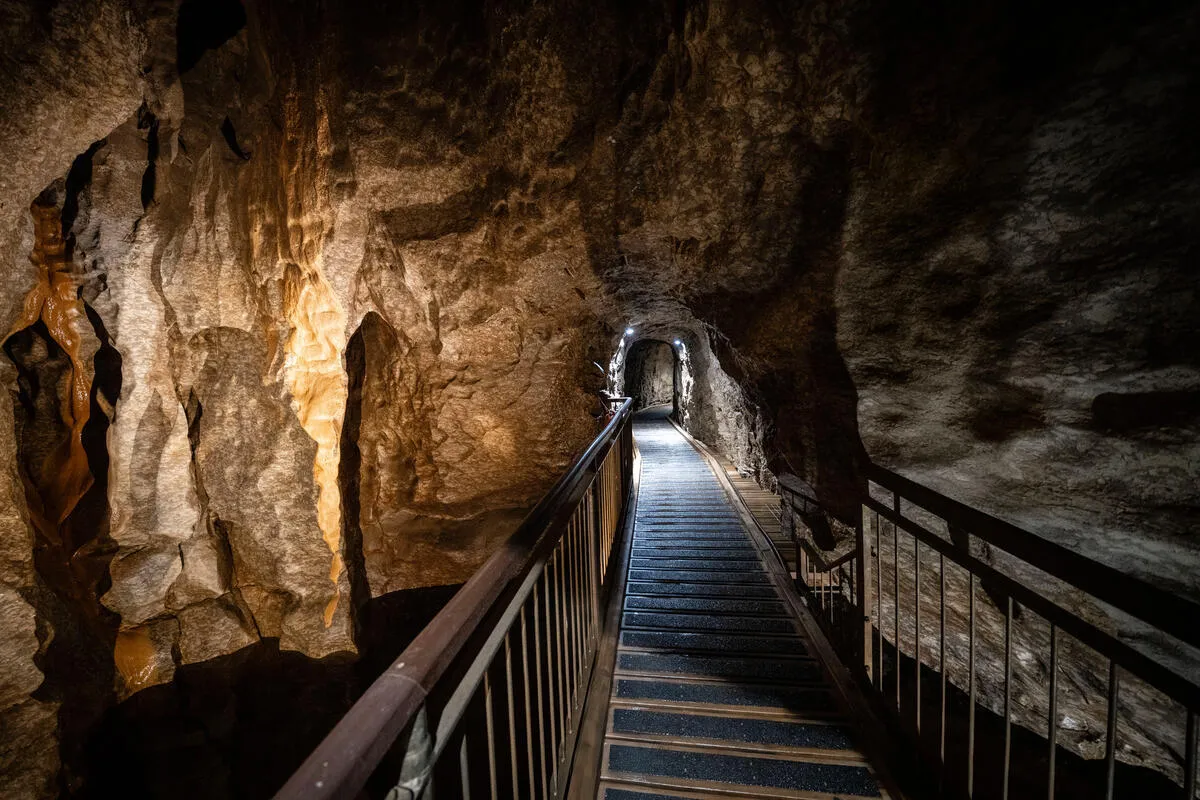
Marble Arch Caves is the best show cave in Ireland. That is not marketing - it is a geological fact backed by UNESCO Global Geopark status. The cave system sits in southwest County Fermanagh, where three rivers disappear underground and carve through 340-million-year-old limestone before emerging at the Cladagh Glen.
Most visitors underestimate two things. First, the 154 steps. There is no lift, no shortcut, and no wheelchair access. If stairs are a problem, this is not the trip for you. Second, the cave sits at 9-10°C year-round. People arrive in July wearing t-shirts and spend 75 minutes shivering.
The tour covers 1.5 kilometres and includes an underground boat ride on a subterranean river. You walk past stalactites, stalagmites, and flowstone formations that took millions of years to build. Group sizes cap at 21, so booking ahead is not optional during summer. After heavy rain the cave floods and closes without notice. Always check before you drive out.
What to Expect
The tour starts at the visitor centre, where your guide briefs the group on what to expect. You get a hard hat. No helmets with lights - the cave is fully lit with electric walkways throughout. The first stretch descends concrete steps into the gorge where the Cladagh River vanishes underground.
You board a flat-bottomed boat on the underground river. The ceiling drops low in places - not claustrophobia-inducing, but you notice it. The water is black and still. Your guide poles the boat forward while pointing out formations overhead. This section lasts about ten minutes and it is the highlight for most visitors.
After the boat, you walk. The path winds through chambers connected by narrow passages. Stalactites hang from every ceiling. Some are thin as drinking straws. Others are thick columns where stalactites and stalagmites have met and fused over thousands of years. The flowstone cascades look like frozen waterfalls. There is an actual waterfall inside the cave too - you hear it before you see it.
The temperature stays at 9-10°C regardless of the season. Bring a jacket even in August. The air is damp and the walkways can be slippery. Wear shoes with grip, not sandals.
The 154 steps are spread across the full route, not concentrated in one climb. But they add up. If you have knee problems or breathing difficulties, this tour will be hard work. There is no option to skip sections or turn back early once you are underground. The guide sets the pace for the group.
Back above ground, do the Cladagh Glen nature trail. It is free and most people skip it, which is a mistake. The trail follows the river through old-growth woodland where the water re-emerges from the cave system. The contrast between the dark underground and the green canopy above is worth the extra 30-40 minutes.
Is It Worth It?
GBP 12.50 and 154 steps, with no lift and no way around them. Marble Arch is the best show cave in the country and a UNESCO Global Geopark, where three rivers vanish underground in southwest Fermanagh and cut through 340-million-year-old limestone before surfacing again at the Cladagh Glen. The cave tour runs 75 minutes and the glen trail above ground is free. Two to three hours for both, and the first morning slot is the one to book.
One warning. After heavy rainfall, the underground river rises and the cave closes at short notice. This happens several times each season. If you are driving an hour to get here, phone ahead or check the website that morning. There is no rain threshold published - the decision is made on the day based on water levels. If the cave is shut, the Cladagh Glen and visitor centre exhibition are still open, but the main event is gone.
How to Get There
Marble Arch Caves is on the Marlbank Road, roughly 5 kilometres south of Florencecourt village. You need a car. There is no bus service to the caves and no train station within reach.
From Enniskillen: Head south on the A4 then take the A32 towards Swanlinbar. Follow signs for Marble Arch Caves from Florencecourt. The drive takes about 20 minutes and the road is straightforward. Free parking at the visitor centre with plenty of spaces.
From Belfast: Take the M1 west to Dungannon, then the A4 through Enniskillen. Total drive is around 2 hours 15 minutes depending on traffic through Dungannon. The last section from Enniskillen is well signposted.
From Dublin: Head north on the M3/N3 through Cavan, then cross the border towards Swanlinbar and follow signs. The drive takes about 2 hours 30 minutes. Roads on the Cavan side are narrow in places but manageable.
The car park is right at the visitor centre. No walking from a distant lot. Coaches park in a separate area. On busy summer days the car park can fill by late morning, which is another reason to book an early tour slot.
If you are visiting without a car, you would need to arrange a taxi from Enniskillen. Budget around GBP 25-30 each way and agree a collection time with the driver. There is no phone signal underground, so sort the return pickup before your tour starts.
Where to Stay Nearby
Enniskillen is the nearest proper town, 20 minutes north by car. It has the widest choice of hotels, restaurants, and supermarkets. For something closer, Florencecourt has one excellent B&B right on the road to the caves. See the full County Fermanagh guide for more accommodation options across the county.
On the Marble Arch Road, just 5.6 kilometres from the caves. This 4-star B&B has won 14 hospitality awards including Taste of Ulster. The on-site restaurant means you do not need to drive to Enniskillen for dinner. GBP 115-166 per night.
Check availability →What Else is Nearby
A Note on the History
Marble Arch Caves holds UNESCO Global Geopark status as part of the Marble Arch Caves Global Geopark. The geopark crosses the border into County Cavan, covering over 2,300 square kilometres of geological interest. It was one of the first European Geoparks, designated in 2001.
The caves formed in Dartry Limestone, laid down around 340 million years ago when this part of Ireland sat near the equator under a tropical sea. Over millions of years, slightly acidic rainwater dissolved the limestone along fractures and bedding planes. The result is a network of passages, chambers, and underground rivers.
Three streams - the Owenbrean, Aghinrawn, and Sruh Croppa - sink underground on the Cuilcagh Mountain plateau and merge inside the cave system. They emerge as the Cladagh River at the cave entrance. This is an active system. The rivers still carve and shape the rock. After heavy rain, the water level inside the caves rises fast enough to force closures.
The cross-border geopark links the caves with sites in Cavan including the Shannon Pot and Cavan Burren Park. All three share the same karst geology - limestone dissolved by water over deep time.
Frequently Asked Questions