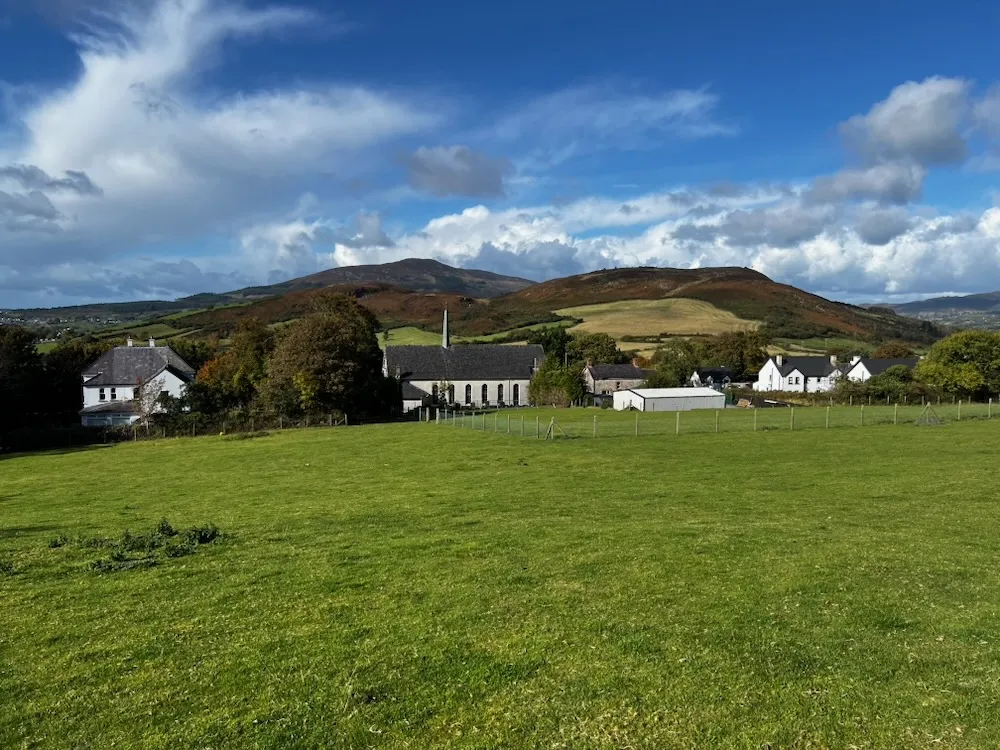
The Ring of Gullion is a geological formation unlike anything else in Ireland. A ring of low hills surrounds Slieve Gullion in a near-perfect circle - a volcanic ring dyke formed 60 million years ago. The whole thing is an Area of Outstanding Natural Beauty covering the hills, villages, and farmland of south County Armagh.
The 62-mile Ring of Gullion Way walking trail is the proper way to see it. But shorter trails around Camlough, Bessbrook, and Mullaghbane open up the landscape for day visitors. This is deep rural Ireland - quiet villages, ancient churches, and a sense of being somewhere that tourism has not yet reshaped.
What to Expect
The Ring of Gullion is best understood by looking at a map. Slieve Gullion sits at the centre and a circle of lower hills surrounds it like a crown. This is the eroded remains of a volcanic caldera - the same geological process that created the Giant's Causeway coast, but here the result is a ring of hills rather than columnar basalt.
The Ring of Gullion Way is a 62-mile waymarked trail that loops around the entire ring. Most walkers tackle it in sections rather than as a continuous route. The sections around Camlough Lake and through the Fathom Forest are particularly scenic. The trail passes through farmland, forest, and open hillside with views inward to Slieve Gullion and outward to the Mournes and Cooley.
Killeavy Castle Estate sits at the base of Slieve Gullion within the ring. The restored castle has a restaurant with a geopark-themed tasting menu that uses the volcanic landscape as its inspiration. It is a luxury base for exploring the area and one of the finest hotels in County Armagh.
The Ti Chulainn Cultural Centre in Mullaghbane celebrates the area's Irish language and cultural heritage. South Armagh is one of the strongest Irish-speaking areas in Northern Ireland. The centre runs language classes, traditional music sessions, and cultural events.
Is It Worth It?
A 60-million-year-old volcanic ring dyke that costs nothing to drive or walk. A near-perfect circle of low hills surrounds Slieve Gullion in south Armagh, and the whole of it is an Area of Outstanding Natural Beauty taking in hills, villages and farmland. The 62-mile Ring of Gullion Way is the full version, with shorter trails off free car parks at Camlough, Bessbrook and Mullaghbane. Ti Chulainn in Mullaghbane and Killeavy Castle Estate are where the food and the context are.
The catch: this is very rural, very quiet south Armagh. Facilities are minimal outside the villages. Mobile phone signal drops out regularly in the valleys. There are no tour buses, no visitor centres with cafes, and no clearly signposted tourist trail. You need a map, a car, and a willingness to explore on your own terms.
How to Get There
The Ring of Gullion is best accessed from Newry (20 minutes to the east) or Armagh city (30 minutes to the north). From Belfast, take the A1 motorway to Newry, then local roads into the ring. From Dublin, the M1 north reaches Newry in about 1.5 hours.
A car is essential. There is no useful public transport within the Ring of Gullion. The roads are quiet, narrow in places, and scenic.
Where to Stay Nearby
Killeavy Castle Estate is the standout option within the ring itself. Newry has the widest range of accommodation. Local B&Bs in Forkhill and Mullaghbane offer a more immersive rural experience.
Luxury hotel and spa at the foot of Slieve Gullion. Restored 12th-century castle with a modern extension. The geopark tasting menu is reason enough to stay.
Check availability →What Else is Nearby
A Note on the History
The Ring of Gullion is a geological feature first - a volcanic ring dyke formed during the same period of volcanic activity that created the Giant's Causeway. The ring is approximately 60 million years old. Within it, human habitation stretches back to the Neolithic, with the passage tomb on Slieve Gullion's summit among the oldest structures.
South Armagh has a complex modern history. The area was heavily affected by the Troubles and bears its scars. The landscape is peaceful now, and the cultural revival - visible in the Ti Chulainn Centre, the Irish language signage, and the growing walking tourism - represents a community looking forward while remembering its past.
Frequently Asked Questions