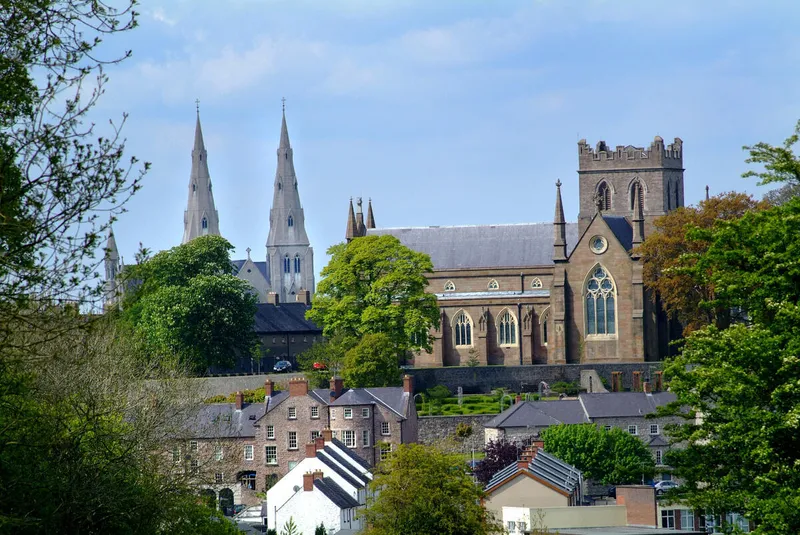
Armagh is where Irish Christianity began. St Patrick established his church here in 445 AD and the city has been Ireland's ecclesiastical capital ever since. Two St Patrick's Cathedrals face each other across the city - one Church of Ireland, one Roman Catholic - each claiming the high ground in every sense. Between them sits one of Ireland's finest Georgian streets and a museum with Viking bracelets and bog butter.
The city is compact and walkable. Three to four hours covers the cathedrals, The Mall, the County Museum, and Robinson Library. It is not a place that demands a full day, but it rewards the hours you give it. The history here runs deeper than almost anywhere else on the island.
What to Expect
The two cathedrals define Armagh. The Church of Ireland cathedral sits on the hill where St Patrick built his first stone church. The current building is medieval, restored in the 1830s. Inside, a plaque marks the alleged burial spot of Brian Boru, the High King killed at the Battle of Clontarf in 1014. The crypt has carved stone heads and medieval stonework.
Across the valley, the Roman Catholic cathedral is Victorian Gothic and dramatically different. Built between 1840 and 1873, the interior is ornate - mosaic floors, painted ceilings, and marble throughout. Guided tours explain the symbolism and the politics of building a Catholic cathedral during the Famine years.
Between the two cathedrals, The Mall is a tree-lined Georgian promenade that was once a racecourse. The terraced houses along it are among the best Georgian architecture in Ulster. The County Museum at the north end has a small but excellent collection - Viking arm rings found locally, bog butter preserved for centuries, and displays on the linen industry.
Robinson Library, beside the CoI cathedral, is Ireland's oldest public library. It holds a first edition of Gulliver's Travels with Swift's own annotations. The librarian will show you if you ask.
The catch: Armagh is quiet. Really quiet. The streets empty by early evening and the food scene is limited. If you are looking for nightlife or restaurant variety, this is not it. The appeal is entirely historical and architectural.
How to Get There
Armagh is one hour from Belfast via the M1 motorway and about 1.5 hours from Dublin via the M1 and A28. Street parking is available in the city centre with time limits.
There is no direct train service to Armagh. Bus services run from Belfast (Translink Goldline, about 1.5 hours) and from Newry. A car gives the most flexibility, especially if combining Armagh with Navan Fort or Slieve Gullion.
Where to Stay Nearby
Armagh has a small selection of hotels and guesthouses in the city centre. One night is enough for the city itself. Two nights if you plan to explore Navan Fort, Slieve Gullion, and the Ring of Gullion from here.
Central 4-star hotel with good rooms and a reliable restaurant. Walking distance to both cathedrals and The Mall.
Check availability →What Else is Nearby
A Note on the History
Armagh has been Ireland's ecclesiastical capital since 445 AD when St Patrick chose this hilltop for his principal church. The name comes from Ard Macha - the height of Macha, a goddess of the Ulster Cycle. The city was a centre of learning in the early medieval period, rivalling Clonmacnoise and Iona.
The Book of Armagh, a 9th-century manuscript containing the earliest biography of St Patrick, was produced here. Vikings raided the city repeatedly. The Normans came later. Through it all, Armagh retained its status as the seat of both the Catholic and Church of Ireland primates - a distinction it holds to this day.
Frequently Asked Questions