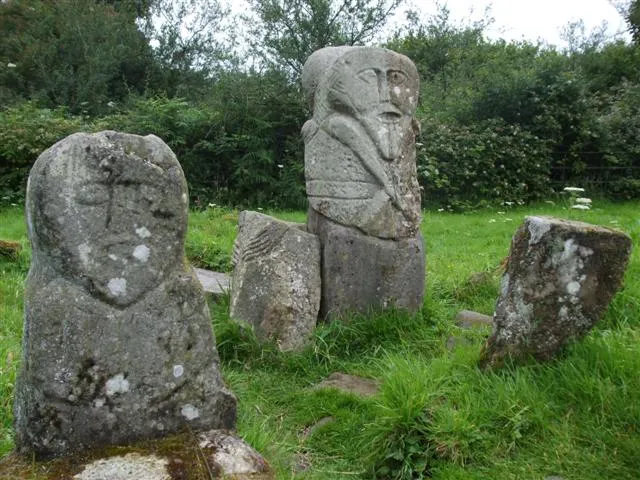
Two carved stone figures stand in a small graveyard on County Fermanagh's Boa Island, and nobody can agree on what they are. The larger one - the Janus figure - has two faces carved back to back, with crossed arms and interlaced patterns worn smooth by centuries of rain. The smaller one, Lustymore Man, was brought here from a neighbouring island and placed alongside it. Are they pagan deities? Early Christian saints? Something older and stranger? Scholars have argued about this for decades without settling the question.
There is no visitor centre, no information board worth the name, no entrance fee. You walk across a boggy field, pass through a gate, and find them standing among modern headstones in Caldragh cemetery. The Boa Island Janus figures are one of Ireland's most enigmatic ancient sites - and one of the least visited. On most days, you will have the place entirely to yourself.
What to Expect
Finding Caldragh cemetery takes a bit of faith. The signposting on Boa Island is minimal, and the turnoff is easy to miss. You pull into a small layby beside a working farm, and from there a rough path crosses a field towards a cluster of trees. The field can be genuinely boggy after rain - proper walking shoes or wellies are not optional here.
The graveyard itself is small and still in occasional use. Modern headstones sit alongside much older graves, and the two stone figures stand near the centre. There is a low fence around them, but you can get close enough to study the carvings in detail.
The bilateral Janus figure is the larger of the two, roughly a metre tall. Two faces look outward in opposite directions, each with hollowed eyes and a straight mouth. The arms are crossed over the body, and faint interlaced patterns run down the sides. It has the blunt, solid presence of something very old. The carving is crude by medieval standards, which is part of why dating it remains so difficult.
Lustymore Man stands nearby, smaller and more weathered. This figure originally came from Lustymore Island, a short distance across the water, and was moved here at some point in the 20th century. It has a single face with a pointed chin and what might be hands clasped below it. The two figures clearly come from different traditions or periods, but placing them side by side has given them a strange companionship.
What the site does offer is silence and proximity. You stand a few feet from carved stones that are at least a thousand years old, possibly much older, with no crowds and no rope barriers between you and them. For anyone interested in Ireland's pre-Christian or early Christian past, that direct contact is worth the muddy boots.
Is It Worth It?
Half an hour, no charge, and an argument nobody has settled. Two carved stone figures stand in a small graveyard on Lower Lough Erne: the Janus figure, two faces back to back with interlaced patterns worn smooth by rain, and Lustymore Man beside it, brought over from a neighbouring island. Pagan deities, early Christian saints, or something older again, depending on which scholar you ask. Thirty to forty-five minutes covers it.
The reality of visiting Boa Island is that the site demands effort for a brief experience. There are no facilities of any kind - no toilets, no shelter, no refreshments within walking distance. The parking is tight. The approach is muddy. On a grey afternoon in winter, the graveyard can feel genuinely isolated, which some visitors find atmospheric and others find unsettling. If you are expecting a polished heritage attraction, this is not it.
How to Get There
Boa Island sits in the northern part of Lower Lough Erne. Despite the name, it is connected to the mainland by bridges at both ends, so you can drive straight onto it. A car is essential - there is no public transport to the island or to Caldragh cemetery.
From Enniskillen, take the A32 north towards Irvinestown, then pick up the B82 towards Kesh and Belleek. The drive takes around 30 minutes in normal conditions. On the island, look for a small sign pointing to Caldragh cemetery on the western side. The turnoff is not well marked - if you reach the bridge at the far end of the island, you have gone too far.
From Kesh, the drive is shorter - roughly 10 minutes west along the B82. Kesh is the nearest village with a shop and a pub, so it makes sense to stop there before or after your visit.
Parking is a layby beside a farm gate, with space for two or three cars at most. If someone else is already there, you may need to wait or find a safe spot to pull in along the road. During summer weekends, this can be a genuine problem, though the site rarely draws large numbers.
If you are renting a car in Belfast or Dublin, the drive to Boa Island takes around two hours from Belfast and three from Dublin. The roads in Fermanagh are good but mostly single carriageway.
Where to Stay Nearby
Kesh is the nearest village to Boa Island, a small settlement on the shore of Lower Lough Erne with a handful of pubs and shops. Most accommodation in the area sits along the lakeshore or on the islands themselves. For a wider look at what County Fermanagh offers, the county guide covers the full range.
A private 75-acre island in Lower Lough Erne, reached by a short boat crossing near Kesh. Self-catering lodges, spa, indoor pool, and restaurant. The setting matches the ancient feel of Boa Island. From GBP 110 per night.
Check availability →What Else is Nearby
A Note on the History
The dating of the Boa Island figures remains genuinely unresolved. Some archaeologists place them in the early Christian period, around the 7th to 9th century, pointing to the interlaced patterns on the Janus figure as evidence of Insular art influence. Others argue that the crude carving style and bilateral form suggest something much older - possibly Iron Age, possibly connected to Celtic religious practice.
The bilateral Janus figure - named after the Roman two-faced god, though the connection is purely visual - is the more striking of the two. Its two faces look in opposite directions, a motif found in Celtic stone carving across Europe. The crossed arms and the hollowed eyes give it an expression that is difficult to read. Protective? Watchful? Threatening? Interpretations vary widely.
Lustymore Man arrived in Caldragh sometime in the early 20th century, moved from nearby Lustymore Island for safekeeping. It is smaller, more weathered, and clearly carved by a different hand. Whether the two figures are separated by decades or centuries is another open question.
What makes the site remarkable is its ambiguity. These are not labelled, explained, or contextualised. They simply stand in a graveyard, as they have for a very long time, and you are left to draw your own conclusions.
Frequently Asked Questions