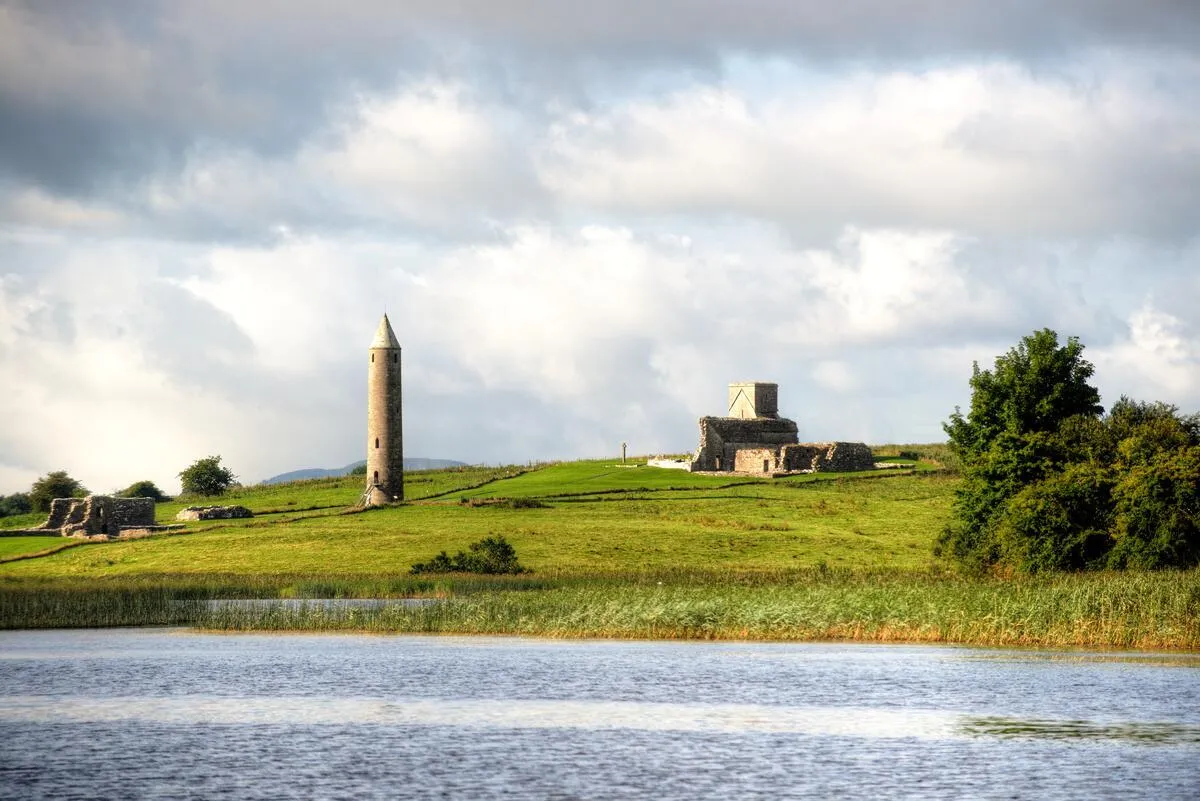
Devenish Island sits in the southern reach of Lower Lough Erne, a low green island holding one of Ireland's finest monastic sites. The round tower here is among the most complete in the country - 25 metres of carefully fitted stone rising above the ruins of churches, an Augustinian abbey, and a carved high cross. St Molaise founded a monastery on this island in the 6th century. What you see today spans a thousand years of building, rebuilding, and slow abandonment.
The island is only accessible by boat, which keeps visitor numbers low. On a weekday in summer you might share it with a handful of others. The crossing from Trory Point takes about ten minutes. Once on the island, a gravel path loops through the ruins. There are no entry fees. Allow two to three hours for the visit including the ferry crossing both ways.
Devenish is exposed ground with no shelter. If the forecast shows rain, bring waterproofs or postpone.
What to Expect
The visit starts at Trory Point, a small jetty about 5 km north of Enniskillen on the B82. The ferry crossing takes roughly ten minutes across open water. Lower Lough Erne can be choppy, and crossings do get cancelled in bad weather. Check conditions before you drive out.
You land on a small stone jetty on the island's eastern shore. A gravel path leads uphill through the monastic enclosure. The seasonal visitor centre sits near the landing point with an exhibition covering the island's history and a set of toilets - both only open in summer months.
The Round Tower
The round tower dominates the island. At 25 metres tall, it is one of the most intact examples in Ireland. The doorway sits several metres above ground level, as was standard - monks pulled up the ladder when raiders appeared. Look closely at the stonework near the top. A carved human face peers out from below the cap. You cannot enter the tower, but the exterior alone is worth the crossing.
The Abbey and Ruins
South of the tower, the remains of the Augustinian priory spread across the hilltop. The walls of St Molaise's House still stand to a good height. Nearby, the lower church and St Mary's Priory show different building periods layered over each other. A carved high cross stands among the ruins, its patterns still sharp after centuries of Fermanagh weather.
The ground across the island is uneven and can be slippery when wet. There are no paved paths beyond the main gravel track. Wheelchairs and buggies will struggle here. Wear boots or sturdy shoes with grip.
Walking the Island
A full loop of the monastic site takes about 45 minutes at an easy pace. The island is not large. Most of the interest sits in the central and southern sections. The northern end is open grassland with views across the lough to the Fermanagh shore.
There is no shelter anywhere on the island. If rain arrives mid-visit, you have no cover beyond the small visitor centre near the jetty. Bring a waterproof jacket regardless of the forecast. Wind off the lough adds a chill even in summer.
The return ferry runs on a rough schedule. Confirm your pickup time with the operator before they leave. Getting stranded is unlikely but not impossible if communication breaks down.
How to Get There
Devenish Island is reached by boat from Trory Point, roughly 5 km north of Enniskillen along the B82 Kesh road. A small car park at the jetty is free and rarely full. The crossing takes about ten minutes.
Ferry Details
Erne Water Taxi and local operators run seasonal services to the island, typically from April through September. Expect to pay around GBP 10-15 return per person. Services run most reliably in July and August. Outside peak season, you may need to book ahead or arrange a private crossing. There is also a departure point at Round O jetty, south of Trory Point.
By Car
From Enniskillen town centre, take the A32 north then turn onto the B82 towards Kesh. Trory Point is signposted on the left after about 4 km. From Belfast, the drive takes roughly two hours via the M1 and A4. From Dublin, allow around two and a half hours via the N3 and A509.
Public Transport
There is no public transport to Trory Point. Bus Eireann and Ulsterbus serve Enniskillen from Belfast and Dublin, but you will need a car or taxi to reach the jetty. A taxi from Enniskillen centre costs roughly GBP 8-10 each way.
A hire car is the practical option if you plan to explore Fermanagh beyond Enniskillen town.
Where to Stay Nearby
Enniskillen is the natural base for visiting Devenish Island. The town sits between Upper and Lower Lough Erne with a good range of hotels and restaurants. It is also well placed for exploring the rest of County Fermanagh, including Marble Arch Caves and Florence Court.
Lakeside four-star on the shores of Lough Erne, 1 km south of Enniskillen centre. Indoor pool, Elemis Spa, and 20 self-catering lodges - six with private hot tubs. Over 2,600 TripAdvisor reviews. GBP 105-130 per night.
Check availability →What Else is Nearby
A Note on the History
St Molaise founded a monastery on Devenish in the 6th century. He chose well. An island in a large lake offered natural protection from cattle raiders and petty kings. Fresh water, fish, and grazing land made it self-sufficient. The monastery grew into one of the most important religious houses in Ulster.
The round tower was built sometime between the 10th and 12th centuries. These towers served multiple purposes - bell towers, watchtowers, and places of last refuge during Viking raids. The doorway was set high above ground so the entrance could be sealed from inside. The carved face near the top is unusual and may represent a saint or abbot.
In the 12th century, Augustinian canons established a priory alongside the older monastic buildings. St Mary's Priory added Gothic arches and more formal church architecture to the site. The monastery survived into the early 17th century before dissolution and abandonment.
What remains today is a layered site. Six centuries of building sit within a few hundred metres. The round tower, the high cross, the priory walls, and St Molaise's House together tell the story of Irish monasticism from its earliest days through to its end.
Frequently Asked Questions