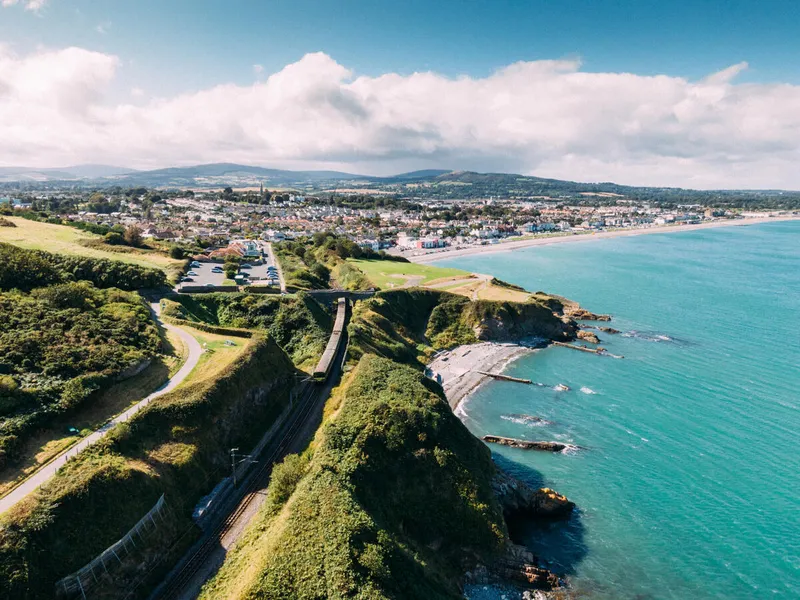
The Bray to Greystones cliff walk is 7 kilometres of coastal path along the edge of County Wicklow, with the Irish Sea on one side and Bray Head rising above you on the other. It is the best coastal walk within easy reach of Dublin, and the fact that you can take the DART train to the start and from the finish makes it one of the most practical day walks in Ireland.
The path follows the old railway line around Bray Head before dropping to sea level and running along the coast to Greystones. The views south along the Wicklow coast are excellent throughout. On a clear day you can see the Sugarloaf, the Great and Little Sugar Loaf mountains, and the Wicklow range stretching inland. It takes 2-3 hours at a comfortable pace, and the reward at the end is a pint in Greystones and a DART ride back.
What to Expect
Start at the southern end of Bray promenade. The path begins where the promenade ends, climbing gradually onto the old railway cutting around Bray Head. The railway line was moved inland decades ago and the original route became this walking path. The surface is rough in places - compacted earth, gravel, and some rock. Proper footwear is not optional.
The first section climbs steadily around Bray Head with views back over Bray, Dublin Bay, and on clear days, Howth Head to the north. The cross on Bray Head summit is visible above you. The path cuts through cuttings in the rock where the old railway ran, and in a few places you can see the remains of the railway infrastructure - retaining walls, drainage channels, the ghost of the track bed.
After Bray Head, the path descends to near sea level and runs along the coast. This middle section is the most exposed - waves crash onto the rocks below and in winter storms the path can be impassable. The views south along the coastline to Greystones and beyond are the highlight. The water is a deep grey-green, the cliffs are layered sedimentary rock, and on a good day the light on the sea is beautiful.
The final section drops into Greystones along the harbour. The town has good cafes, pubs, and the DART station is a 10-minute walk from the harbour. The Happy Pear and a clutch of other places on the main street make a good post-walk stop.
Is It Worth It?
Seven kilometres, a EUR 3.50 DART fare, and no car needed at either end. The path follows the old railway line around Bray Head before dropping to sea level and running down the coast into Greystones, with the Irish Sea beside you the whole way and views south along the Wicklow coast. Two to three hours one way, and the train at both ends is what makes it the most practical day walk in the country.
The catch: the path is rough and uneven. Ankle injuries are common, especially on the descent to Greystones. After rain, sections become muddy and slippery. In winter, rockfalls occasionally close the path entirely - check before you go. And on sunny summer weekends, the path is crowded enough that you are walking in a queue for the first kilometre out of Bray. Start early or go midweek.
How to Get There
Take the DART to Bray station, which is a 5-minute walk from the start of the promenade. Trains run every 15-20 minutes from Dublin city centre. At the end, Greystones DART station is a 10-minute walk from the harbour. The one-way walk with DART connections is the ideal setup - no need to retrace your steps.
If driving, park in Bray and take the DART back from Greystones. Or park in Greystones and DART to Bray, then walk back to your car. Either direction works. A car is not needed for this walk - the DART makes it one of the easiest day trips from Dublin.
Where to Stay Nearby
This is a day walk from Dublin - you do not need to stay in Wicklow. But if you want to combine it with other Wicklow destinations, Bray and Greystones both have accommodation. See the County Wicklow hub.
Absurdly grand for a county this close to Dublin. The Sika restaurant is excellent and the views of Sugar Loaf from the terrace are worth the room rate alone.
Check availability →What Else is Nearby
A Note on the History
The cliff walk follows the route of the original Dublin and Wicklow Railway, opened in 1855. The line hugged the coast around Bray Head because tunnelling through the headland was too expensive. For over a century, trains rattled along these cliffs with passengers looking straight down into the sea. Rockfalls and landslips were a constant problem.
In 1915, the railway was rerouted through a new tunnel inland, and the coastal track was abandoned. The old railway bed became the walking path. You can still see the engineering - cuttings through rock, retaining walls, the gentle gradient designed for steam locomotives. It is one of the few places in Ireland where a disused railway has become a genuinely popular walking route.
Frequently Asked Questions