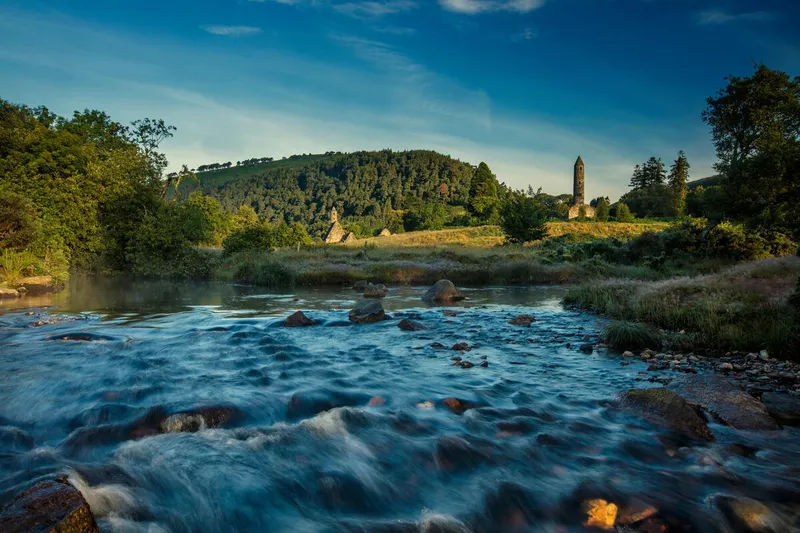
Glendalough is a glacial valley in the Wicklow Mountains with a 6th-century monastic settlement, two lakes, and some of the best walking in eastern Ireland. St Kevin founded a monastery here around 570 AD, and for centuries it was one of the great centres of learning in Europe. Vikings burned it. Normans raided it. The English dissolved it. The round tower and stone churches survived all of them.
The valley sits less than an hour south of Dublin, which means it gets busy. Tour buses arrive from mid-morning and the lower car park fills by 11am in summer. But the crowds thin dramatically once you walk past the monastic site and into the upper valley. Most visitors photograph the round tower, glance at the lake, and leave. The people who walk deeper find something quieter and considerably more impressive in County Wicklow.
What to Expect
The visitor centre is the formal starting point. The exhibition covers the monastic history with a good short film. From there you walk through the monastic gateway - the only surviving example of a monastic entrance in Ireland - into the cemetery and round tower precinct. The round tower is 33 metres tall, over a thousand years old, and remarkably intact. The cathedral, St Kevin's Church (called the Kitchen because of its chimney-like bell tower), and the Celtic crosses are all within a few minutes' walk.
The lakeside trail from the monastic site follows the south shore of the Lower Lake to the Upper Lake. This is a flat, easy walk of about 30 minutes and is where the valley opens up properly. The Upper Lake is darker, deeper, and ringed by steep oak-covered hillsides. A small beach at the eastern end is popular in summer. St Kevin's Bed - a cave in the cliff face above the lake where the saint supposedly lived - is visible from below but not accessible.
Beyond the Upper Lake, the Poulanass Waterfall trail climbs steeply through forest to a viewpoint over the valley. The Spinc Walk (marked white trail) is a 9-kilometre loop that climbs the ridge south of the valley with views down to both lakes. It takes 3-4 hours and is moderately difficult. This is the walk that justifies an entire morning in Glendalough.
The Miner's Road along the north side of the Upper Lake follows an old lead mining track and is less walked than the south shore. The ruins of mine buildings and spoil heaps are visible in the forest. It is quieter and has a different atmosphere to the main trails.
Is It Worth It?
A glacial valley with a 6th-century monastery in it, and the monastery costs nothing. St Kevin founded it around 570 AD and it grew into one of the great centres of learning in Europe. Vikings burned it, Normans raided it, the English dissolved it, and the round tower and stone churches came through all three. The visitor centre is EUR 5 and parking EUR 4 to 5. Two to three hours for the site and the lakeside walk, half a day if you take the longer valley trails, which are the best walking in eastern Ireland.
The catch: Glendalough is genuinely overcrowded from 10am to 3pm in summer. The monastic site becomes a bottleneck of tour groups and selfie sticks. The lower car park fills and the overflow system is not well managed. If you are driving from Dublin on a sunny Saturday, arrive before 9am or accept that parking will be a problem. The valley trails are much emptier but the monastic site itself can feel like a theme park at peak times.
How to Get There
From Dublin, Glendalough is about 50 kilometres south via the N11 and R755 through Roundwood, or the R115 over the Sally Gap - a longer but more scenic route through the Wicklow Mountains. Allow 1-1.5 hours depending on the route and traffic.
St Kevin's Bus Service runs daily from Dublin (Dawson Street) to Glendalough. Departures at 11:30am and 6pm from Dublin, returning at 7:15am and 4:30pm from Glendalough. The journey takes about 90 minutes. Outside of that, a car gives you much more flexibility, especially if you want to arrive early or combine with other Wicklow stops.
Where to Stay Nearby
Laragh village, a few minutes from the valley entrance, has B&Bs and a pub. For more options, Enniskerry and the wider Wicklow area are within 30-40 minutes. The County Wicklow hub covers accommodation across the county.
Absurdly grand for a county this close to Dublin. The Sika restaurant is excellent and the views of Sugar Loaf from the terrace are worth the room rate alone.
Check availability →What Else is Nearby
A Note on the History
St Kevin arrived in Glendalough around 570 AD, apparently seeking solitude. He got the opposite. His reputation for holiness attracted followers and within a century the valley had become a major monastic settlement with churches, workshops, a scriptorium, and a round tower. At its peak, hundreds of monks lived and worked here.
The Vikings raided Glendalough at least four times between 775 and 1071. Each time the monks rebuilt. The Normans came in the 12th century and the English crown finally suppressed the monastery in 1539 during the Dissolution. The buildings fell into ruin but the valley never lost its reputation as a sacred site. People have been making pilgrimages here for 1,400 years and they still come.
Frequently Asked Questions