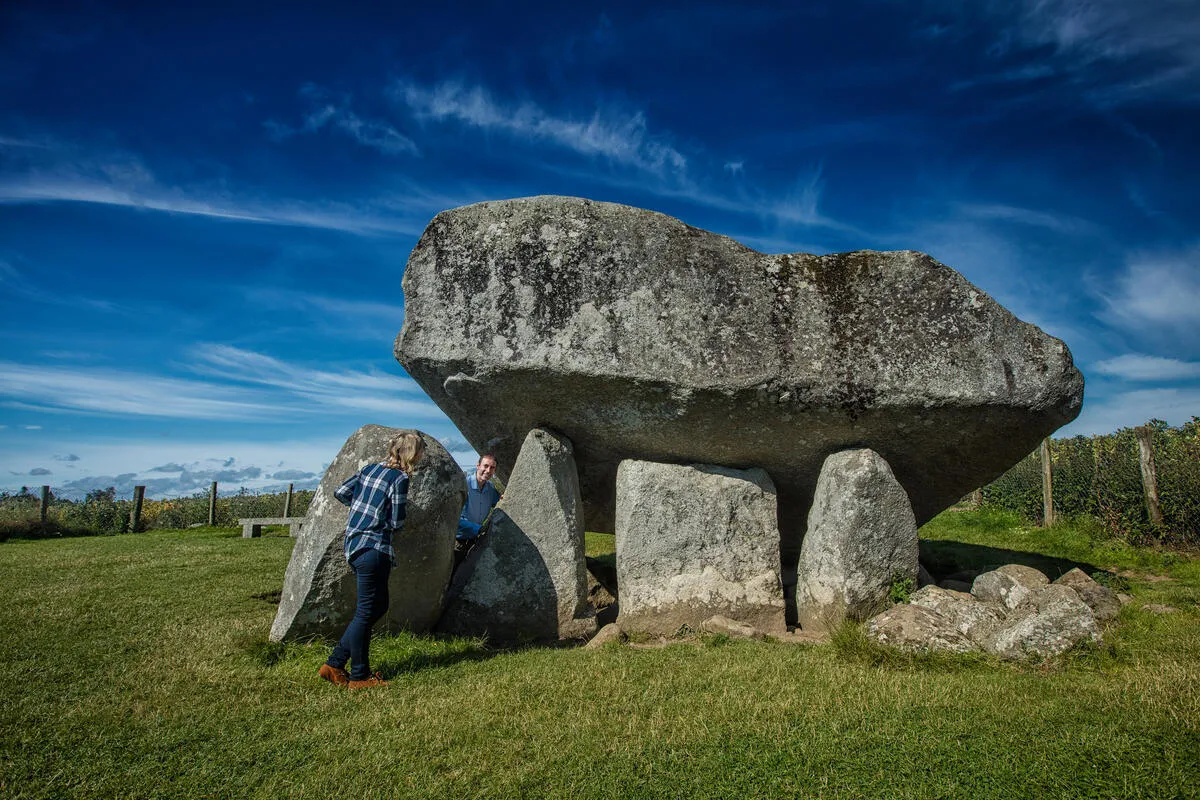
Browne's Hill Dolmen sits in a field on the edge of Carlow town, three kilometres out the Hacketstown Road. There is no visitor centre. No audio guide. No interpretive panels beyond a single information board. Just a 5,000-year-old portal tomb with a capstone that weighs somewhere between 100 and 150 tonnes - the largest in Europe - balanced on its uprights in a way that nobody has satisfactorily explained.
The visit itself takes about fifteen minutes. You park, walk a paved path across a field, stand underneath it, try to process the engineering involved, and leave. It is one of the shortest visits in this guide and one of the most memorable. The Neolithic builders who placed this stone did so without metal tools, without wheels, and without written language. It has not moved since.
What to Expect
The walk from the car park takes about five minutes on a level tarmac path. The dolmen is fenced but clearly visible and you can get close enough to appreciate the scale. The capstone is enormous - roughly 4.7 metres by 6.1 metres, sloping down to the west where it rests on the ground. Two portal stones and a door stone support the eastern end. The engineering is the point. How did they lift it? Nobody knows for certain.
There is no guided tour and no facilities beyond the car park. The site is managed by the OPW as a National Monument. It has never been excavated, which means whatever was placed beneath it - burial remains, offerings, tools - is still there. Similar portal tombs across Ireland have yielded cremated bone, pottery, and flint tools, so the assumption is that this was a burial site of some importance. The scale of the capstone suggests someone very significant was buried here.
The field around the dolmen is farmed, so stay on the path. On a clear day, the Blackstairs Mountains are visible to the south. The whole visit is short but the image stays with you - this thing has been sitting here for longer than the pyramids of Giza have existed.
How to Get There
Browne's Hill Dolmen is three kilometres east of Carlow town on the R726 (Hacketstown Road). It is signposted from the town centre. The turn-off is on the right and the car park is a short distance down a lane. The dolmen is visible from the road if you know where to look.
Carlow town has a train station with regular services from Dublin Heuston (about 1 hour 20 minutes). From the station, the dolmen is a 40-minute walk or a five-minute taxi ride. There is no direct bus to the site. If you are driving from Dublin, Carlow is about 85 kilometres south on the M9, and the dolmen is well signposted from the town.
Where to Stay Nearby
Most visitors to Browne's Hill Dolmen are based in Carlow town, which has a decent range of hotels and guesthouses. The dolmen is a quick stop rather than a destination that requires overnight accommodation, but if you are exploring the Barrow Valley or visiting Altamont Gardens as well, a night in Carlow makes sense.
What Else is Nearby
A Note on the History
Portal tombs like Browne's Hill were built during the Neolithic period, roughly 3300 to 2900 BC. They are found across Ireland, Wales, and Cornwall, but the Carlow example is exceptional for its capstone size. The tomb type is characterised by two tall portal stones at the entrance, a lower closing stone between them, and a large capstone that slopes downward to the rear.
The purpose was almost certainly funerary, though the rituals involved are unknown. Comparable sites have yielded cremated human remains and grave goods. The choice of location - on a slight rise with views across the valley - was deliberate. These tombs were landmarks, visible from a distance, marking territory and ancestry. Five thousand years later, the dolmen is still doing exactly that.
Frequently Asked Questions