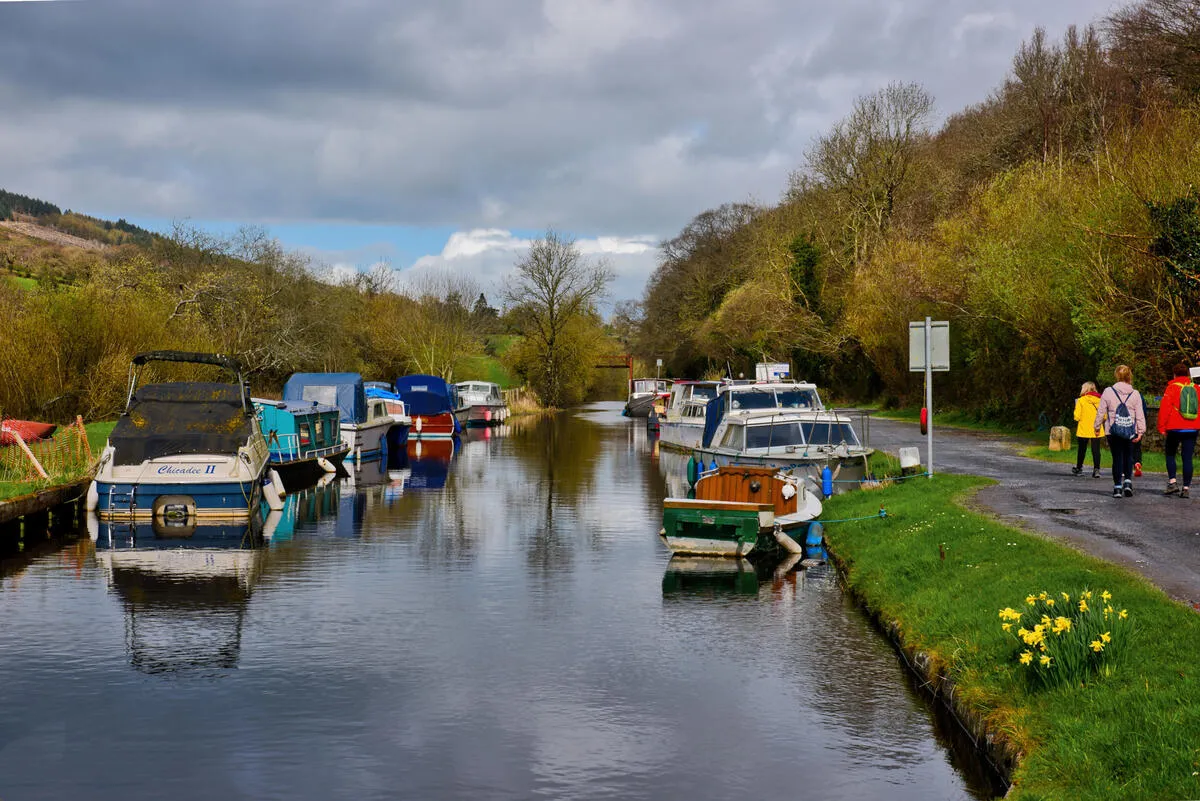
St Mullins is a tiny village at the tidal limit of the River Barrow in south County Carlow. It has a 7th-century monastic site, a Norman motte, a holy well, a heritage trail, a cafe, and a pub. It does not have much else, and that is the entire point. This is one of the most peaceful spots in Leinster - a place where the Barrow stops being a canal and becomes a tidal river, where the ruins of five medieval churches stand in a graveyard that has been in continuous use for over 1,300 years.
Most visitors arrive on foot or by bike, finishing the Barrow Way towpath from Graiguenamanagh. Others paddle in by canoe or kayak. A few drive in on the narrow road from the N9. However you arrive, the feeling is the same - you have reached somewhere genuinely remote, despite being only two hours from Dublin. The monastery that St Moling founded here in the 7th century chose this location for the same reason people still come: it is beautiful, it is quiet, and the river gives it a sense of being apart from the rest of the country.
What to Expect
The heritage trail around the monastic site takes about thirty minutes and covers the main features. Teampall Mor is the oldest church, with sections possibly dating to the 10th century. The larger "Abbey" church is 15th century. A small oratory dedicated to St James stands nearby. The remains of a round tower are visible, and an early medieval high cross - showing Christ and the Apostles - survives in fragmentary form. The graveyard contains an impressive collection of 18th and 19th-century headstones and remains in active use.
St Moling's Well is enclosed within a roofless stone baptismal chapel built around 1100. The well has been venerated for its healing properties since the monastery's foundation. An annual Pattern Day pilgrimage still takes place on the Sunday nearest to St James's Day (25 July), when pilgrims wade the stream barefoot, circumambulate the well, and pray at each ruin - a ritual that has continued for over a thousand years. During the Penal era, Mass was said at a rock altar in the centre of the graveyard when formal worship was prohibited.
The Anglo-Norman motte, visible above the monastic site, dates to the 12th century and provides views over the river and valley. It is a short steep climb and worth the effort for the perspective it gives.
On the water, several operators offer guided and self-guided canoe trips on the Barrow, with St Mullins as either start or finish point. The three-day self-guided canoe hire from Leighlinbridge to St Mullins is a popular option, following the river through locks and countryside at a walking pace.
How to Get There
St Mullins is reached by narrow local roads from the R729 (Borris-New Ross road) or from Graiguenamanagh. There is no public transport. The nearest town with a train station is Bagenalstown (Muine Bheag), about 25 kilometres north. From Graiguenamanagh, the drive is about 15 minutes. From Dublin, allow about two hours via the M9 and local roads.
The most atmospheric way to arrive is on foot via the Barrow Way towpath from Graiguenamanagh - 6 kilometres, about 1.5 hours, along the most scenic stretch of the trail. Alternatively, paddle in by canoe from further upstream.
Where to Stay Nearby
St Mullins itself has very limited accommodation - this is a tiny village. Graiguenamanagh (15 minutes) has B&Bs and guesthouses and is the natural base. Borris (20 minutes) and Bagenalstown (25 minutes) are alternatives. For a wider range, Carlow town is about 40 minutes north.
What Else is Nearby
A Note on the History
St Moling (614-696 AD) was born a prince of Leinster and became a monk, poet, artist, and eventually Bishop of Ferns. He founded the monastery at St Mullins under the patronage of Maedoc of Ferns and, according to tradition, freed the people of Ossory from the Boroma tribute - a tax in cattle owed to the High Kings. The monastery became an important centre of learning and pilgrimage.
The site survived Viking raids, Norman conquest, and the Reformation, though each left its mark. The round tower was partially destroyed, the churches were rebuilt and modified over centuries, and the Anglo-Normans added their motte in the 12th century. Through all of this, the cemetery remained in use and the holy well continued to draw pilgrims. Even during the Penal Laws, when Catholic worship was suppressed, Mass continued at the rock altar in the graveyard. It is a place where continuity is measured in millennia rather than centuries.
Frequently Asked Questions