When I was learning history at primary school, ancient civilisation meant Egypt and the Tower of Babel. The older the history, the further away it seemed to be. It took years before I understood that Ireland carries its own deep past - and County Meath wears that past more visibly than anywhere else on the island.
Newgrange is a Neolithic passage tomb in the Boyne Valley, built around 3200 BC. That makes it roughly 500 years older than the Great Pyramid of Giza and a full millennium older than Stonehenge. Most people know that much. What they get wrong is the logistics. You cannot drive to Newgrange directly. Every visit starts at the Bru na Boinne Visitor Centre, and you take a shuttle bus to the monument. Tickets sell out days or weeks ahead, depending on the season.
None of that should put you off. It should just make you plan properly. This guide covers exactly how to do that - tickets, timing, what you will actually see inside, and how to build Newgrange into a broader Boyne Valley day.
What to Expect
The Visitor Centre earns its keep before you ever reach the tomb. The refurbished exhibition walks you through the Neolithic world of the Boyne Valley farmers who built Newgrange - their tools, their agriculture, and their extraordinary understanding of astronomy. Allow 30 to 40 minutes here. The audio-visual reconstruction of the winter solstice illumination is worth watching, especially if you will not be inside the chamber on 21 December.
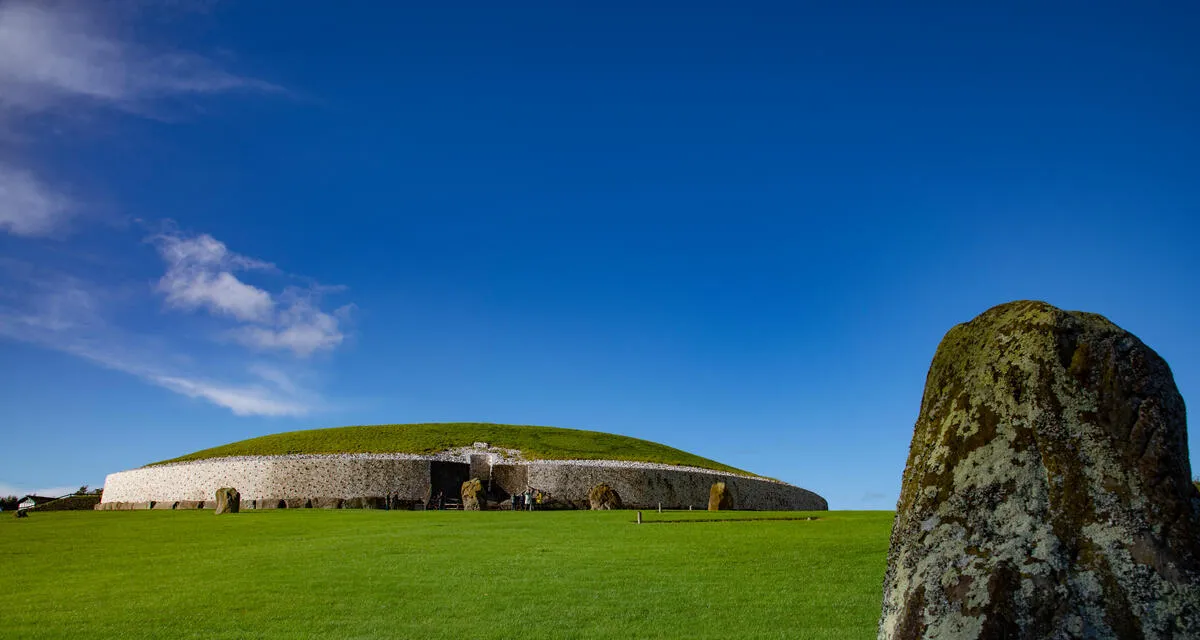
The shuttle bus ride to Newgrange takes about five minutes. When you step off, the mound dominates the landscape - a grass-covered dome ringed by white quartz stones, roughly 85 metres across. Your guide gathers the group outside and explains the kerbstones. The entrance stone, carved with triple spirals and diamond shapes, is one of the finest pieces of megalithic art in Europe. These carvings are over 5,000 years old. Nobody knows exactly what they mean.
Then you go inside. The passage is about 19 metres long, narrow, and slightly uphill. You will brush the walls with your shoulders. The ceiling gets lower in places. If you are claustrophobic, this will test you - that is the reality. At the end, the chamber opens into a corbelled vault that has kept water out for five millennia without mortar.
The guide switches off the lights. In the darkness, a simulation of the solstice sunbeam traces its way along the passage floor and into the chamber. Even as a simulation, it lands. The idea that people 5,000 years ago engineered a building so precisely that a shaft of sunlight would penetrate 19 metres of stone passage for exactly 17 minutes on the shortest day of the year - that is not something you rationalise away easily.
What struck me most was how Newgrange gives a physical inscription to something deeply Irish. Long before written language arrived on this island, people here were carving spirals into stone and building with light. There is a writerliness to it - a need to mark meaning into the landscape that still runs through Irish culture today.
Is It Worth It?
Five thousand years old and you can still walk into it, which is most of the argument. Newgrange went up around 3200 BC, five hundred years before the Great Pyramid at Giza and a thousand before Stonehenge, and the entrance stone alone is one of the finest pieces of megalithic art in Europe. You cannot drive to it: every visit starts at the Bru na Boinne Visitor Centre and goes on by shuttle. Tickets release 7 days ahead from November to March and 30 days ahead from April to October, and peak slots go within hours. Allow two hours, or three if Knowth is open, and it is free on an OPW Heritage Card.
The whole Newgrange tour, including the shuttle ride back, takes about 90 minutes. A word of caution: the site has no shelter between the shuttle stop and the tomb entrance. If it rains - and in Meath it will rain - you will stand in it. Bring a waterproof layer regardless of the forecast.
How to Get There
Newgrange sits roughly 50 minutes north of Dublin by car. Take the M1 motorway north, exit at junction 9 for Donore, and follow signs for Bru na Boinne Visitor Centre. The route is well signposted from the motorway. Free parking at the centre means you will not circle looking for a spot.
From Navan, it is a 15-minute drive east along the R153. From Trim, allow 25 minutes via the R161 and local roads. Both towns make good bases if you are spending more than a day exploring the Boyne Valley.
If you are building Newgrange into a broader day trip from Dublin, a car gives you the most flexibility. You can pair it with the Hill of Tara, Trim Castle, or Slane in a single day. If you do not have your own transport, renting a car is the most practical option for this part of Meath. Public transport exists but is limited - Bus 188 runs from Drogheda to the Visitor Centre area, though the service is seasonal and infrequent.
There is no rail connection to the Boyne Valley. If you are relying on public transport from Dublin, a guided coach tour may be more realistic than piecing together bus connections. That said, if you are planning a wider Ireland road trip, Meath is an easy first or last stop before Dublin Airport.
Where to Stay Nearby
Newgrange itself has no accommodation. Your nearest base towns are Trim (25 minutes), Navan (15 minutes), and Drogheda (20 minutes). Trim is the strongest option if you want to explore the wider Boyne Valley over two days - it has its own castle, good restaurants, and a walkable town centre. Check the County Meath guide for more on where to stay.
Right beside the castle with views of the ruins from some rooms. The bar does reliable food and the location is hard to beat for a Boyne Valley base.
Check availability →What Else is Nearby
A Note on the History
Newgrange was built around 3200 BC by Neolithic farming communities in the Boyne Valley. It is a passage tomb - a large circular mound covering a stone-lined passage that leads to a cruciform chamber. The mound is 85 metres in diameter and 13 metres high, faced with white quartz cobblestones and grey granodiorite boulders.
It sits within the Bru na Boinne complex alongside two other major passage tombs, Knowth and Dowth, and dozens of smaller satellite tombs. Together they form one of the most important archaeological landscapes in Europe. UNESCO designated the complex a World Heritage Site in 1993.
The defining feature is the roof box above the entrance. On the mornings around the winter solstice - roughly 19 to 23 December - a beam of sunlight enters through this narrow opening and travels the full length of the 19-metre passage to illuminate the chamber floor. The alignment is precise to within a single degree. Each year, a public lottery selects a small number of people to witness this inside the chamber. Tens of thousands apply.
The kerbstones and interior walls carry elaborate megalithic art - spirals, lozenges, concentric circles. Newgrange has the densest collection of megalithic carving in western Europe. These symbols predate written language on this island by over 3,000 years.
Frequently Asked Questions