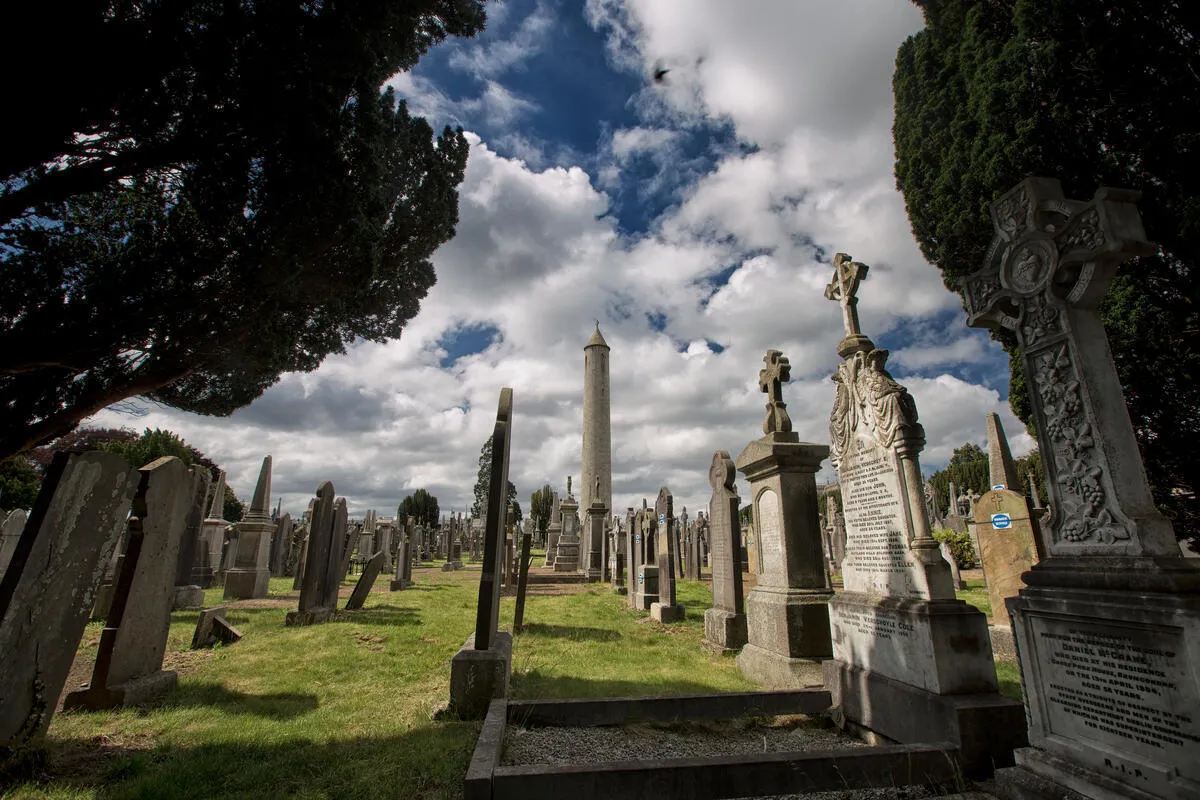
Glasnevin Cemetery is Ireland's national necropolis. O'Connell, Parnell, Collins, de Valera, Countess Markievicz, Brendan Behan - they are all here. The guided tours are exceptional and the museum gives you the political history that makes the rest of Ireland make sense. It is one of the most underrated things to do in Dublin.
The cemetery opened in 1832 as the first place where Catholics could bury their dead with dignity in Dublin. Daniel O'Connell founded it and is buried under a 55-metre round tower that dominates the skyline. Over 1.5 million people are buried here. Walking through it is like walking through 200 years of Irish history with headstones as your guide.
What to Expect
The guided tour is the way to do Glasnevin. The guides are historians who know the stories behind the headstones. They walk you through the cemetery connecting graves to the sweep of Irish history - from the Famine burials to the 1916 leaders to the politicians who built the modern state.
Daniel O'Connell's crypt is beneath the round tower. Michael Collins' grave is simple and always has fresh flowers. Eamon de Valera is here too - he and Collins fought on opposite sides of the Civil War and are buried in the same ground. Charles Stewart Parnell's grave is marked by a single massive boulder. The juxtaposition of these graves tells Ireland's story more plainly than any textbook.
The museum covers the history of death, burial, and remembrance in Ireland. It sounds grim but the treatment is sensitive and often fascinating. The interactive database lets you search for ancestors - useful if you have Irish roots.
Is It Worth It?
One of the most underrated two hours in Dublin. O'Connell, Parnell, Collins, de Valera, Markievicz and Behan are all here, in a cemetery that opened in 1832 as the first place Catholics could bury their dead with dignity in the city. O'Connell lies under a 55-metre round tower and roughly 1.5 million people are buried around him. The guided tour is EUR 15, the museum alone EUR 8, and walking the grounds yourself costs nothing.
The catch: the cemetery is large and the main graves are spread out. Without a guided tour, you will miss most of the stories. The museum is small and can be covered in 30-40 minutes. The location in north Dublin is not within walking distance of the main tourist areas - you need to take a bus. And the cafe is basic.
How to Get There
Bus 140 from O'Connell Street runs directly to the cemetery gates (20 minutes). Bus 40 from Parnell Square also works. There is no convenient DART station - the cemetery is inland. Dublin transport details here.
If driving, there is free parking at the museum entrance on Finglas Road. From the city centre, it is about 15 minutes by car outside rush hour.
Where to Stay Nearby
Glasnevin is in north Dublin. Any city centre hotel is within 20 minutes by bus. The County Dublin hub covers accommodation across the city.
Large hotel in Drumcondra, 10 minutes from the cemetery. Good value by Dublin standards.
Check availability →What Else is Nearby
A Note on the History
Before Glasnevin opened in 1832, Catholics in Dublin had nowhere to bury their dead with a proper ceremony. Penal laws restricted Catholic burials and Protestant graveyards charged exorbitant fees. Daniel O'Connell campaigned for a non-denominational cemetery and Glasnevin was the result. It is open to all faiths and none.
The watchtowers and high walls around the cemetery were not decorative. They were built to deter body-snatchers who dug up fresh graves to sell corpses to medical schools. Armed watchmen patrolled the grounds at night. The bloodhound kennels near the entrance are still visible.
Frequently Asked Questions