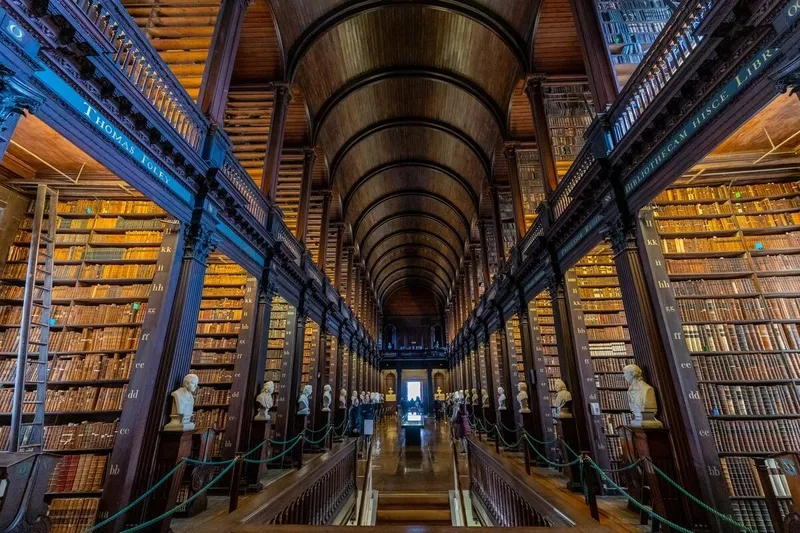
The Book of Kells is an illuminated manuscript from around 800 AD that somehow survived Viking raids, a theft in 1007, and over a thousand years of Irish weather. It lives in the Old Library at Trinity College in the centre of Dublin. The Long Room library that houses it is genuinely extraordinary - one of those rare places that lives up to every photograph.
The days of walking in off the street are over. Timed tickets are essential and summer slots sell out days in advance. Book online, arrive on time, and budget 90 minutes. The exhibition has been redesigned and expanded. It is worth the effort and the EUR 25 entry - but only if you plan ahead.
What to Expect
The Book of Kells Experience starts with a modern exhibition that puts the manuscript in context - who made it, where, why, and how it survived. The exhibition is well designed and not too long. It builds toward the main event: the manuscript itself, displayed in a darkened room under controlled lighting. Two of the four volumes are on display at any time, open to different pages that rotate regularly.
The manuscript is extraordinary up close. The detail in the illuminations - produced with natural pigments on vellum by monks working by candlelight - is almost impossible to believe. You lean in and see brushwork finer than anything you could produce with modern tools. The colours are still vivid after 1,200 years.
From the exhibition, you ascend to the Long Room. This is the image that sells a million postcards - a 65-metre barrel-vaulted library lined with 200,000 of the oldest books in Ireland. Marble busts of philosophers and writers line the central aisle. The atmosphere is hushed. It is as close to a sacred space as a secular building gets.
Is It Worth It?
Book the right slot and it is comfortably worth EUR 25. The Long Room is the part that lives up to every photograph, and it is the reason to go. Budget 90 minutes for the exhibition and the library together. The one decision that matters is the time slot: go first thing on a midweek morning outside school holidays and most of the crowding below stops being a problem.
The catch: EUR 25 is steep. On a busy summer day, the timed entry system means you are shuffled through at pace. The Book of Kells room is crowded and you get perhaps 2-3 minutes at the display case before the flow of people moves you on. The Long Room is more relaxed but still busy. If you can, go first thing on a Tuesday or Wednesday outside school holidays.
How to Get There
Trinity College is at College Green in the absolute centre of Dublin. You can walk from O'Connell Street in 10 minutes. Buses 11, 13, 27, 40, and 41 stop within 200 metres. The DART at Pearse Station is a 5-minute walk. The Luas Green Line at St Stephen's Green is 3 minutes away.
Dublin's public transport gets you here easily. Do not drive - there is no campus parking and city centre parking is expensive and difficult.
Where to Stay Nearby
Trinity is in the heart of Dublin. Any city centre hotel puts you within walking distance. See the Dublin travel guide and the County Dublin hub for full accommodation options.
Former bank building on Westmoreland Street. Walking distance to everything in the city centre.
Check availability →What Else is Nearby
A Note on the History
Trinity College was founded in 1592 by Queen Elizabeth I on the grounds of a dissolved Augustinian priory. For centuries it was effectively a Protestant institution - Catholics were formally admitted from 1793 but the Catholic hierarchy discouraged attendance until 1970. The campus you walk through today has buildings spanning four centuries.
The Book of Kells was probably created at the monastery of Iona off the Scottish coast, then moved to Kells in County Meath when Viking raids made Iona unsafe. It arrived at Trinity in the 1650s. The Long Room was built in 1732 and the barrel-vaulted ceiling was added in 1860 when the shelves were running out of space.
Frequently Asked Questions