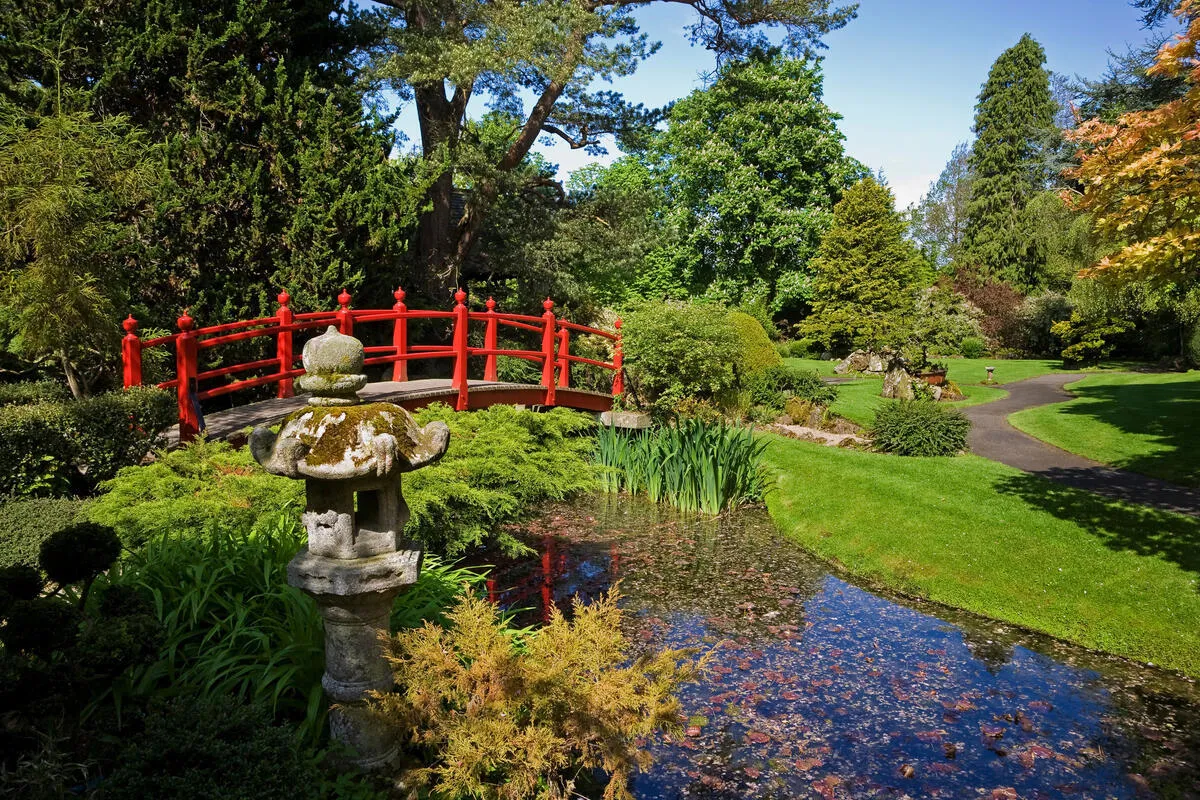
The Irish National Stud is the only working stud farm in Ireland that opens its gates to the public. It sits just outside Kildare town in flat, green horse country - the kind of landscape that explains why this part of Ireland became the centre of the thoroughbred industry.
Your ticket covers four attractions on one site. The stud farm itself, where stallions worth tens of millions of euros stand at stud. The Japanese Gardens, created between 1906 and 1910 and among the finest in Europe. St Fiachra's Garden, a contemplative space built around water and stone. And the Irish Racehorse Experience, a newer addition covering the sport from foal to finishing post.
It is a genuine day out rather than a quick stop. Allow two to three hours minimum. The grounds are extensive and the gardens demand slow walking. If you time it right you might catch a guided tour of the stallion yard. This is a working agricultural operation that happens to be open to visitors.
What to Expect
I first visited the Irish National Stud on a school tour. The kind where thirty teenagers pile off a bus and half of them are more interested in the gift shop than the stallions. I went back years later as a student at Maynooth, spending time around Kildare in the mid-90s. That second visit landed differently.
The stud farm is the draw that most people come for, and it delivers. You walk through paddocks where retired champions graze. Stable blocks house stallions that earned their owners millions on the track. The information boards explain the economics of breeding in plain terms. A single covering from a top stallion can cost hundreds of thousands of euros.
Free guided tours run at set times and they are worth catching. The guides know the horses by name and temperament. They will tell you which stallion is friendly and which one would rather you kept walking. It brings the place alive in a way that reading a plaque never does.
Then there are the Japanese Gardens. Tassa Eida, a Japanese gardener brought to Kildare by Colonel William Hall-Walker, created them between 1906 and 1910. They represent the journey of life from birth to death. Even if you are not someone who reads symbolism into landscaping, the craftsmanship is extraordinary.
For me, these gardens were my first real encounter with Japanese culture. That beginning in County Kildare planted a seed. Years later, when I visited Tokyo, I made sure to seek out gardens there. Eida brought something across the world and it took root here.
St Fiachra's Garden is the quieter sibling. It opened in 1999 and is built around a subterranean crystal garden with Waterford Crystal installations. Some visitors skip it. I would not. It takes fifteen minutes and the contrast with the Japanese Gardens is worth it.
The catch: the Irish Racehorse Experience feels like it belongs in a different venue. The interactive screens and simulated race footage sit awkwardly beside the living stud farm outside. It is clearly designed for rainy days and younger visitors. If you are short on time, spend it in the gardens instead.
How to Get There
The Irish National Stud is on the southern edge of Kildare town. From Dublin, it is about 50 minutes by car via the M7 motorway. Follow signs for Kildare town and then for the National Stud from the R415. There is a large free car park on site.
By public transport, Irish Rail runs a direct service from Dublin Heuston to Kildare station. The journey takes around 35 minutes on the intercity line. From the station, the stud is about a 20-minute walk along a flat footpath. There is no dedicated shuttle.
Kildare sits on the main Dublin to Cork and Dublin to Limerick rail lines. That makes it one of the better-connected towns for a day trip without a car.
For those driving a rental, this slots easily into a loop. You could combine it with Castletown House in Celbridge or Kildare Village for shopping. Heading south brings you toward Kilkenny. The Curragh racecourse is five minutes up the road. A rental car gives you the most flexibility for combining stops.
Where to Stay Nearby
Kildare town has limited hotel options. The surrounding area has stronger choices. The county is compact, so staying within 20 minutes works. Naas or Maynooth both have better evening options for food and pubs.
Luxury resort on a former estate with two championship golf courses. About 25 minutes from the stud. Expect prices to match.
Check availability →What Else is Nearby
A Note on the History
The land at Tully has been associated with horses since at least the 18th century. The modern story begins with Colonel William Hall-Walker, a wealthy Scotsman with a passion for breeding. He had an unusual belief that the stars influenced a horse's temperament. He designed stable skylights so moonlight could reach the animals. Eccentric, perhaps, but his horses kept winning.
In 1900, Hall-Walker invited Tassa Eida and his son Minoru from Japan to create a garden on the estate. Over four years they built what is now one of the finest Japanese gardens in Europe. The garden charts the journey of a human life - from the Gate of Oblivion through the tunnel of ignorance to the gateway of eternity.
Hall-Walker gifted his bloodstock and the Tully estate to the British Crown in 1915. After independence, the Free State took ownership. The National Stud Act of 1945 formalised it as a state body. Since 1946 the Irish government has run the operation. The public access is a welcome side effect.
Frequently Asked Questions