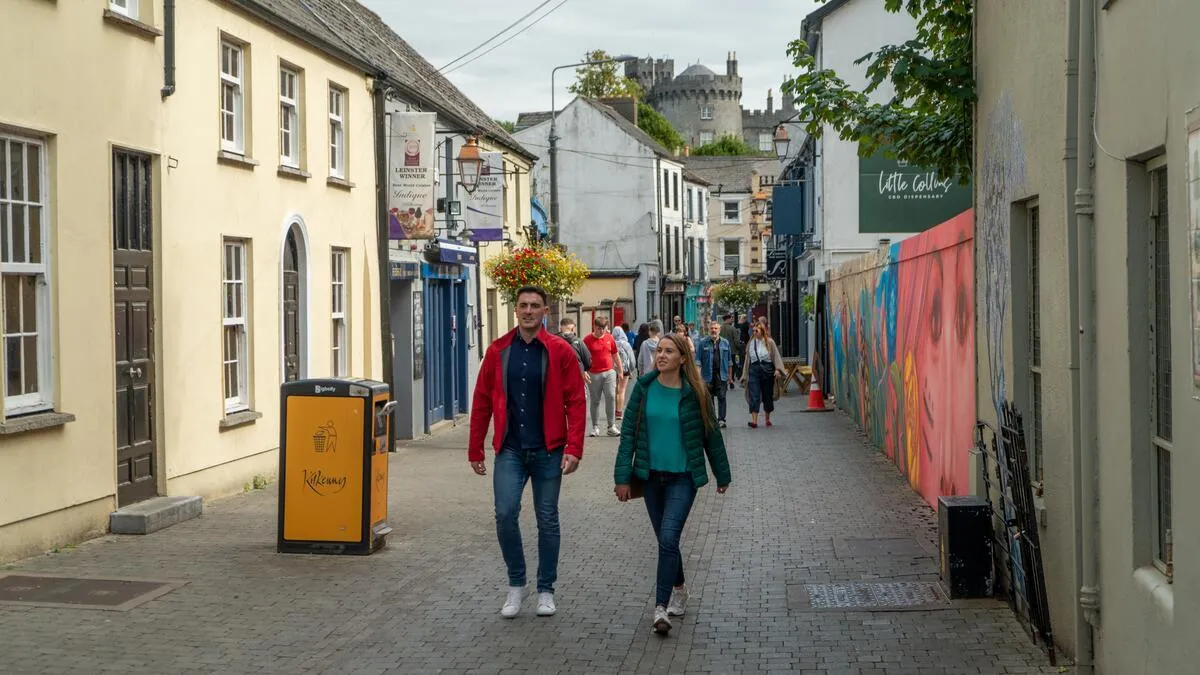
The Medieval Mile is the spine of Kilkenny city. It runs roughly one mile from Kilkenny Castle in the south to St Canice's Cathedral and Round Tower in the north, following the old High Street through what was once one of the most important Norman towns in Ireland.
Walking it takes about 20 minutes if you do not stop. But you will stop - there are medieval churches, 17th-century merchant houses, narrow alleyways, and some of the best pubs and restaurants in the southeast along the way. Budget 3 to 5 hours if you want to explore properly, or a full day if you add the Smithwick's Experience and a long lunch.
This is not a marked walking trail with signposts. It is simply the main street through the old city, and most of what you will see is visible from the pavement. That makes it easy to do at your own pace, ducking in and out of sites as you go.
What to Expect
Start at Kilkenny Castle and head north along the Parade, which becomes High Street. The route is natural and you will not get lost - the city centre is compact and everything radiates from this single axis.
The Key Stops
Rothe House is the standout. Built in the early 1600s for merchant John Rothe, it is the only surviving example of a Tudor merchant's townhouse in Ireland. Three houses connected by courtyards, now a museum with period furniture, a restored garden out the back, and a good small exhibition on the history of the Kilkenny Archaeological Society. Allow 45 minutes to an hour.
The Medieval Mile Museum occupies the former St Mary's Church, a 13th-century building that served as a parish church for over 700 years. The collection of carved tomb slabs is one of the best in Ireland. The building itself, with its high stone walls and stained glass, is worth the entry fee alone.
Black Abbey is a Dominican friary founded in 1225. Still an active church, it has a striking medieval Rosary Window - one of the few surviving examples in Ireland. Entry is free.
The Round Tower
At the northern end, St Canice's Cathedral anchors the Mile. The cathedral is impressive enough, but the real draw is the Round Tower beside it. This is one of only two or three climbable round towers remaining in Ireland. The climb is steep and narrow - 100 steps up a ladder-like staircase inside the original 9th-century structure. At the top, you get 360-degree views across Kilkenny and the surrounding countryside. Not for anyone with claustrophobia or mobility issues, but if you can manage it, the view is worth every step.
The Butterslips
Duck into the Butterslips, a narrow medieval alleyway connecting High Street to St Kieran's Street. These passages were once used by butter sellers and other traders. They are easy to miss if you are not looking for them, but they give a genuine sense of the medieval street pattern that modern roads have widened over.
Where to Eat
The Medieval Mile has some of Kilkenny's best food. Campagne, just off the main route, holds a Michelin star and is one of the top restaurants in the country. Zuni on Patrick Street is a reliable mid-range option. For pubs, Kyteler's Inn dates to 1324 and has a connection to Ireland's most famous witchcraft trial - the food is decent and the atmosphere is genuine. Matt the Millers and the Hole in the Wall are also worth a look.
How to Get There
The Medieval Mile is in the centre of Kilkenny, so if you are in the city, you are already there. For drivers, the Parade car park at the castle end is the most convenient starting point. Market Yard car park near the Tholsel (City Hall) is a good alternative if the Parade is full.
Kilkenny is about 90 minutes from Dublin by car on the M9, 50 minutes from Waterford, and 90 minutes from Cork. If you are exploring County Kilkenny more broadly, having a car lets you combine the Medieval Mile with Jerpoint Abbey and Inistioge in a single day. Compare car rental prices here.
By train, Kilkenny's MacDonagh Junction station has direct services from Dublin Heuston (90 minutes). The station is a 15-minute walk from the castle. Bus Eireann also runs regular services from Dublin, Waterford, and Cork.
What Else is Nearby
A Note on the History
Kilkenny's medieval character is not accidental. The Normans established it as the capital of the Liberty of Kilkenny in the 12th century, and for a time it rivalled Dublin as the administrative centre of Anglo-Norman Ireland. The 1366 Statutes of Kilkenny, passed in an attempt to prevent the Norman settlers from adopting Irish customs, were among the most significant pieces of legislation in medieval Irish history.
The density of medieval buildings along the Mile reflects this status. Few Irish cities can match the concentration of 13th to 17th-century structures within such a short distance. The Confederation of Kilkenny (1642-1649) briefly made the city the seat of an independent Catholic government during the Irish Confederate Wars, adding another layer of political significance.
Cromwell's siege in 1650 ended Kilkenny's political importance, but the buildings survived better than in most Irish cities. The lack of major industrial development in the 18th and 19th centuries, which might have demolished medieval structures, turned out to be a gift. What you walk through today is remarkably intact.
Frequently Asked Questions