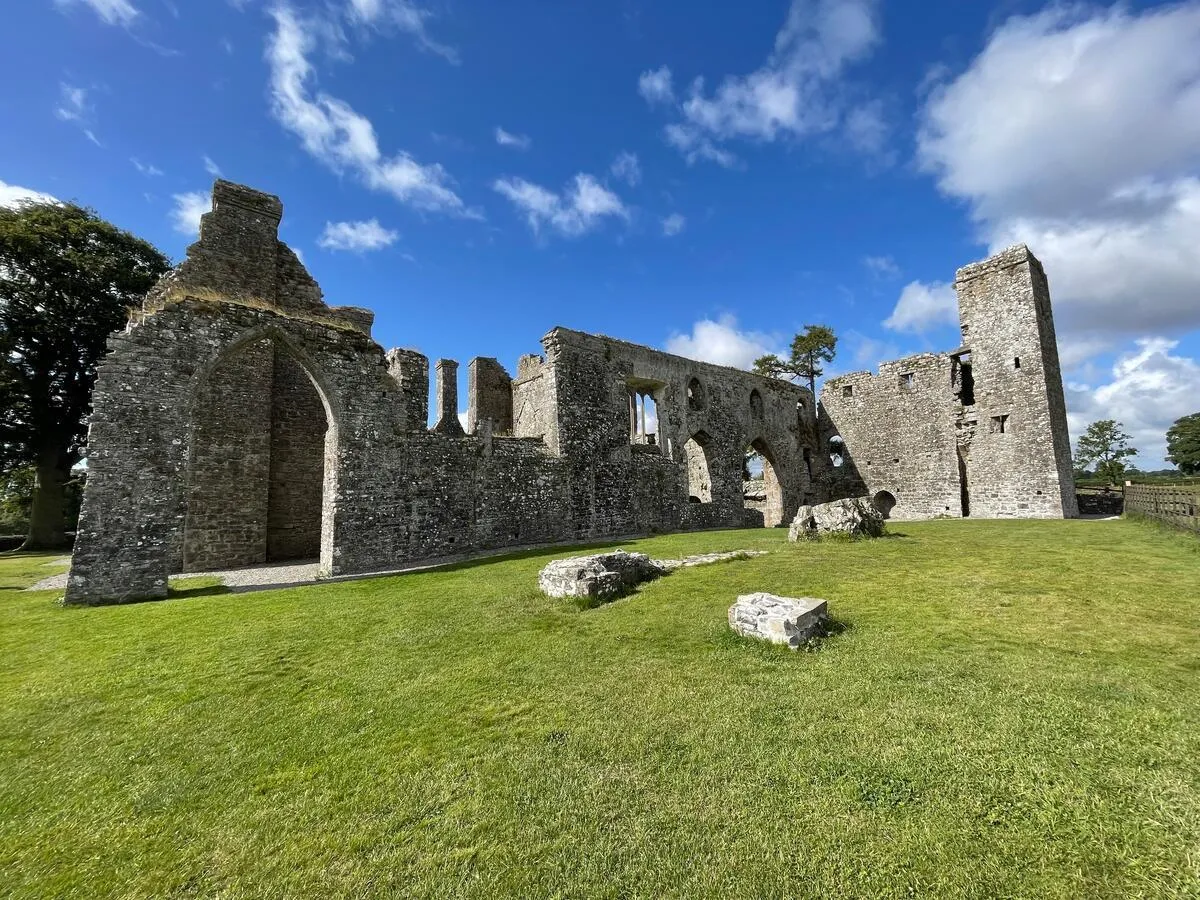
Bective Abbey sits on a bend of the River Boyne in County Meath, roughly 10 kilometres northeast of Trim. It was Ireland's second Cistercian monastery, founded in 1147 as a daughter house of Mellifont. The name comes from the Latin Beatitude Dei - the Blessedness of God.
What survives today is mostly 15th-century stonework. The cloister is the main draw - a compact square of cinque-foiled gothic arches that holds together remarkably well after five centuries. A defensive tower still stands at one corner. There are traces of the original 12th-century church beneath later additions.
The site is free to visit, open year-round during daylight hours, and rarely crowded. There are no queues, no ticket desks, no audio guides. You walk in from a small car park and have the place to yourself. For anyone driving the Boyne Valley, it is a 30-minute stop that rewards the short detour. Film fans may recognise the cloister from Braveheart, which used it as a backdrop in the 1990s.
What to Expect
From the car park, a short path leads directly to the abbey entrance. You step through a doorway into what was once the nave of the church - or at least what was built over it. The ground level changes several times as you move between rooms, so watch your footing.
The cloister is the centrepiece. Four walkways frame a grassy courtyard, and the arches along each side are in good condition. The stonework has a warm, golden colour in afternoon light. It is easy to see why the Braveheart crew chose this spot. The scale is intimate - this was never a grand cathedral complex, and that works in its favour.
At the southwest corner, a 15th-century tower rises above the rest of the structure. You can climb partway up for a view over the surrounding farmland and the Boyne below. The river wraps around the eastern edge of the site, and on a still day the water is visible through gaps in the walls.
One wing of the complex was converted into a Tudor manor house after the dissolution in 1536. Look for the mullioned windows on the upper floor - they belong to a completely different architectural period from everything else around them.
Is It Worth It?
Ireland's second Cistercian monastery, on a bend of the Boyne and free to walk into. It was founded in 1147 as a daughter house of Mellifont, taking its name from the Latin for the Blessedness of God. Most of what stands is 15th-century, and the cloister is the reason to stop: a compact square of cinque-foiled gothic arches still holding together after five centuries, with a defensive tower at one corner. Thirty minutes to an hour, ten kilometres northeast of Trim.
The catch: there is nothing at all to explain what you are looking at. No information boards, no leaflets, no guide. Without some background reading beforehand, the different periods of construction blend together and the site risks being just a set of old walls. Do ten minutes of research before you arrive.
How to Get There
Bective Abbey is roughly 10 minutes by car from either Trim or Navan. From Trim, take the R161 north and follow signs for Bective village. From Navan, head southwest on the R161. The abbey is signposted from the road.
It fits naturally into a Boyne Valley driving route. You could pair it with Trim Castle in the morning, stop at Bective on the way north, and continue to Newgrange or the Hill of Tara in the afternoon. The whole loop works comfortably as a day trip from Dublin or as part of a wider Ireland road trip.
A rental car is essential here. There is no public transport to Bective, and the abbey sits on a rural road between villages. The car park is small but rarely full.
Where to Stay Nearby
Bective Abbey itself takes under an hour to visit, so most people base themselves in Trim or Navan. Trim is the better option if you are exploring the Boyne Valley - it has more restaurants, a compact town centre, and Trim Castle on your doorstep. Navan is larger and more practical for onward travel north.
Right beside Trim Castle with views of the ruins from some rooms. Good restaurant, solid base for a Boyne Valley stay. 10 minutes from Bective by car.
Check availability →What Else is Nearby
A Note on the History
Murchad O'Maeil-Sheachlainn, King of Meath, founded Bective Abbey in 1147. It was the second Cistercian house in Ireland, established as a daughter monastery of Mellifont Abbey. The Cistercians chose the site for its river access and fertile land - practical considerations that mattered more than scenery.
The abbey operated for nearly 400 years. During that time it was rebuilt and expanded several times, which is why the surviving structures span multiple centuries. The cloister and tower date mostly to the 15th century, when the community had both the resources and the need for defensive architecture.
Henry VIII dissolved Bective in 1536 as part of the wider suppression of monasteries across Ireland and England. The buildings were granted to Thomas Agard, who converted the abbey into a private manor house. That conversion is actually why so much of the structure survived. Instead of being quarried for stone, it was roofed, modified with Tudor windows, and kept in use as a residence well into the 17th century.
The site passed through several owners before falling into ruin. It is now a National Monument in state care.
Frequently Asked Questions