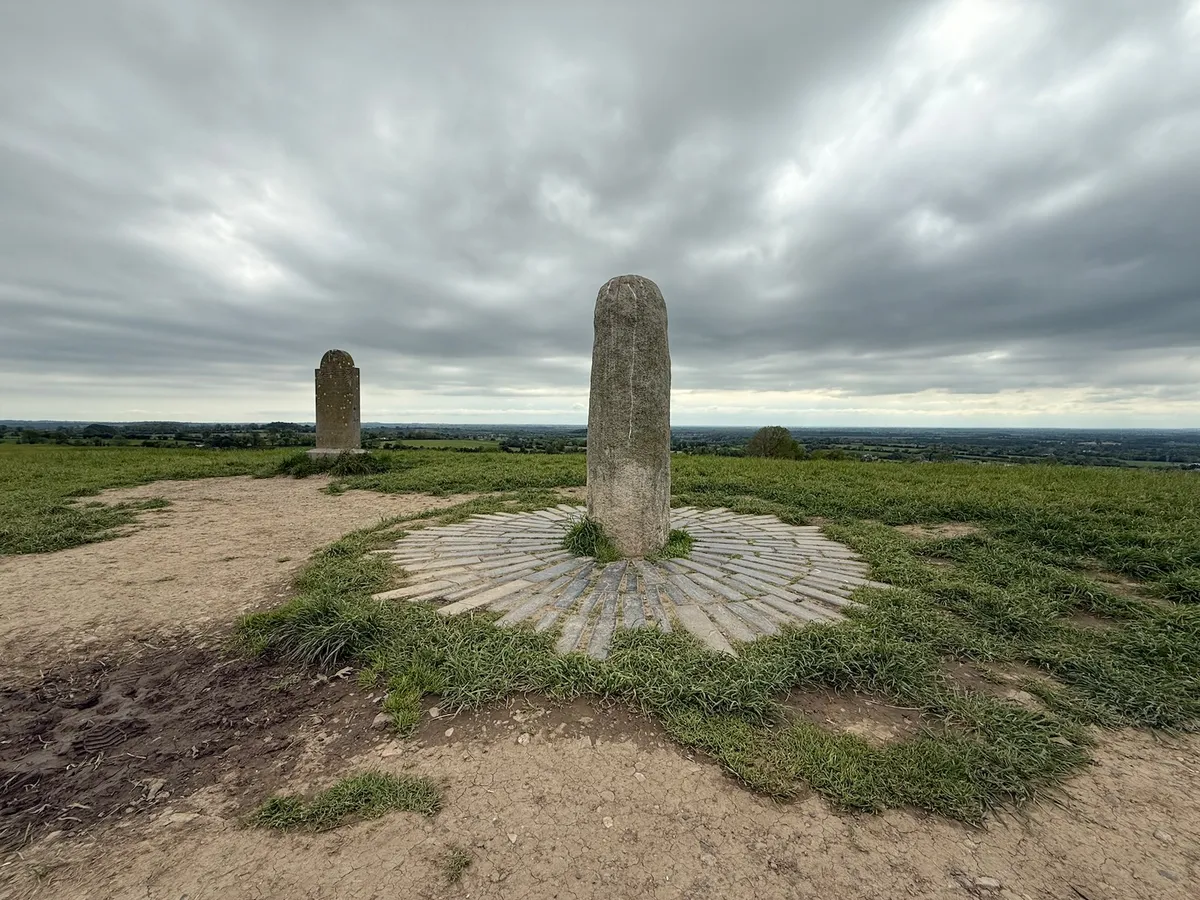
The Hill of Tara is cruelly undervisited. It sits 12 kilometres south of Navan in County Meath, a low rise of green farmland that once decided the fate of Ireland. For roughly two thousand years, this was where High Kings were crowned, where tribal law was set, and where the political power of the island was concentrated. Today it gets a fraction of the attention that Newgrange receives, despite being just as significant.
I was there in summer 2025. A friend lives nearby in Ashbourne, and I realised I had not been since childhood. It was time to reconnect with the ancient cultures from which I come - and perhaps you do too. The visit itself is just a walk to the top of a hill, but what that hill represents is something else entirely.
Tara does not announce itself with towers or ramparts. There are no dramatic ruins. What you get instead is a 100-acre site of grass-covered earthworks, a standing stone, and one of the best panoramic views in the Boyne Valley. It takes imagination - or a good guide - to see what was here. But if you are willing to look, this is one of the most historically loaded places in Ireland.
What to Expect
The car park is well-signed off the main road, and from there it is a 25 to 35 minute walk uphill to the key monuments. The path is uneven in places - proper shoes, not sandals. There is no dramatic entrance gate or ticketed barrier. You simply walk up through farmland and suddenly you are standing on what was once the most important political site in Ireland.
The first thing that strikes you is the view. On a clear day, the panorama extends across the Boyne Valley and into counties you would need a map to identify. It is a reminder of why the High Kings chose this spot. Whoever held Tara could see anyone coming from any direction.
The earthworks themselves are the challenge. They look like grass mounds. That is exactly what they are - circular ditches and raised banks now softened by thirty centuries of weather. Without context, you could walk across the Rath of the Synods or Cormac's House and not realise you were treading on anything significant. The Mound of the Hostages is the exception. It is a visible passage tomb dating to roughly 3200 BC, making it older than the Egyptian pyramids. You cannot enter it, but you can peer through the gated entrance.
The Lia Fail - the Stone of Destiny - stands upright near the centre of the site. It is a granite pillar about a metre tall. According to tradition, this is where the High Kings of Ireland were crowned. The stone was said to cry out when the rightful king touched it. It does not cry out now. It is just a stone in a field, but the weight of what it represents is considerable if you know the story.
I spent about 90 minutes in total - 20 minutes in the visitor centre, the rest walking the hill and reading the interpretive panels. That felt about right. Longer if you want to sit on the grass and absorb the view, which I recommend.
Is It Worth It?
Two thousand years of Irish kingship on a hill you can walk up for nothing. This is where High Kings were crowned and the politics of the island were settled, and the Mound of the Hostages here is a passage tomb from around 3200 BC, older than the pyramids at Giza. The Lia Fail still stands in the middle of it. Allow one to two hours, with 25 to 35 minutes of that walking up from the car park on uneven ground.
I will be plain about this: if you arrive expecting anything like a castle, a monastery, or even a well-preserved archaeological site with clear structures, Tara will disappoint you. There are over 30 monuments here, but most are buried or visible only as subtle undulations in the grass. The visitor centre - housed in a 19th-century church at the base of the hill - helps enormously. The 20-minute audiovisual show gives context that transforms the walk from a pleasant stroll into something far more meaningful. Take the guided tour if one is running. It costs nothing extra and lasts 35 to 40 minutes.
How to Get There
The Hill of Tara is 45 minutes from Dublin by car. Take the M3 motorway and exit at Junction 6, then follow signs south towards Tara. The road narrows to a single-track lane for the last kilometre. Free parking is available at the site with ample space.
From Navan, it is a 12-kilometre drive south on the N3. From Trim, head northeast on the R154 and you will be there in about 25 minutes. If you are combining Tara with Newgrange, allow 30 minutes between the two sites.
Public transport is limited. Bus Eireann runs a service from Dublin that passes through the area, but the stop is not at the site entrance and you will need to walk from the main road. This is not a place well served by buses. If you are relying on public transport from Dublin, a guided day tour that includes Tara is the more practical option.
For visitors basing themselves in Dublin without a car, I would recommend hiring one for a day to cover Tara, Newgrange, and Trim Castle in a single loop. Having your own wheels makes the Boyne Valley far more accessible. You can compare car rental options here. The roads in Meath are good, flat, and well-signed - easy driving even if you are new to Irish roads. See my transport guide for the full picture on getting around the country.
Where to Stay Nearby
Tara itself is a day visit, not a base. The nearest towns with accommodation are Navan (12km north), Trim (25 minutes west), and Ashbourne (20 minutes south towards Dublin). Trim is the most appealing base if you want to explore the wider Boyne Valley - it has a castle, good restaurants, and a compact town centre.
Four-star hotel overlooking Trim Castle. Central location, good restaurant, and the best base for exploring the Boyne Valley. 25 minutes from Tara.
Check availability →What Else is Nearby
A Note on the History
Tara's history stretches back over 5,000 years. The Mound of the Hostages - a passage tomb dating to roughly 3200 BC - is the oldest structure on the hill, predating the kingship tradition by millennia. By the early medieval period, Tara had become the ceremonial seat of the High Kings of Ireland. Some 142 kings are linked to the site, though the historical reliability of the earliest names is debated.
The Lia Fail - the Stone of Destiny - served as the coronation stone. A king who was legitimate would, according to legend, cause the stone to roar. The Hill was not a permanent residence but a ritual and political centre. Kings came here to be recognised, to hold assemblies, and to settle disputes.
Tara's political importance declined after the Norman invasion in the 12th century. The old Gaelic order that had sustained the kingship fractured, and Tara was gradually abandoned as a seat of power. What remains today are the earthworks - the physical footprint of a civilisation that governed Ireland for two thousand years without building in stone. The absence of grand ruins is itself part of the story. These were a people who built in earth and wood, and the land absorbed their monuments.
Frequently Asked Questions