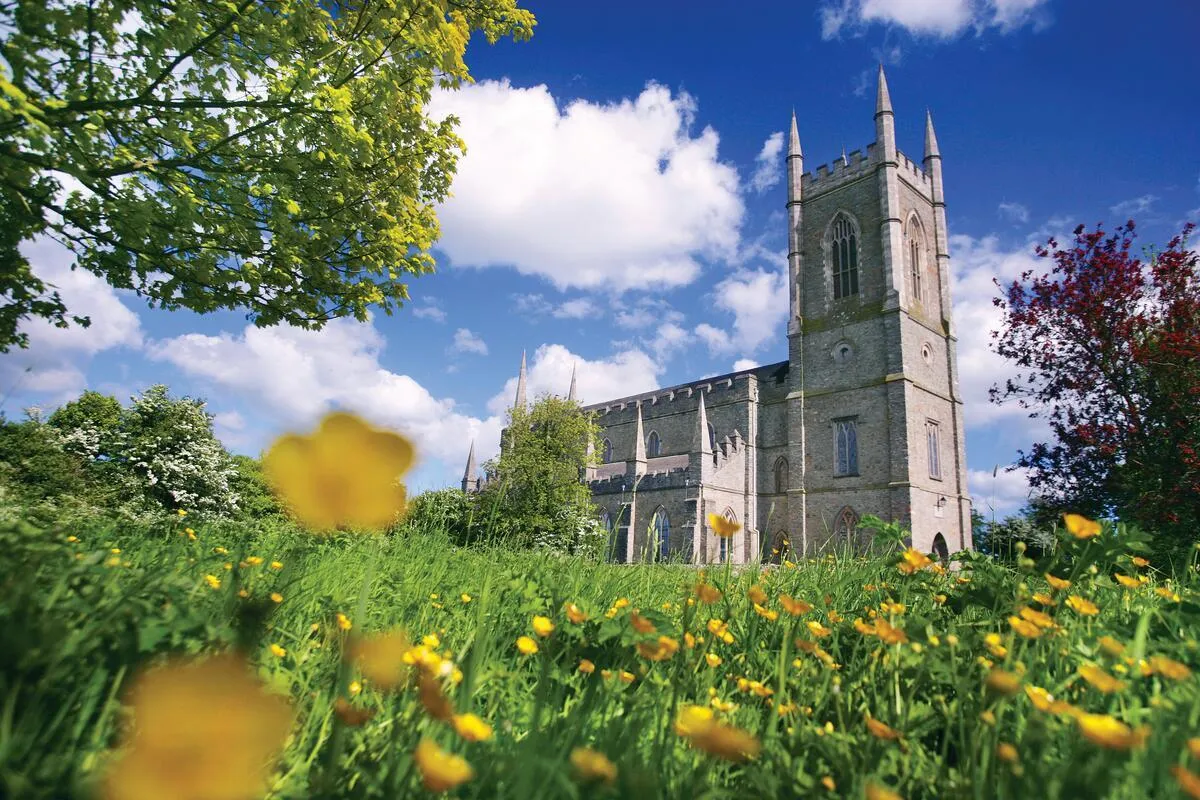
Downpatrick is where St Patrick's story in Ireland begins and ends. He built his first church at nearby Saul in 432 AD, and his grave - or at least the spot where tradition puts it - lies in the grounds of Down Cathedral. Between those two facts, this quiet town in County Down holds more of the Patrick story than anywhere else on the island.
The town does not shout about it. There is no theme park, no Patrick-branded merchandise at every corner. The cathedral sits on a hill. The grave is marked by a granite slab. Saul Church is a small granite building down a country road. Inch Abbey crumbles peacefully by the River Quoile. The Saint Patrick Centre in town tells the story with proper scholarship.
Together, these sites form St Patrick's Trail - a self-guided route you can walk or drive in half a day. It is one of the most historically significant pilgrimages in Ireland, and one of the least crowded.
What to Expect
Down Cathedral is the obvious starting point. It sits on Cathedral Hill above the town with views across the surrounding farmland to the Mournes on clear days. The current building dates to the early 19th century, though it stands on the site of a Benedictine monastery that goes back to the 12th century. The interior has fine stained glass and carved box pews. St Patrick's grave is in the churchyard - a rough granite slab placed there in 1900 to mark the traditional burial site.
Whether Patrick is actually buried here is debated. Armagh and Glastonbury also claim him. But Downpatrick has the strongest tradition, and standing at the slab on a quiet morning, with the cathedral behind you and the countryside stretching to the mountains, the historical accuracy matters less than the atmosphere.
The Saint Patrick Centre is in the town centre, a five-minute walk downhill from the cathedral. It is a proper interpretive museum with multimedia exhibits that trace Patrick's life from Roman Britain to his mission in Ireland. The "time bridge" installation is well done. Allow an hour. Group rates are about GBP 8.50 per adult.
Saul Church is two miles from town along the Saul Road. Built in 1932 to mark the 1,500th anniversary of Patrick's arrival, it is a small granite church with a round tower, designed to evoke early Irish monasticism. The churchyard is peaceful. The views across the Quoile estuary are good. It is free to visit and usually open.
Inch Abbey is the quiet star. The 12th-century Cistercian ruins sit in a field by the river, reached by a short drive from town. There is no entrance fee, no ticket office, just information boards and crumbling stone walls. On a misty morning, it is atmospheric. Allow 30 to 45 minutes.
The catch: Downpatrick itself is a small market town. The commercial centre is functional rather than attractive. The Patrick trail sites are all modest in scale - if you are expecting a grand visitor experience, you may feel underwhelmed. The power here is cumulative. Each site adds a layer. Together, they amount to something significant.
How to Get There
Downpatrick is about 35 minutes south of Belfast on the A7. The town is well signposted. Street parking is available in the town centre, and there is a free car park near the Saint Patrick Centre.
Down Cathedral is a short uphill walk from the town centre. Saul Church is 2 miles east, best reached by car. Inch Abbey is signposted from the A7 on the Downpatrick bypass.
Ulsterbus services run from Belfast to Downpatrick (route 15, about 50 minutes). Once in town, the cathedral and Saint Patrick Centre are walkable, but Saul and Inch Abbey require a taxi or car.
Where to Stay Nearby
Downpatrick has limited accommodation. For a wider choice, Strangford village (15 minutes), Newcastle (25 minutes), or Belfast (35 minutes) are all within easy reach. See the full County Down guide for options.
In Strangford village, 15 minutes from Downpatrick. Modern rooms, on-site restaurant, right on the lough.
Check availability →What Else is Nearby
A Note on the History
Patrick arrived in Ireland as a slave, probably in the early 5th century. He escaped, trained as a cleric in Gaul, and returned to Ireland around 432 AD. Tradition holds that he founded his first church at Saul, where a local chieftain named Dichu gave him a barn - "sabhall" in Irish, which became Saul.
Patrick spent decades travelling Ireland, establishing churches and converting communities. He died around 461 AD. The claim that he is buried at Downpatrick is based on a tradition recorded in the medieval Book of Armagh. The granite grave slab was placed in 1900 when the site was being overwhelmed by souvenir hunters chipping away at the original marker.
Frequently Asked Questions