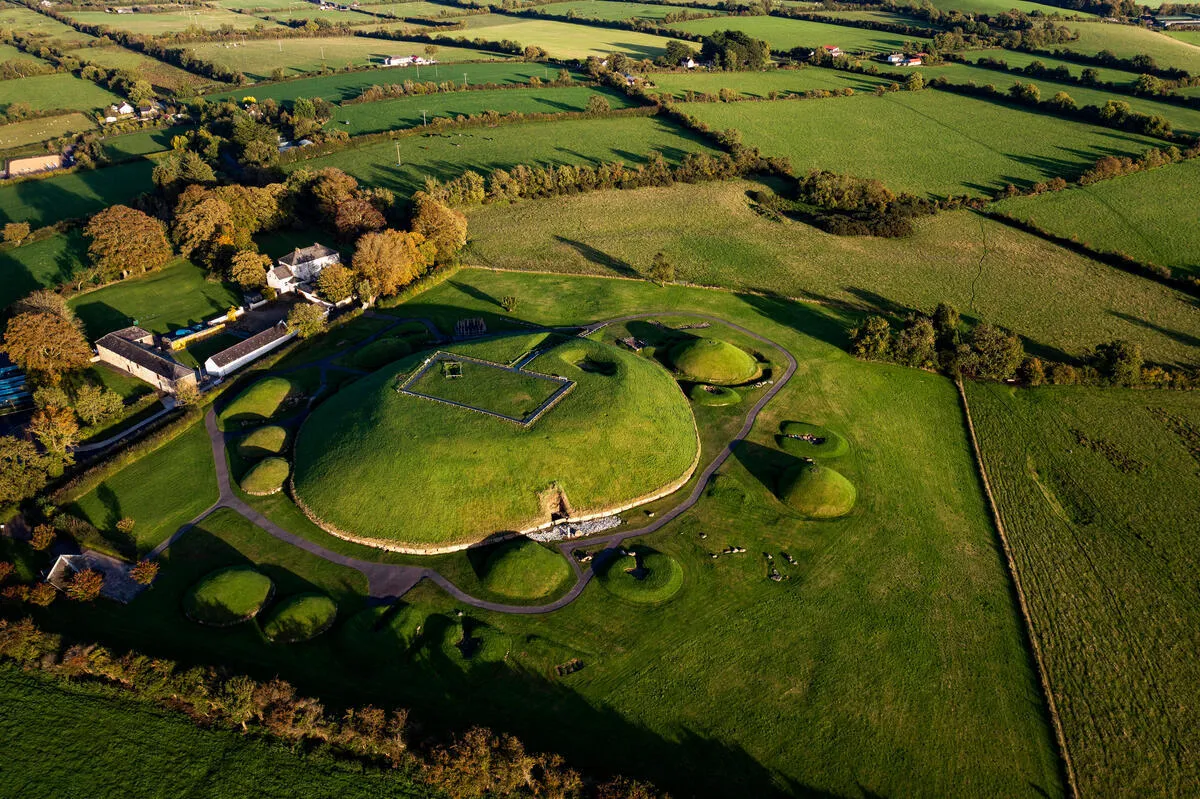
Knowth sits barely a kilometre from Newgrange in the Boyne Valley, but most visitors skip it entirely. That is a mistake. If Newgrange is the headline act, Knowth is the deeper story. It holds two passage tombs instead of one, 18 satellite tombs clustered around the main mound, and the largest collection of megalithic art in western Europe. Over 300 decorated stones. A third of all known Neolithic art on the continent is here.
You cannot enter the main passages at Knowth - that is the trade-off. But you can climb the mound, which you cannot do at Newgrange. The views from the top across the Boyne Valley are worth the visit alone. If you are planning a trip to County Meath, Knowth and Newgrange together make one of the most important archaeological days you can have anywhere in Ireland.
What to Expect
You start at the Bru na Boinne Visitor Centre, the same centre that serves Newgrange. The exhibition inside is worth your time - it covers the entire Boyne Valley complex and gives you context before you reach the mound. From the centre, a shuttle bus takes you to Knowth in about five minutes.
The guided tour lasts around 50 minutes. Your guide walks you around the exterior of the Great Mound, pointing out the decorated kerbstones that ring the base. There are 127 of them. Many are carved with spirals, concentric circles, lozenges, and serpentine forms that are over 5,000 years old. The density of art is extraordinary. At Newgrange you see the famous entrance stone and a handful of others. At Knowth, you are surrounded by them.
The Great Mound contains two passages - an eastern passage running about 40 metres and a western one of 34 metres. They are aligned with the spring and autumn equinoxes, not the solstice like Newgrange. You cannot enter either passage. The chambers were excavated over decades by Professor George Eogan and are closed to protect the art inside. This is the catch with Knowth - you see everything from the outside.
What you can do is climb the mound. Steps lead to the top, and from up there the views across the Boyne farmland are genuinely beautiful. You can see Newgrange from the summit. On a clear day, the landscape rolls out in every direction - green fields, the river, church spires. It is a surprisingly peaceful spot for somewhere so ancient.
The 18 satellite tombs are scattered around the base of the Great Mound. Some are visible as grass-covered humps, others have been excavated and you can peer into them. The sheer concentration of archaeology in this small area is hard to grasp until you stand in the middle of it. Knowth was in continuous use for over 4,000 years - passage tomb, then henge, then Iron Age settlement, then early Christian settlement, then Norman earthwork. Layer upon layer.
How to Get There
Knowth is accessed exclusively through the Bru na Boinne Visitor Centre near Donore, County Meath. You cannot drive to the tomb directly. The Visitor Centre is well signposted from the N2 and M1 motorways.
From Dublin, the drive takes about an hour via the M1 northbound, exiting at Donore. From Drogheda, it is 15 minutes. From Navan, about 20 minutes via the R161. If you are staying in Slane, the Visitor Centre is barely 10 minutes away.
There is no public transport to the Visitor Centre. You will need a car or a tour from Dublin. If you are renting, DiscoverCars compares prices across the main rental companies at Dublin Airport.
If you are visiting both Knowth and Newgrange, book both tours for the same day. The Visitor Centre serves both sites, and you take separate shuttle buses to each. Allow a full morning or afternoon for the pair.
A Georgian country house near Slane with beautiful grounds and one of the best restaurants in the county. About 10 minutes from the Visitor Centre. If you want to make the Boyne Valley visit feel like an occasion, this is where to stay.
Check availability →What Else is Nearby
A Note on the History
Knowth was built around 3200 BC, roughly the same period as Newgrange and the other Boyne Valley tombs. The builders were Neolithic farmers who had the engineering skill to construct passage tombs aligned to celestial events and the artistic impulse to decorate hundreds of stones with abstract designs whose meaning is still debated.
After the passage tomb era, Knowth was reused repeatedly. Iron Age settlers dug souterrains into the mound. Early Christian communities built houses on top of it. The Normans used it as a motte. Each layer of occupation left traces that archaeologists have been unpicking since excavations began in 1962 under Professor George Eogan. The dig ran for over 40 years - one of the longest archaeological excavations in Europe.
The art is what sets Knowth apart. The kerbstones carry motifs that appear across Neolithic Europe but nowhere in such concentration. Some researchers see astronomical maps. Others see territorial markers or ritual symbols. The plain answer is that nobody knows for certain what the carvings mean. What is certain is that the people who made them were skilled, deliberate, and working to a plan that covered an enormous site.
Frequently Asked Questions