The Ulster American Folk Park sits on 30 acres of County Tyrone countryside, just outside Omagh. It tells one specific story - how 250,000 Ulster Scots left Ireland for the American colonies between 1717 and 1775. That story plays out across more than 30 buildings, from thatched cottages on the Ulster side to a full American frontier street on the other.
I first visited here as a child on a school trip from County Armagh - Tyrone is the next county along. I went back years later for a university project, and the experience was completely different. As an adult, you see it not as a collection of old buildings but as a story about why a quarter of a million people abandoned everything they knew. That shift in perspective is what makes it one of the strongest heritage sites in Ireland.
The Ulster American Folk Park draws over 170,000 visitors a year. It is one of the most visited heritage sites in Northern Ireland. It was built around the actual homestead where Thomas Mellon was born - the man who founded the Mellon banking dynasty in Pittsburgh. Most visitors underestimate the time needed. This is not a building you walk through in an hour. It is an outdoor site spread across two continents, connected by a full-size emigrant ship replica.
What to Expect
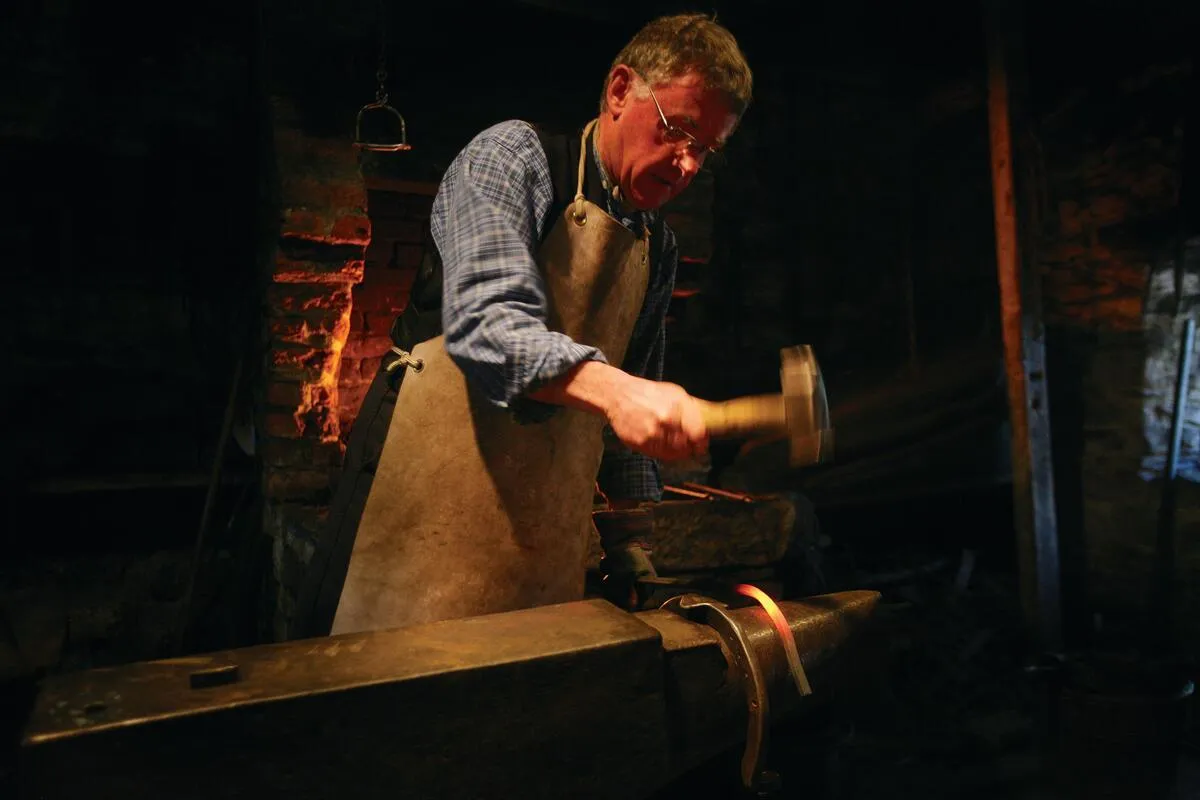
The site splits into two halves. The Ulster side comes first - a cluster of whitewashed cottages, a forge, a weaver's cottage, and a Presbyterian meeting house arranged along gravel paths through trees. Each building has a costumed guide inside. These are not actors reading scripts. They explain the emigration story from the perspective of whoever lived in that building.
The weaver talks about the linen trade collapsing. The schoolteacher explains why families left everything behind. The blacksmith demonstrates ironwork while answering questions about daily life in rural Ulster. You can spend 15 minutes in each building easily. The guides welcome questions and will tailor what they tell you based on what you are interested in.
The Thomas Mellon homestead is on this side. It is the actual building where Thomas Mellon was born in 1813. The cottage is modest - two rooms, a hearth, a dirt floor. It is hard to connect it with the banking empire that followed. That contrast is the whole point of the park. A boy from a two-room cottage in Tyrone built one of the largest financial dynasties in American history.
From the Ulster side, you walk through a full-size replica of an emigrant sailing ship. Below decks, the cramped bunks and low ceilings give a physical sense of what a six-to-eight-week Atlantic crossing felt like. The guide here talks about disease, overcrowding, and the death rate on these voyages. This is the best single exhibit on the site and the one that stays with you longest.
The American side feels different immediately. The buildings are timber-framed, the street is wider, and there is a log cabin, a covered wagon, and a frontier store. Costumed guides on this side play American settlers. Some explain what happened to emigrants after they landed - the land grants, the tensions on the frontier, the building of new communities from scratch.
I come from the people who stayed. My family stayed in County Armagh, not far from here, in similar conditions. Having toured America with Riverdance, performing Irish music and dance for the diaspora, I had already met the other side of this story - the descendants of those who left. They had their own threads of Irishness that evolved from the point of departure into something distinctly Irish-American. The folk park shows you where those threads began. It goes deeper than old thatched cottages.
School groups visit regularly, especially in May and June. A busload of children inside a small thatched cottage changes the atmosphere entirely. If you want a quiet, reflective experience, go on a Tuesday or Wednesday morning outside school term. On a wet Tuesday in September, you might have entire buildings to yourself.
The cafe near the entrance is decent for soup and sandwiches but nothing more. There is no food available inside the grounds themselves. If you are planning a full day combining the folk park with the Sperrins or other Tyrone stops, bring water and a snack. The gift shop sells a reasonable selection of books on Irish emigration and local history.
Is It Worth It?
GBP 13 and most of a day, for one story told properly. Thirty acres outside Omagh tracing how 250,000 Ulster Scots left for the American colonies between 1717 and 1775, across more than 30 buildings running from thatched Ulster cottages to a full American frontier street. Costumed guides work the buildings and will talk as long as you will listen. Three to four hours for a thorough visit, closer to four if you stop at every one. Closed Mondays, and parking is free.
The catch: the outdoor paths between buildings are long, and in wet weather (which is frequent in Tyrone), it gets muddy underfoot. Wear proper shoes, not trainers. Some buildings were closed for conservation on recent visits, including the Single Room Cabin and Campbell House. There is no way to know which buildings are closed until you arrive. That is frustrating if you have planned around a specific exhibit.
How to Get There
The Ulster American Folk Park is on the A5 road, about 5 kilometres northwest of Omagh town centre. From Omagh, follow signs for Newtownstewart on the A5. The park is signposted on the left after about 5 minutes of driving. The address is 2 Mellon Road, Omagh, BT78 5QU.
From Belfast, the drive takes around 1 hour 40 minutes via the M1 and A5 through Dungannon and Ballygawley. The road narrows to single carriageway after Ballygawley, so add time if you are behind slow traffic. The route is well signposted from the M1 junction.
From Dublin, allow 2 hours 30 minutes via the M1 north to Dungannon, then the A5 to Omagh. The cross-border route is straightforward with no stops required. You will pass through Monaghan and into Tyrone without even noticing the border.
From Derry, the drive is about 50 minutes south on the A5. This makes a folk park visit easy to combine with a day exploring Derry's city walls or the western Sperrins.
Public transport is limited. Ulsterbus runs services between Omagh bus station and the park, but frequency is poor and the last bus back is early. Check Translink timetables before relying on it. A taxi from Omagh town centre costs around £10 to £12 each way.
If you are visiting from Dublin or arriving at Belfast International Airport, a hire car is the only practical option for this part of Tyrone. Public transport connections between attractions do not exist at a useful frequency. The car park at the folk park is free and large enough that you will always find a space.
Where to Stay Nearby
Omagh is the nearest town with a full range of hotels, restaurants, and shops. It is a 10-minute drive from the folk park. I have friends who live in Omagh and know it well - it is a practical county town rather than a tourist base, but it has everything you need. For the full picture of where to stay across the county, see the County Tyrone guide.
Just 1.3 miles from the folk park entrance. Family-run with an on-site restaurant. Rooms from around £90 per night. The most practical base if the folk park is your main reason for visiting Tyrone.
Check availability →What Else is Nearby
A Note on the History
Thomas Mellon was born in a two-room cottage on this site in 1813. His family emigrated to Pennsylvania when he was five years old. He became a lawyer, then a judge, then founded T. Mellon and Sons Bank in Pittsburgh in 1869. That bank became Mellon National Bank. His son Andrew became one of the richest men in America and served as US Treasury Secretary under three presidents.
The folk park was founded in 1976 to mark the American Bicentennial. It was built around the original Mellon homestead, which had survived largely intact. The concept was simple - show both sides of the emigration story on one site. The Ulster side represents what people left behind. The American side represents what they found.
Between 1717 and 1775, more than 250,000 Ulster Scots crossed the Atlantic to the American colonies. They settled across Appalachia, the Carolinas, and the frontier territories. Many of their descendants became US presidents, generals, and industrialists. The Mellon Centre for Migration Studies, on the park grounds, holds one of the largest emigration archives in Europe. It is open to anyone researching family connections between Ulster and North America.
Frequently Asked Questions