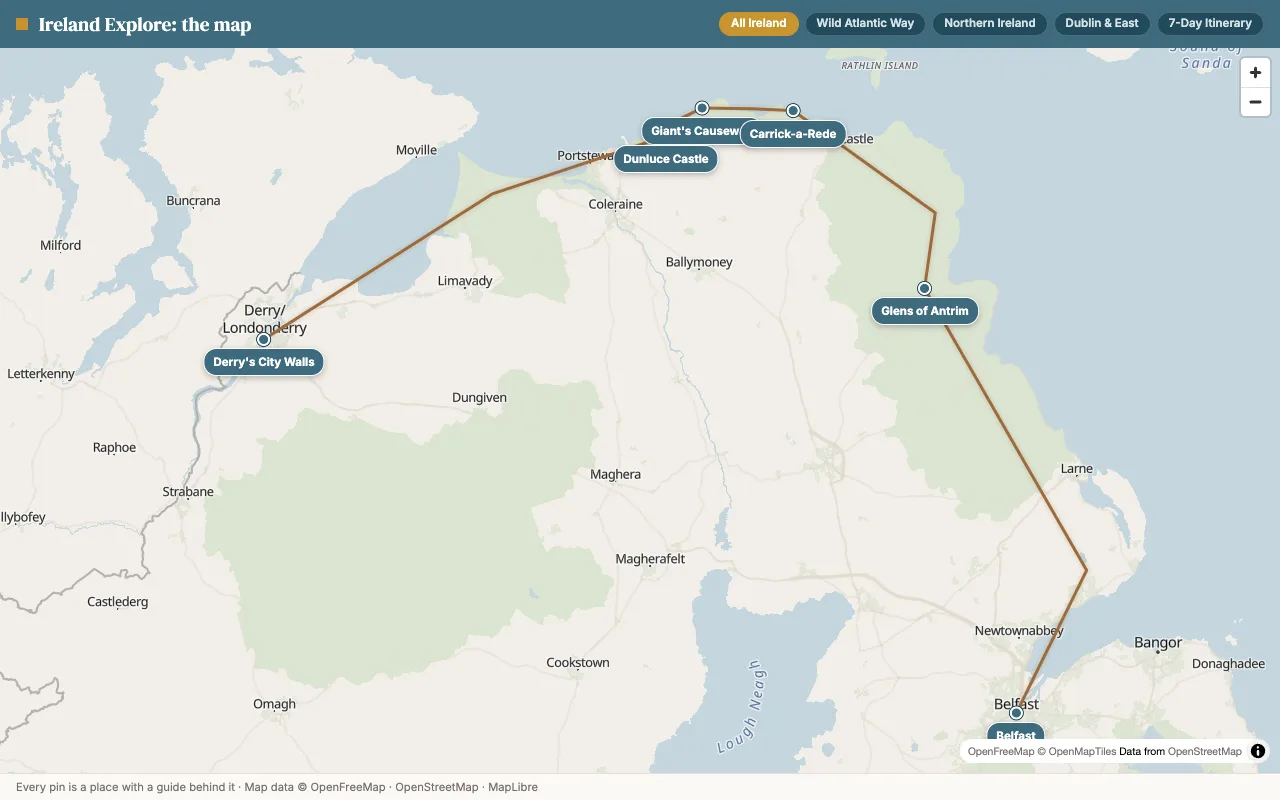
If you look at the map, Ireland's Causeway Coastal Route makes no sense. Belfast to Derry is about an hour and a half on the A6 inland. The coast road is roughly 120 miles and could easily eat up the best part of four hours before you've stopped for a photo. But that's the whole point. You don't take this road to get to Derry. You take it for the cliffs, the castles and a coastline that keeps interrupting you, and you take the slow way deliberately.
I'm from County Armagh, and remember driving it with my mother and aunt as a child, stopping off in Cushendun to see my aunt's godmother. It was wild back then and has a charming wildness still.
It has the weather I grew up with, where you might get lashing rain across the sea and, on the same day, the chance to glimpse Scotland from the headlands. I'm drawn back again and again, so here's my (local's) guide on how to do this drive. Let me suggest an order to follow, share my take on the stops worth your time, what you must book before you leave, and where to spend a night along the way.
Causeway Coastal Route at a glance
- Route: Belfast to Derry along the Antrim and Causeway coast.
- Distance: about 120 miles. Driving time alone is close to four hours, before any stops.
- How long you need: one day is possible but tight. Two days is the sweet spot. Three lets you slow right down.
- Direction: I drive Belfast to Derry, so the sea sits on your right the whole way and pulling in is easy.
- Money note: prices here are in pounds, not euro. This is the UK side of the island.
The map shows you the real route. See how it's not really a straight line? I want you to notice that. It wanders out to the Gobbins, loops through the Glens, and curls all the way around Lough Foyle to reach Derry. That wandering is the drive.
Why drive the Causeway Coast (and how long you really need)
The straight answer to "how long" is two days. One day works if you start early, pick three or four stops and accept that you're driving more than you're standing still. You'll see the Giant's Causeway and Carrick-a-Rede and not much else.
Two days changes the trip. You can stop in a Glens village for lunch without watching the clock. You can walk a headland properly. Best of all, you can reach the big sites either early or late, when the coaches from Belfast aren't there. That timing matters more than any single attraction on the route.
If one day is all you have, here's how I'd spend it. Leave Belfast by half eight. Skip the Gobbins and most of the Glens, lovely as they are, and drive straight for Carrick-a-Rede with a pre-booked morning slot. Do the Giant's Causeway next, then Dunluce and the Dark Hedges in the afternoon, and roll into Derry for dinner. It's a full day with a lot of driving, but it works.
The driving itself is the underrated part. The road clings to the edge for long stretches, dips into harbour villages, and climbs back out to another sea view. It's the kind of road you remember. Just know the trade going in: this is a slow road by design, and rushing it defeats the purpose.
The drive, stop by stop
The Gobbins, Islandmagee
A guided cliff path bolted to the rock just north of Belfast. It's a genuine thrill and a little hair-raising, on bridges and tunnels above the waves. You can only do it on a guided tour. It runs around two and a half to three hours, and it sells out, so book ahead. This is an add-on near the start, not a quick lay-by stop. Only build it in if you've the time and a head for heights.
The Glens of Antrim
Nine green valleys running down to the sea between Larne and Cushendun. This is the stretch most day-trippers blast through to reach the famous stops, and they're wrong to. Glenarm and Carnlough are proper villages with harbours and tearooms. Pull in. If you fancy a leg-stretch, Glenariff Forest Park has a waterfall walk that takes about an hour. The Glens are where the drive stops being a checklist and starts being a pleasure.
Cushendun
A tiny National Trust village of Cornish-style cottages, plus the sea caves just south that Game of Thrones fans will know. It's a five-minute stop or a long coffee, depending on your mood. Either way it's a good place to stretch before the road climbs north to the headlines.
Carrick-a-Rede Rope Bridge
The rope bridge to a fishing island, swaying over a 30-metre drop. It's run by the National Trust on timed tickets, and in summer those tickets sell out on the day, so book online before you leave. Peak adult entry is around £15 and it's free for National Trust members, but everyone still needs to pre-book a slot. The price includes the car park. Read my full guide to Carrick-a-Rede for the booking detail and what the crossing is actually like.
The catch: if you're nervous of heights, the bridge is short but it does sway, and there's a queue system on busy days. It's a there-and-back walk of a fair distance from the car park too. Wear proper shoes.
Ballintoy Harbour
A tiny working harbour tucked below the cliffs, a couple of minutes' drive from Carrick-a-Rede. The road down to it is steep and narrow, so take it slowly. It costs nothing, the crowds rarely bother with it, and it's one of the prettiest little spots on the whole coast. Another Game of Thrones location, if that's your thing. I'd stop here for ten minutes even on a tight schedule.
The Giant's Causeway
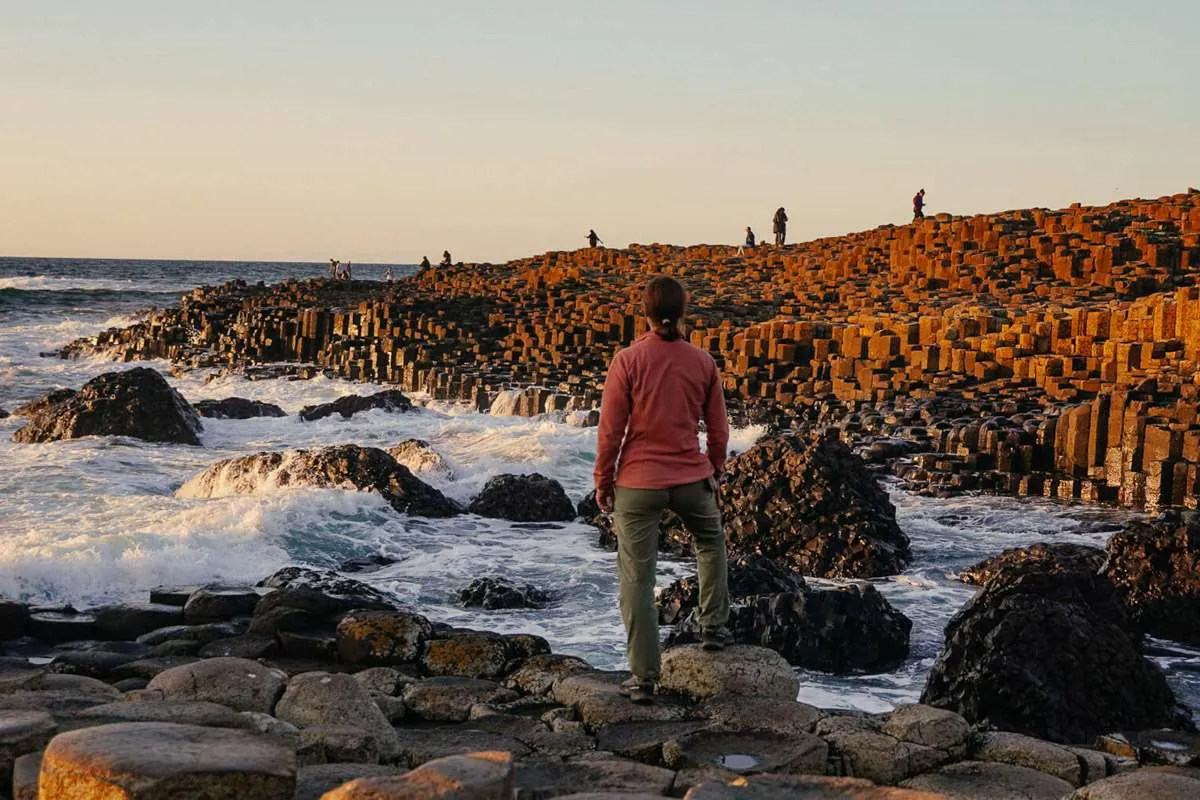
The one everyone comes for, and it earns it. Forty thousand basalt columns stepping down into the sea. Here's the thing the brochures bury: the stones are free. You can walk down to them along the coast for nothing.
The ticket buys the exhibition, the audio guide and the visitor-centre car park, not the rocks themselves. If you just want to stand on the columns, park off-site and walk in. My Giant's Causeway guide lays out the parking options and which you actually need.
Bushmills
The village between the Causeway and Dunluce, home to the old whiskey distillery of the same name. You can tour the distillery if that appeals, though book ahead and don't be the one driving afterwards. Even if you skip it, Bushmills makes a handy lunch stop. It's also a sensible base for the night, right in the middle of the headline sites.
Dunluce Castle
A ruined castle perched right on the cliff edge, with a kitchen that reputedly slid into the sea in 1639. It's a quick stop and dramatic from the road, with a small admission to go inside. Give it twenty minutes. After the Causeway crowds, the quiet up here is half the appeal.
The Dark Hedges
The beech-lined avenue from the opening of Game of Thrones, inland from the coast near Stranocum. Worth the short detour, but mind this: you cannot drive or park on Bregagh Road itself. It's been closed to traffic since 2017 to protect the tree roots, and you can be fined up to £1,000 for ignoring that. Park free at The Hedges Hotel on Ballinlea Road and walk the two minutes in. My Dark Hedges guide has the exact parking and the quiet times to go.
Mussenden Temple and Downhill Demesne
A little domed temple on a cliff edge above a vast beach, with the ruins of a clifftop mansion behind it. It's National Trust land, and you can walk out to the temple from the Downhill car park in a few minutes. On a clear evening it's the best view on the whole route. The wind up there is no joke, though, even in summer, so bring a layer. My full notes are in the Mussenden Temple and Downhill Demesne guide.
Into Derry
The drive ends at Ireland's only fully walled city, and it's a fine place to finish. Walk the 17th-century walls, which take under an hour the whole way round. From up there you look down on the Bogside, where the murals tell the city's more recent history. Then you've earned a sit-down and something to eat. See Derry's city walls and the Bogside murals for what to look for. It's worth a night here rather than a rushed hour.
Where to stay along the route
Where you sleep decides how the drive feels. The trap is staying in Belfast both nights and doing the whole coast as a long out-and-back. Don't. Move along it.
For a two-day trip I'd base the middle night around Ballycastle, Bushmills or Portrush. You wake up beside the headline stops and reach the Causeway or Carrick-a-Rede before the day-trip coaches roll in from Belfast. That early hour is the difference between a quiet visit and a car park full of buses.
Of the three, Portrush is the liveliest, with the most places to eat and a proper seaside-town feel. Bushmills is quieter and sits dead-centre between the big sites. Ballycastle is the most low-key, and handy if you've the Glens still to do. Book ahead in summer, because this stretch fills up and the good places go early. The bases below, and my full where to stay in Northern Ireland guide, will sort you out.
Renting a car and driving the coast
I'd strongly recommend hiring a car and driving this route yourself, for the simple joy of stopping when you feel like it. That freedom is the whole appeal, and it's why I'd always choose to drive. If driving isn't for you, there are good tours from Belfast, and I've a pick further down.
A few practical things. We drive on the left here, which catches some visitors out. The coastal sections are narrow, with stone walls and the odd tractor. Take your time and use the pull-ins rather than holding up the car behind you.
Fuel up before the quieter western stretch past Mussenden, where filling stations thin out. And the weather genuinely changes the drive. Check the forecast, and don't bank on the views if it's coming in off the Atlantic. I use DiscoverCars to compare hire prices across the Belfast and Derry depots before I book.
When to go (and the weather reality)
Late spring and early autumn are the sweet spots. You get longer days, the big stops are calmer than peak summer, and the light on this coast in September is hard to beat.
Summer is busiest. The Causeway and Carrick-a-Rede get genuinely crowded in July and August, which is the strongest argument for an early start and a bed nearby. Winter is the gamble. The coast is wild and empty, and it can be wonderful. But the days are short, some smaller attractions cut their hours, and an Atlantic storm will close the rope bridge in a heartbeat. That's the trade for having the place to yourself.
Doing the Causeway Coast without a car
If you can't or don't want to drive, you've still got a good option. Several operators run full-day tours from Belfast. They take in the Giant's Causeway, Carrick-a-Rede and the Dark Hedges, with the Glens seen from the coach window. If I were picking one, I'd go for this guided day tour from Belfast - it does the Causeway, Carrick-a-Rede, the Dark Hedges and Dunluce in a day. You lose the freedom to linger, but you see the headliners without the wrong-side-of-the-road stress.
Before you turn the key
Your questions,
answered.
How long is the Causeway Coastal Route?
It runs about 120 miles between Belfast and Derry. Allow the best part of four hours' driving before you stop anywhere.
Where does the Causeway Coastal Route start?
Belfast or Derry, whichever suits your trip. I'd drive Belfast to Derry so the coast is on your right the whole way.
Can you drive the Causeway Coastal Route in one day?
You can, but it's a long day with few real stops. Two days lets you actually get out of the car.
Where should you stop on the Causeway Coastal Route?
Carrick-a-Rede, the Giant's Causeway, Dunluce, Mussenden and the Dark Hedges are the headliners. The quieter Glens of Antrim are the surprise.
Do you need to book anything in advance?
Yes. Carrick-a-Rede uses timed tickets and the Gobbins is guided-only. Both sell out in summer, so book before you set off.
When is the best time to drive it?
Late spring or early autumn. Summer is busiest at the big stops, and winter days are short and often wet on this coast.
Do you need a car for the Causeway Coastal Route?
It's much easier with one. If you can't drive, a day tour from Belfast covers the main stops.
Is the Giant's Causeway free?
The stones themselves are free to walk. The ticket pays for the exhibition, the audio guide and the car park, not the rocks.
Explore the route’s destination guides
Tap a stop to open its guide on the national map.